Travel
Booked Korea for August or September? The Honest Truth About Typhoon Season (2026)
The payoff Refreshing flight-tracker forums at 2 a.m. wondering if your dream trip is ruined → boarding anyway, watching the storm blow through in a single indoor day, and getting the clearest skies of your whole trip right after it passes.
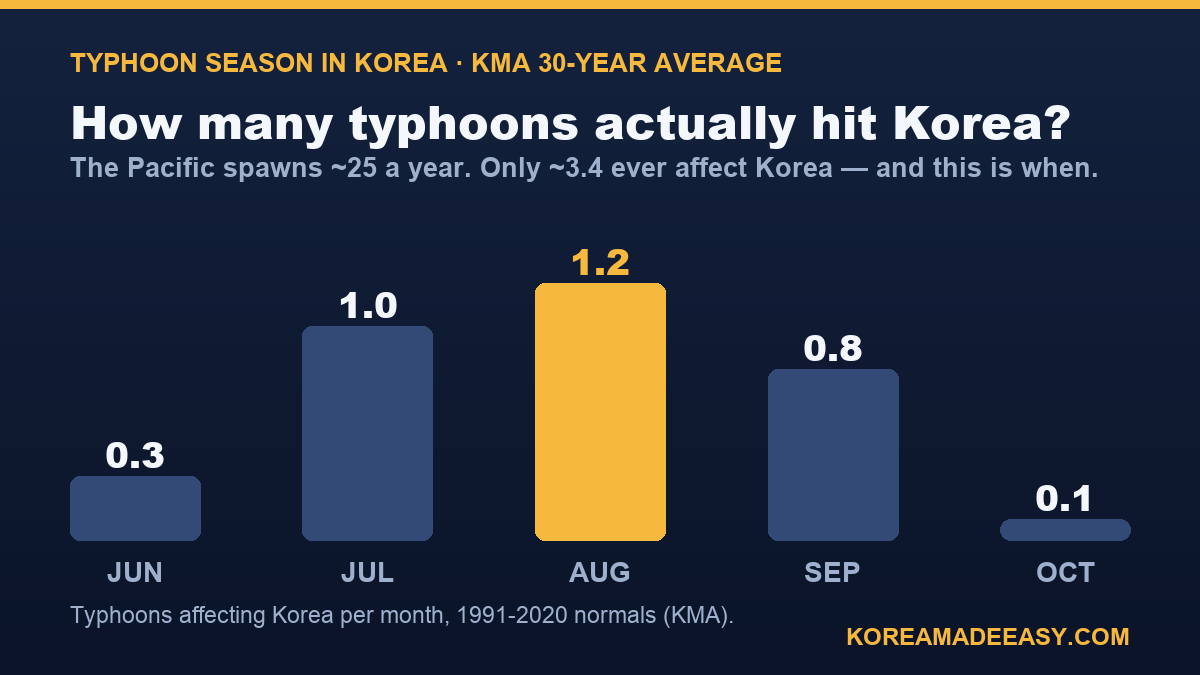
📈 Trend signal: Peak pre-trip anxiety window: Aug–Sep is Korea's statistical typhoon peak (KMA 1991–2020 normals: 1.2 affecting typhoons in Aug, 0.8 in Sep), so late-July is when 'should I cancel my Korea trip typhoon' searches spike among travelers who booked months ago
You booked the flights back in spring. Then last week some algorithm decided you needed to see typhoon footage — sideways rain, snapped umbrellas, a reporter clinging to a lamppost — and now you’re lying awake doing math on your non-refundable hotel. I get that message every single summer from readers: “We land in Busan August 20th. Should we cancel?”
Here’s the answer I give every time, and I’m giving it to you with the actual numbers: no, don’t cancel. But do three specific things differently. Let me show you why.
The number nobody puts in the scary headlines
The western Pacific is the most active typhoon basin on Earth — it spawns about 25 typhoons a year. That’s the number that makes the news. Here’s the number that matters for your trip: on the KMA’s official 30-year climatology (1991–2020), only about 3.4 of those ever affect Korea. Most typhoons curve toward the Philippines, Taiwan, or Japan, or die at sea without Korea feeling a thing.
And “affects Korea” is a generous category — it includes storms that merely brush the south coast with a rainy day. Direct landfalls are rarer still, and research on 60 years of tracks shows ~95% of them squeeze into July–September.
Month by month, here’s your actual exposure (typhoons affecting Korea, KMA 30-year normals):
| Month | Typhoons affecting Korea | What that means for you |
|---|---|---|
| June | 0.3 | Almost never a factor |
| July | 1.0 | Possible, usually late July |
| August | 1.2 | The statistical peak |
| September | 0.8 | Fewer, but historically the strongest ones |
| October | 0.1 | Effectively typhoon-free — peak autumn-foliage season, and the best month to visit |
Read that table honestly and the “risk” reframes itself: in the peak month, Korea averages one typhoon event. A typhoon’s disruptive window here is typically one to two days. On a 7-day August trip, you’re weighing a roughly one-in-a-few chance of losing one day outdoors — against cancelling the whole thing.
What actually happens when one does hit
I’ve sat through plenty of these in Seoul, so let me deglamorize it. Take Typhoon Khanun (August 2023), a direct south-to-north crossing — close to a worst-case path. Nationwide, it cancelled about 355 flights and 161 KTX trains, shut ferry routes and 21 national parks, and closed schools for a day (Yonhap). Busan caught winds near 35 m/s.
And in Seoul? Heavy rain, gusty wind — and the subway ran extra services to get everyone home (Korea Herald). Convenience stores never blinked. By the next afternoon the sky was rinsed clean. That’s the honest shape of a Korean typhoon day in the capital: it’s a stay-inside day, not a disaster movie.
The real pattern to remember:
- Jeju and the south coast (Busan, Yeosu) take the brunt — ferries stop first, coastal flights cancel, beaches close.
- Seoul usually gets the weakened remnant — a very wet, blustery day. The city functions.
- It’s over fast. Typhoons cross the peninsula in roughly a day, and the day after is often freakishly clear.
Your itinerary decides your risk — check yours against this
| Your trip | Typhoon exposure | My move |
|---|---|---|
| Seoul city trip | Low — one indoor day at worst | Go. Have my rainy-day list ready |
| Seoul + Busan by KTX | Medium — KTX can pause for a day | Keep the Busan leg flexible; don’t prepay beach activities |
| Jeju / island hopping | Highest — ferries and flights cancel first | Book refundable everything; build one buffer day |
| Late-Sep trip around Chuseok | Low-medium, but holiday crowds compound delays | Watch forecasts 5 days out; trains sell out fast on re-booking |
The 48-hour playbook (if a typhoon forms during your trip)
Typhoons don’t ambush you — the KMA tracks them for days before arrival. From the moment one is named:
- T-minus 3–5 days: it appears on the KMA English site and every weather app. Nothing to do yet except stop booking ferries for those dates.
- T-minus 1–2 days: airlines pre-emptively reshuffle. Check your airline app (not the airport’s departure board) — Korean carriers rebook cancelled domestic legs for free.
- Typhoon day: make it your indoor day — museum, department-store food hall, a proper jjimjilbang sweat. Don’t go “storm watching” on a beach or riverside; that’s how the only injuries happen. Keep your phone online for KMA and Safety Korea alerts (one more reason an eSIM beats airport WiFi).
- Day after: the clearest skies of your trip. Do the palace, the hike, the viewpoint today.
If you get stuck mid-connection, the 24/7 tourist line 1330 has real English speakers who will talk you through re-bookings.
One thing I’d genuinely spend money on for an August or September trip: a travel-insurance policy that covers weather delay and trip interruption — it turns a cancelled ferry from a crisis into paperwork. Compare trip-interruption cover on Heymondo before you fly, and read the weather-delay clause specifically.
Skip it and the math gets ugly fast: one cancelled Jeju ferry can domino into a missed flight, a no-show hotel night, and a rebooked KTX — easily $300+ out of pocket for want of a $30 policy and one flexible booking.
So… go?
Go. I say that as someone who has never once had a summer visitor lose more than a day to weather — but has watched several torch entire trips cancelling over a storm that fizzled into an afternoon of drizzle. Book flexible, keep one indoor day in your back pocket, and let the data — not the algorithm — set your anxiety level.
Landing at Incheon either way? Start with how to get into Seoul from the airport — typhoon or sunshine, that part never changes.
FAQ
Is it safe to visit Korea during typhoon season? Yes, with normal caution. Korea averages ~3.4 affecting typhoons a year (KMA 30-year data), warning systems are excellent, and disruption typically lasts 1–2 days. The genuinely risky behavior is sightseeing along coasts or rivers during a warning — stay indoors those hours and you’re fine.
Which month is worst for typhoons in Korea? Statistically August (~1.2 affecting typhoons on the 30-year average), with September close behind (~0.8) — and September storms have historically included the strongest landfalls. June and October are close to typhoon-free, which is one reason October is Korea’s golden travel month.
Will my flight be cancelled if a typhoon comes? Domestic routes (especially Jeju) cancel first and in bulk; international arrivals at Incheon more often delay or divert than cancel outright. Airlines usually reshuffle 1–2 days ahead — watch the airline app, and rebooking on Korean carriers for weather is free.
Does travel insurance cover typhoon disruption in Korea? Policies with trip-delay/interruption cover generally do — if you bought before the typhoon was named. Once a storm has a name, it’s a “known event” and new policies won’t cover it. That’s why August–September travelers should buy at booking time, not at the boarding gate.
Is Jeju riskier than Seoul during typhoon season? Meaningfully, yes. Jeju sits closest to typhoon tracks, so it sees the first flight waves cancelled and ferry suspensions, while Seoul usually receives a weakened system. If your trip is Jeju-heavy in August, flexible bookings plus one buffer day are non-negotiable.
Some links above may become affiliate links, meaning I may earn a small commission at no extra cost to you — it never changes the advice. Weather statistics are KMA 30-year normals; always check the live KMA forecast before and during your trip.
Planning Your Korea Trip? Don't Pay Full Price! ✨
Save $20–$50 per person with our verified reader perks & skip the long ticket booth queues:
AREX Incheon ↔ Seoul Express
Non-stop 43-min direct train with guaranteed reserved seats & free Wi-Fi. Scan your mobile QR straight at the gate!
Get 20% Off AREX Ticket →Korea Unlimited 5G eSIM
Skip the 30-min airport counter line. Scan the QR code to connect instantly for smooth Naver Maps navigation.
Get Instant eSIM QR (From $2.80) →WOWPASS Card (Pay + T-Money)
Pay anywhere in Korea with zero FX fees + subway card. Use code KOREAEASY for 0.5% cash top-up bonus!
Top Seoul Passes & Day Tours
Guaranteed entry for Lotte World, Nami Island tours, CIMER Spa, and Hanbok palace rentals with instant mobile vouchers.
Browse Top Seoul Deals →Sources
- https://www.kma.go.kr/download_01/typhoon/typwhitebook_2025.pdf
- https://testweather.kma.go.kr/w/hazard/typhoon/stat.do
- https://en.yna.co.kr/view/AEN20230810001353315
- https://www.koreaherald.com/article/3188999
Search-trend data from Google Trends (KR) and Naver DataLab. This article is independent commentary and is not affiliated with any broadcaster, agency, or the individuals mentioned.