Travel
Korean Floor Heating & Airbnb Boiler Guide (2026): Navien, Kiturami, Rinnai Buttons, Hot Water & Troubleshooting
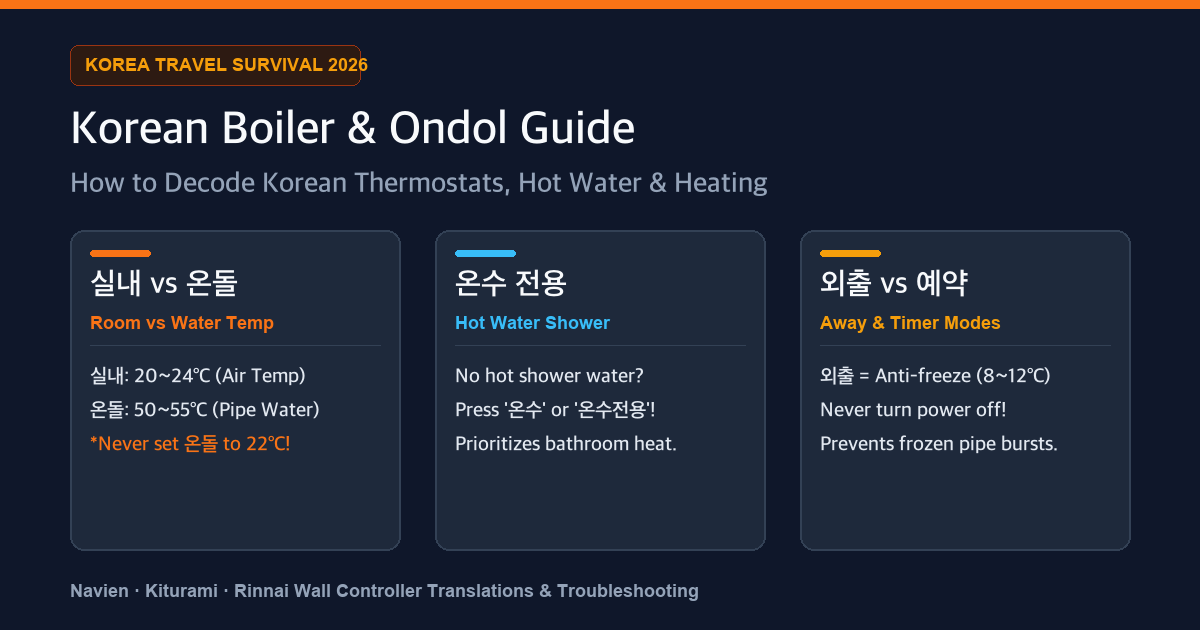
The payoff Shivering under two duvets staring at mysterious Korean buttons at 2 AM → Lounging comfortably on warm radiant floors with steaming hot showers on demand.
Research context: Recurring first-night heating and hot-water questions from overseas guests in Seoul stays each autumn–winter (author's host experience; no search-volume figure claimed)
Whenever I welcome overseas friends visiting Seoul between late autumn and early spring, the very first emergency message I receive after check-in is almost identical:
“Yongwoo, our room is freezing, the shower is ice cold, and the wall thermostat has six buttons written entirely in Korean with numbers blinking. What do we press?”
Outside, Seoul’s winter air can stay below freezing for long stretches, with sharp cold snaps. Stepping into an unfamiliar Airbnb, officetel, or guesthouse with an unheated floor can ruin your first night in Korea.
I don’t have a verified search-volume number for this, so I won’t quote one. What I can say from experience is that the question comes up every cold season: the difference between the Room (실내) and Ondol (온돌) modes confuses overseas guests, and even locals moving into a new studio apartment sometimes mix them up.
Korean homes use Ondol (온돌)—hot water circulating through underground pipes under your floorboards. While radiant floor heating feels exceptionally cozy, controlling it requires understanding a few unique interface rules.
A note on accuracy: button names, temperature ranges and modes vary by manufacturer and model. Treat this guide as a general map, and check the model name printed on your controller or boiler label against the manufacturer’s official site (links in the sources above) or ask your host.
Here is the direct practical playbook to decoding your Korean wall thermostat, mastering the critical switch between room air and floor water temperature, and getting instant hot shower water.
1. Universal Korean Boiler Button Translation Table
Regardless of whether your room uses KyungDong Navien, Kiturami, or Rinnai, many Korean residential wall controllers use these common terms (exact labels vary by model):
| Korean Label | Romanization | English Meaning | Recommended Setting |
|---|---|---|---|
| 전원 | Jeon-won | Power On / Off | Keep ON throughout your stay in winter. |
| 실내 | Sil-nae | Room Air Temp Mode | ~21°C to 23°C is a common comfortable range. |
| 온돌 (or 난방수) | On-dol | Floor Water Temp Mode | Typically a higher range (e.g., ~50°C+); varies by model. |
| 온수 (or 온수전용) | On-su | Hot Water (Showers/Sinks) | Activate for hot showers; levels vary by model. |
| 외출 | Oe-chul | Away Mode (Anti-Freeze) | Press when leaving the apartment for sightseeing. |
| 예약 (or 타이머) | Ye-yak | Timer / Reservation Mode | Behavior varies by model — check your controller. |
| 올림 (▲) / 내림 (▼) | Ol-lim / Nae-rim | Temp Up / Temp Down | Adjust target temperature or dial setting. |
2. The Fatal Trap: ‘실내’ (Room Temp) vs. ‘온돌’ (Floor Water Temp)
This single setting accounts for nearly all traveler confusion in Korean apartments and traditional Hanok stays:
Mode A: 실내 (Indoor Air Temperature)
- What it measures: A sensor inside the plastic wall thermostat measuring ambient air.
- Typical comfortable range: about 21°C to 23°C (70°F to 73°F).
- Caution: Setting the target much higher than you need makes the boiler run more and the room dry and stuffy.
Mode B: 온돌 / 난방수 (Underfloor Pipe Water Temperature)
- What it measures: The temperature of the hot water circulating in pipes under the floor, NOT the room air.
- Target range: This is a water temperature, so the numbers are much higher than room temperature. The usable range differs by model — check the numbers shown on your own controller.
- The Trap: If your thermostat is in
온돌mode and you enter a room-style number like “22°C”, you are asking for very low-temperature water, so on many models you may get little or no heating. Confirm which mode you are in before changing numbers.
💡 Quick Diagnosis Tip: Check the display/indicator for which mode is lit (
실내or온돌). As a rough hint, the Room mode scale usually tops out at a much lower number than the Floor Water mode scale, but the exact numbers vary by model.
3. Brand-by-Brand Quick Guide (Navien, Kiturami, Rinnai)
1) 경동나비엔 (KyungDong Navien)
The most common brand in modern Seoul apartments and high-rise officetels.
- Hot Shower: Some Navien controllers have an
온수전용(Hot Water Only) button; look for a hot-water or온수control on yours. - Heating: Look for a
난방(heating) control and a mode selector between실내and온돌; use▲/▼or the dial to change the target. Buttons differ by model. - Leaving: Look for an
외출(Away) button; the indicator usually lights up when it is active.
2) 귀뚜라미 (Kiturami)
Commonly found in residential villas, Hanoks, and guesthouses around Hongdae and Jongno.
- Controls: Kiturami controller layouts differ by model and age (buttons or dial). Look for the same key words:
난방,실내/온돌,온수,외출. - If you see
목욕(Bath): It is a hot-water-related mode on some models. Read the label/indicator, or ask your host what it does on that unit.
3) 린나이 (Rinnai)
Widely installed in studio officetels and one-room rentals across Seoul.
- Operation: Look for controls labeled
난방,온수, and외출. Exact labels differ by model. - Hot Water Level: Some models let you pick a hot-water level (low/medium/high,
저/중/고). If the shower is lukewarm, try a higher level — what each level means varies by model.
4. Rapid Troubleshooting for Cold Showers & Overheating
Problem 1: “The shower water is freezing cold.”
- Confirm the main
전원(Power) LED indicator is illuminated. - Ensure
온수(Hot Water) is active, and check whether the controller shows외출(Away) — if so, switch back to normal heating and see whether that changes anything on your model. - Residential gas boilers usually fire up when hot water starts flowing. Turn your faucet fully to the LEFT (Hot) and let it run for a minute so hot water can reach the tap.
Problem 2: “The floor is scorching hot, but the room air is still chilly.”
- Ondol heats the floor first, so the room can take a while to warm up (it varies by building and model). Avoid repeatedly raising the temperature when you first arrive.
- If the floor is too hot, do not turn master power off. Lower the target a notch and air the room briefly.
- If sleeping directly on a heated floor, add extra bedding underneath to avoid dry skin and prolonged-contact low-temperature burns (저온화상).
Problem 3: “An error code is blinking on the screen.”
Error codes differ by manufacturer and model, so don’t guess what a code means. Take a photo of the screen and message your host using the showcards below, or look the code up under your model name on the manufacturer’s official site.
5. Emergency Korean Showcards for Your Host
Save or screenshot these polite Korean phrases to message your host:
Showcard 1: No Hot Water
한국어: “보일러 작동이 안 돼요. 샤워실에 따뜻한 물이 전혀 안 나와요.”
발음: “Boiler jak-dong-i an dwae-yo. Shower-sil-e tta-tteut-han mul-i jeon-hyeo an na-wa-yo.”
English: “The boiler isn’t working properly. No hot water is coming out in the shower at all.”
Showcard 2: Room is Too Cold
한국어: “방이 너무 추운데 보일러 온도 조절하는 방법 좀 알려주세요.”
발음: “Bang-i neo-mu chu-un-de boiler on-do jo-jeol-ha-neun bang-beop jom al-lyeo-ju-se-yo.”
English: “The room is too cold. Could you please show me how to adjust the boiler temperature?”
Showcard 3: Error Code on Controller
한국어: “보일러 조절기에 에러 코드가 깜빡거려요. 확인 좀 부탁드립니다.”
발음: “Boiler jo-jeol-gi-e error code-ga kkam-ppak-geo-ryeo-yo. Hwak-in jom bu-tak-deu-rim-ni-da.”
English: “An error code is blinking on the boiler controller. Could you please check it for me?“
6. Practical Tips for Staying Warm in Seoul
- Stay Hydrated: Radiant heating dries out bedroom air overnight. Keep a water bottle nearby or drape a clean damp towel to maintain humidity.
- Heading Out: Simply press 외출 (Away). This protects internal pipes from freezing while saving gas. Switch back to normal heating when you return.
- Planning Accommodations: If managing individual wall controllers feels daunting, explore our verified guides on where to stay in Seoul, Korea hotel booking strategies, and early check-in & luggage storage tips for central hotels with automated climate control.
Frequently Asked Questions
What temperature should I set my Korean Airbnb boiler to?
For daily comfort, a common choice is 실내 (Room Air Temp) mode at about 21°C to 23°C (70°F to 73°F). If your controller is in 온돌 (Floor Water Temp) mode, the numbers are water temperatures and the right range varies by model, so don’t enter a room-style number like 22°C — switch to 실내 mode or ask your host.
Why is my shower cold even though the floor is warm?
Many residential units prioritize either space heating or instantaneous domestic hot water. Ensure 온수 (Hot Water) or 온수전용 (Hot Water Only) is active on the controller. Turn the shower faucet fully to the left (hot) and let the water run for a minute.
Should I turn off the boiler when leaving for the day?
Generally no. In sub-zero weather, fully powering off may risk frozen pipes. Use 외출 (Away Mode) instead, which on most units keeps freeze protection while using less energy — confirm on your model or ask your host.
Sources
- KyungDong Navien (official site, main page only — find your model's manual by the model name on the boiler label): https://www.kdnavien.co.kr (reference note; no source URL supplied)
- Kiturami (official site, main page only — find your model's manual by the model name on the boiler label): https://krb.co.kr (reference note; no source URL supplied)
- Rinnai Korea (official site, main page only — find your model's manual by the model name on the boiler label): https://www.rinnai.co.kr (reference note; no source URL supplied)
This is independent guidance, not an official operator or government publication. Evidence and check dates vary by article. See our editorial and corrections policy for the distinction between source checks, personal visits and planning advice.