Travel
Rained Out in Seoul? 12 Indoor Things to Do During Korea's Monsoon (2026)
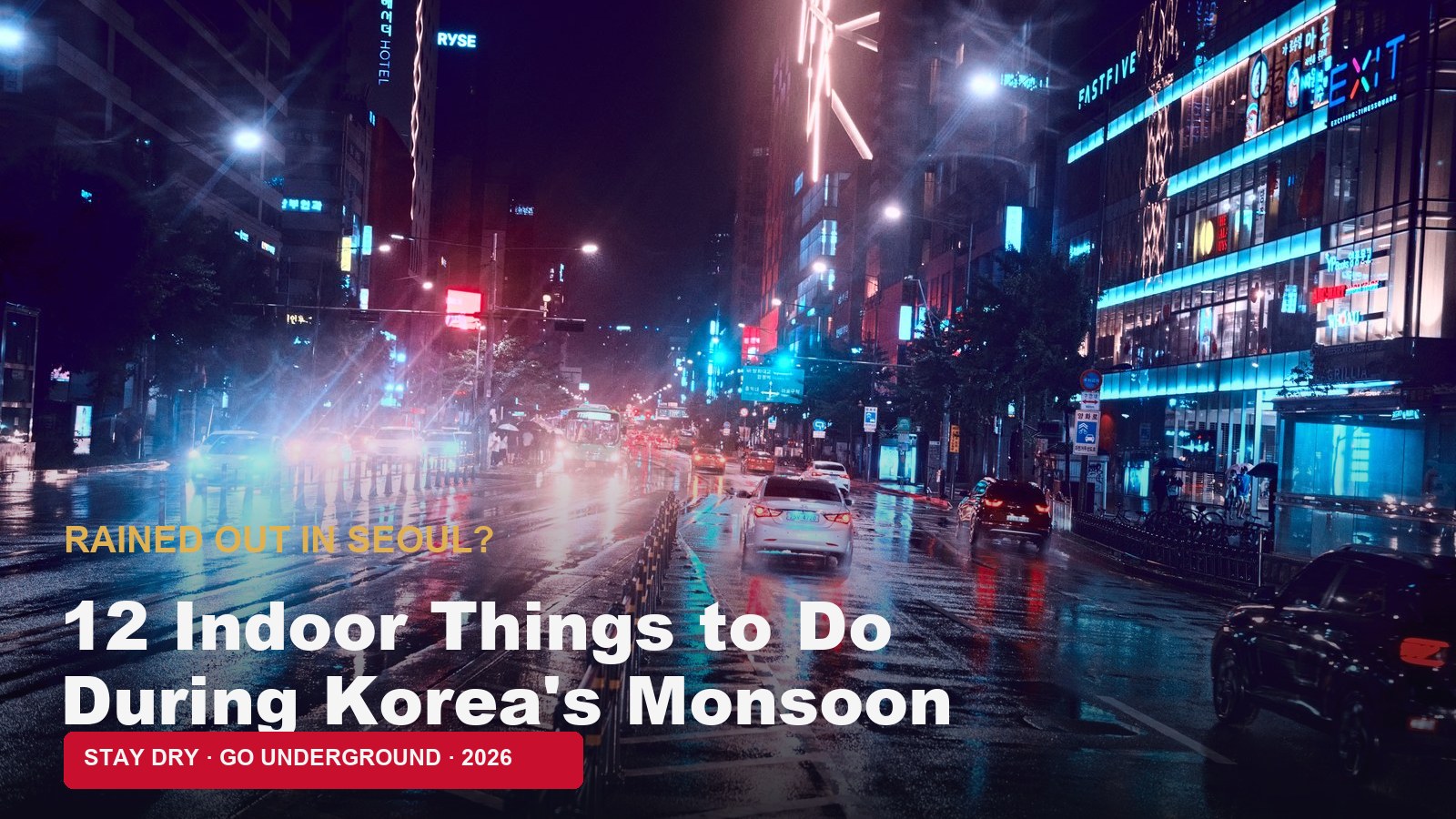
The payoff Staring at a forecast that's a solid wall of umbrella icons and quietly writing the whole day off → filling a dry eight-hour day inside the COEX loop — aquarium, spa, library, cinema and food hall — without opening your umbrella even once.
📈 Trend signal: 장마 (오늘 KR 트렌드 실측: '홍수' 검색 전국 2위·2,000+)
As I write this on the morning of July 19, 2026, “flood” (홍수) is the #2 trending search in all of Korea — more than 2,000 people spiking it in an hour — and heavy-rain warnings are live across the southern half of the country (news feed, Daum). This is peak jangma, Korea’s monsoon, and if you’ve landed in Seoul this week you already know: the forecast is a wall of little umbrella icons.
Here’s the thing I tell every friend who visits during monsoon season, after five years of living through Seoul summers: do not write the day off. Rain is when Seoul quietly reveals its second self — an entire indoor city stacked under the wet one. Below are 12 things worth doing when the sky opens up, with real 2026 prices, and the part no other guide bothers to map: a subway route that lets you fill a whole day without opening your umbrella once.
This guide contains affiliate links — if you book through them we may earn a small commission at no extra cost to you.
First, what jangma actually is (so you can plan around it)
Jangma (장마) is the East Asian monsoon front that parks over the Korean peninsula for roughly a month each summer. For Seoul it usually runs from late June to the end of July, and 2026 has run late — cold air lingered and delayed the rain front’s push north (Korea JoongAng Daily). Mid-to-late July, right now, is still soaking wet.
The number that should reshape your itinerary: Seoul gets roughly 300–400 mm of rain in these peak weeks — 30 to 50% of its entire annual rainfall compressed into three or four weeks, with heavy days topping 100 mm (South of Seoul). That’s not “pack an umbrella” weather. That’s “build a plan that assumes indoors” weather. (Jangma dates shift every year — these are the 2026 patterns; confirm the forecast before you travel.)
The good news, and the whole point of this post: Seoul is arguably the most indoor-friendly big city on earth. So let’s use it.
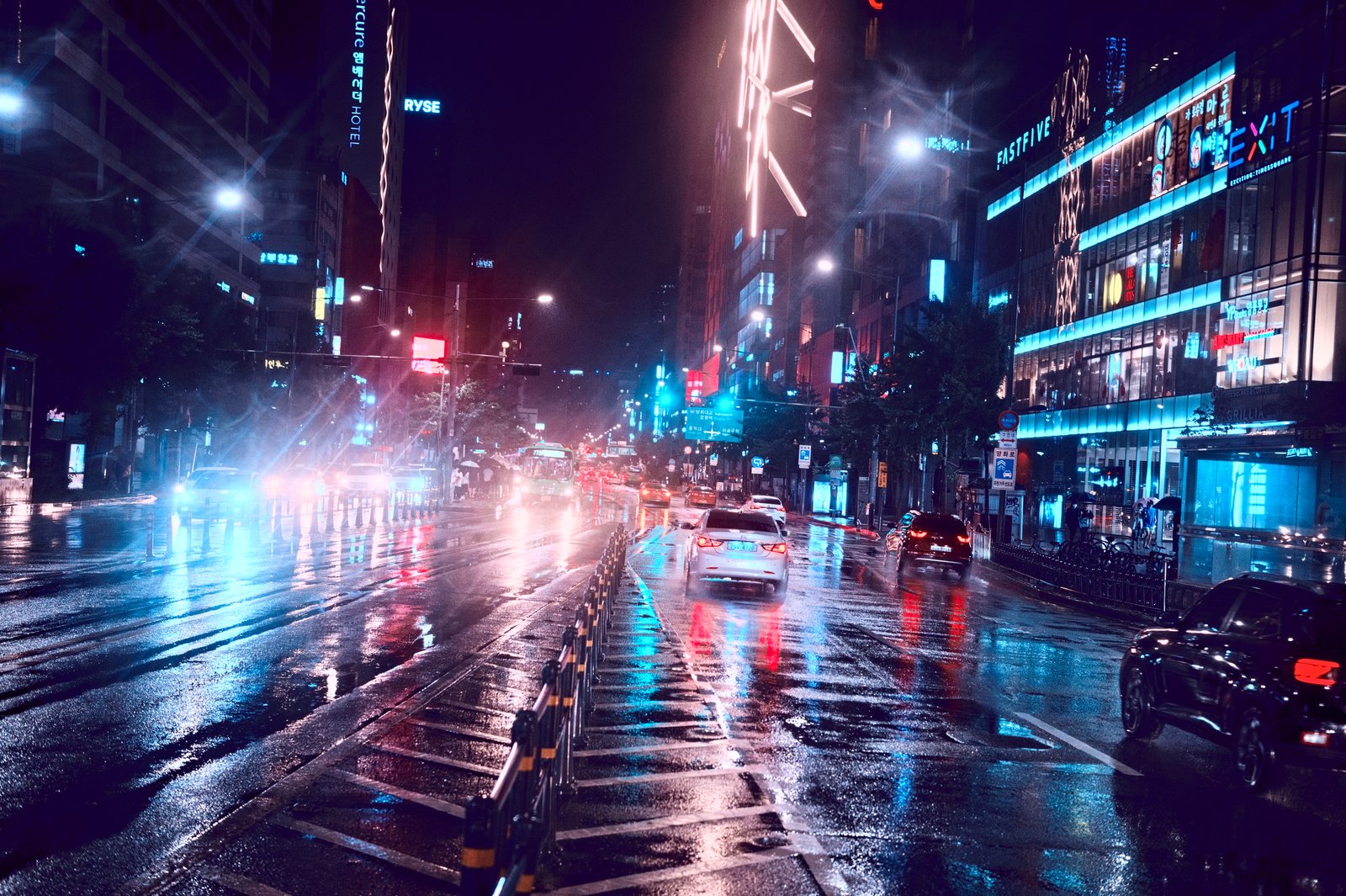
Monsoon Seoul has a mood of its own — but you don’t have to stand in it. Photo by Tony via Wikimedia Commons, CC BY 2.0.
The move nobody tells you: go underground and stay there
Every rainy-day listicle just lists places. What they never do is connect them — and Seoul is built so you can chain a full day of shopping, food, aquariums, a spa and a movie without your shoes ever getting wet. One Redditor on r/koreatravel put the feeling perfectly: “I’m still baffled at the number of underground shops in Korea. A building could look so unassuming externally, only to find 2 underground floors with so many businesses and restaurants. Found a rock climbing place once and even a florist!” (source thread).
Here’s how I’d actually route a monsoon day:
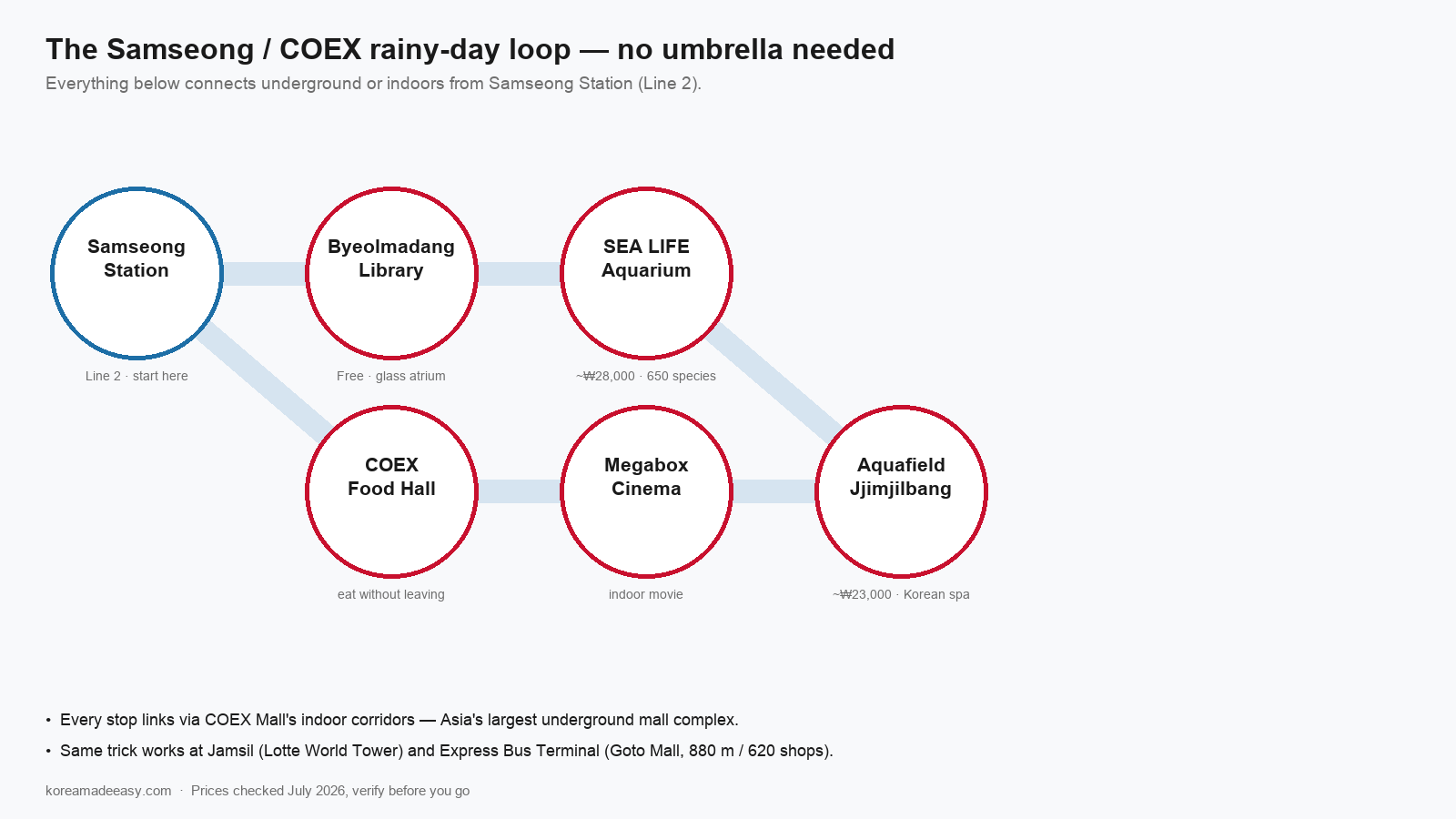
The Gangnam/Samseong indoor loop — everything below connects without going outside. Map graphic by Korea Made Easy.
- The Gangnam/Samseong loop (best single option). Ride Line 2 to Samseong Station and walk straight into COEX Mall, Asia’s largest underground mall complex. Inside, without ever surfacing, you have the free Byeolmadang (Starfield) Library, the SEA LIFE COEX Aquarium, the Aquafield Korean spa, a multiplex cinema, and a huge food hall. You can genuinely spend eight hours here.
- Goto Mall at Express Bus Terminal. Subway Lines 3/7/9 feed straight into Goto Mall — 620 shops strung along an 880-metre underground corridor of cheap fashion, accessories and flowers (VisitKorea). You never touch daylight.
- The Jamsil complex. One station cluster links Lotte World Adventure (indoor theme park), Lotte World Aquarium, Lotte World Mall, and the Seoul Sky observation deck — all under one connected roof.
- The Gangbuk (north-of-the-river) cluster. If you’re based around Myeongdong, Insadong or Hongdae rather than Gangnam, you’re not stranded: Myeongdong’s underground shopping arcade connects to the station, Insadong’s Ssamziegil is a covered spiral of craft shops and tea houses, the National Museum of Korea and War Memorial in Yongsan are vast and free, and Hongdae packs the Trick Eye Museum, board-game and animal cafés, and arcades into a few covered blocks. A full rainy day works on either side of the river.
- Everywhere else. Gangnam Station’s underground arcade, the Euljiro–Myeongdong underground shopping tunnels — most major Seoul transfer stations hide an arcade. Chain them on Naver Map or KakaoMap and you can shop, eat and ride the metro with near-zero rain exposure.
One safety note for heavy-rain days: when a downpour warning (호우경보) is out, skip low-lying underground shopping arcades near streams during the worst of it — Seoul has seen flash flooding in spots like these — and expect some subway and bus delays. Check the weather alert on the Naver or KakaoMap app before you set out, and if it’s truly torrential, the mall-and-tower complexes above (COEX, Lotte World Tower) are the safest bet because you can arrive and leave entirely by connected indoor passages.
The 12: what to do, and what it costs in 2026
Prices below were checked in July 2026. Attraction and spa prices change often, so treat every number as “confirm before you go.”
| # | Indoor pick | Where | 2026 price (approx) | Book |
|---|---|---|---|---|
| 1 | Lotte World Adventure (indoor theme park) | Jamsil | ~₩42,500 foreigner online / ~$30 | GetYourGuide |
| 2 | SEA LIFE COEX Aquarium | Gangnam/COEX | ~₩28,000 online / ~$21 | GetYourGuide |
| 3 | Lotte World Aquarium | Jamsil | ~₩29,000 | GetYourGuide |
| 4 | Byeolmadang (Starfield) Library | COEX | Free | — |
| 5 | National Museum of Korea | Yongsan | Free | — |
| 6 | Aquafield jjimjilbang (Korean spa) | COEX | ₩23,000 spa / ₩55,000 multi | KKday |
| 7 | Korean cooking class | central Seoul | ~$40–60 | GetYourGuide |
| 8 | Hanbok rental studio | Gyeongbokgung area | ~₩19,800 | GetYourGuide |
| 9 | Trick Eye Museum (3D illusion) | Hongdae | ~$14 | Viator |
| 10 | Underground shopping (Goto Mall etc.) | Gangnam/Terminal | Free to browse | — |
| 11 | Escape room / PC bang / coin karaoke | everywhere | ₩500–2,000 | walk-in |
| 12 | Themed cafés (cat/dog/board-game) | Hongdae/Gangnam | ~₩8,000–12,000 | walk-in |
Now the detail that actually helps you choose.
The two free anchors. Start here if money’s tight — and honestly even if it isn’t. The National Museum of Korea in Yongsan is free for the permanent collections, world-class, and open 10:00–18:00 (until 21:00 on Wednesdays and Saturdays) (official site). The War Memorial of Korea is a short walk away, so you can pair them into a full free indoor day. The Byeolmadang Library inside COEX — two 13-metre walls of books under a glass atrium — is also free and open daily until about 22:00 (VisitKorea). It’s the most photographed indoor spot in Gangnam and costs nothing.
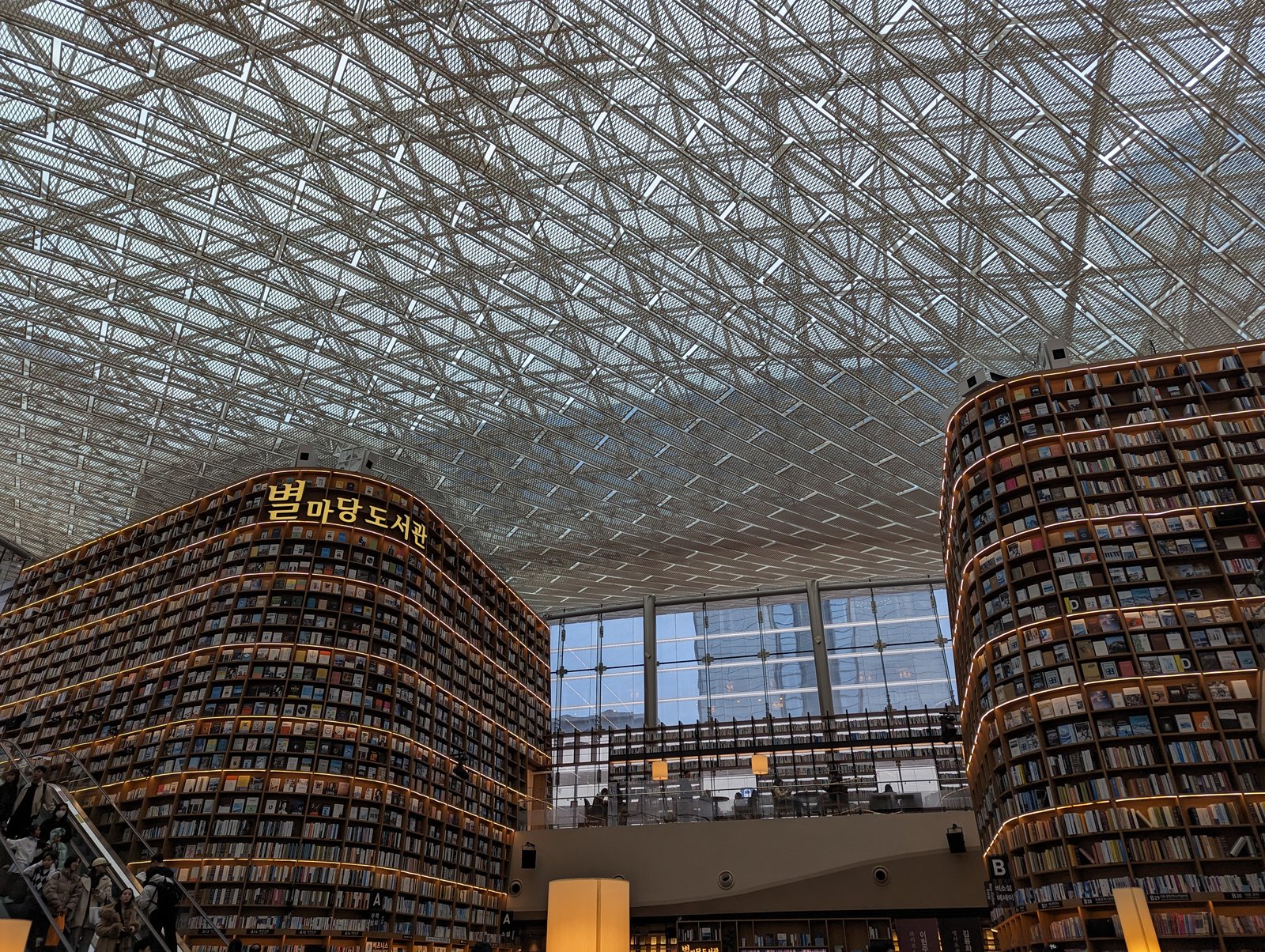
Byeolmadang (Starfield) Library inside COEX — free, fully indoor, and the most-photographed spot in Gangnam. Photo by Sean Young via Wikimedia Commons, CC BY 4.0.
The aquariums (the big rainy-day winners). The SEA LIFE COEX Aquarium holds 650 species and Korea’s largest shark habitat, and it’s inside the COEX loop, so zero rain exposure — adult tickets run about ₩28,000 online versus ₩35,000 at the door (SEA LIFE). Over in Jamsil, the Lotte World Aquarium sits inside the Lotte World Tower complex. Which one? I answer that head-to-head in the FAQ below, because it’s the single most-asked rainy-day question.
Lotte World Adventure is Korea’s giant indoor theme park — 22-plus rides under a glass dome, plus an ice rink and folk museum, all roofed. The regular full-day pass is around ₩62,000, but the foreigner online ticket runs closer to ₩42,500 (official pricing), and booking online skips the queue.
The Korean spa (jjimjilbang) — read this carefully. A jjimjilbang is a public bathhouse-plus-sauna, and it’s the most gloriously appropriate thing to do while it pours. For a first-timer I’d point you at Aquafield at COEX/Starfield: English-friendly, spotless, and part of the underground loop. The jjimjil-spa entry is about ₩23,000, the water park ₩45,000, and a multi-pass around ₩55,000 (KKday). One honest warning: two spas that still appear in older guides and on booking sites — Dragon Hill Spa in Yongsan and Siloam Sauna near Seoul Station — have unconfirmed reports of closure in recent reviews. Don’t build your evening around either without confirming they’re open first. Aquafield is the safe, confirmed pick.
The hands-on options for when you want to do, not just look. A small-group Korean cooking class (kimchi, bibimbap, tteokbokki) is the ideal monsoon activity — warm kitchen, busy hands, and you eat what you make; most run about two hours for $40–60 via GetYourGuide. A hanbok rental studio near Gyeongbokgung (~₩19,800) does the fitting, hair and photos indoors — just skip the palace walk if it’s genuinely pouring. And in Hongdae, the Trick Eye Museum of 3D illusions is fully indoor and bundles an Ice Museum (Viator).
The dirt-cheap local stuff. This is what Koreans actually do in the rain. A PC bang (gaming café) is ₩1,000–2,000 an hour with food delivered to your seat — one Redditor’s tip: “Even if you don’t play games, you can just watch a movie on the big screen.” A coin noraebang (karaoke booth) is about ₩500 a song. Escape rooms, board-game cafés, cat and dog cafés — all quintessential Korean indoor culture, all under ₩15,000. None need booking; just walk in.
What Seoul locals and travelers actually recommend
I’m not the only one who thinks rain is no reason to sulk in your hotel. On the r/koreatravel thread “What are the fun things to do in Seoul when it is raining?”, the answers were unanimous that the city delivers:
- u/C0mput3rs (19 upvotes): “Museums are my favourite thing to do when the weather is bad. National Museum of Korea is free and is amazing. War Memorial museum is also nearby so you can hop over there.” — exactly the free anchor I lead with.
- u/RamenNoodle1985 (41), flaired Korean Resident: “Underground shopping. Spa day, day at the jimjilbang. Covered traditional markets.”
- u/AfraidInspection2894: “Aquariums! There is one in Coex, one in Lottetower and one in the 63building.” — three roofed aquariums, take your pick.
- u/RoutinePresence7 (43): “Sometimes sitting at a cool cafe vibing with korea’s coffee culture… is good for decompressing.”
The recurring theme — museums, jjimjilbang, underground shopping, aquariums — is precisely the underground loop above. The locals route it by instinct; I’m just drawing you the map.
Practical rain-day tactics
- Reserve these, walk into those. Book online for Lotte World, the aquariums, cooking classes and hanbok (cheaper and skips queues). Just walk in for museums, PC bangs, karaoke, cafés and underground shopping.
- Three genuinely free options: the National Museum of Korea, the Byeolmadang Library, and simply browsing Goto Mall or the Gangnam underground arcade. A full, dry, memorable day for the cost of subway fare.
- On the worst downpour days, route by app. Naver Map and KakaoMap show which exits connect to underground malls — plan station-to-mall so you surface as little as possible. You’ll lean on those maps constantly, so make sure your phone has data; a Korea eSIM means you’re never map-less in the rain.
- Sometimes the right call is to stay in. On a 100 mm day, a nice hotel with a spa and a good window is a legitimate itinerary. That’s partly why where you sleep matters so much in monsoon season — which is the next thing worth reading.
- When the rain breaks, get out of the city. Monsoon rain is often on-and-off, so keep a half-day escape ready for the clear window: Nami Island is a leafy, easy day trip an hour east of Seoul that’s perfect the moment the sky lifts.
FAQ
What is there to do in Seoul when it rains? Plenty, all indoors: free world-class museums (National Museum of Korea, War Memorial), three roofed aquariums (COEX, Lotte World Tower, 63 Building), Lotte World’s indoor theme park, Korean spas (jjimjilbang), cooking classes, hanbok studios, the free Byeolmadang Library, and vast underground shopping malls like Goto Mall. The smartest move is to base yourself around COEX in Gangnam, where a library, aquarium, spa, cinema and food hall all connect underground — you can fill a whole day without opening your umbrella.
COEX Aquarium or Lotte World Aquarium — which should I pick? It comes down to where you already are and what else you want to do. The COEX (SEA LIFE) Aquarium sits in central Gangnam, has Korea’s biggest shark habitat and more species, and slots straight into the COEX underground loop — best if you want an all-indoor Gangnam day. The Lotte World Aquarium is in Jamsil inside the Lotte World Tower, so it pairs naturally with Lotte World’s indoor theme park and the Seoul Sky observation deck. If you want the bigger, more central aquarium, go COEX; if you’re spending the day at Lotte World anyway, do its aquarium. Both are fully indoor and rain-proof.
Is the rainy season a bad time to visit Korea? Not a dealbreaker — just a planning constraint. You’ll get warm temperatures, fewer crowds at outdoor sights, and often cheaper flights and hotels, in exchange for heavy rain concentrated into bursts (Seoul absorbs 30–50% of its yearly rain in these weeks). If your trip is all beaches and hikes, monsoon isn’t ideal. But Seoul specifically is so packed with world-class indoor options — and so cleverly connected underground — that a rainy city trip can be just as full as a sunny one. Build an indoor-first plan, keep the aquariums and jjimjilbang as rain insurance, and you won’t lose a single day.
Planning Your Korea Trip? Don't Pay Full Price! ✨
Save $20–$50 per person with our verified reader perks & skip the long ticket booth queues:
AREX Incheon ↔ Seoul Express
Non-stop 43-min direct train with guaranteed reserved seats & free Wi-Fi. Scan your mobile QR straight at the gate!
Get 20% Off AREX Ticket →Korea Unlimited 5G eSIM
Skip the 30-min airport counter line. Scan the QR code to connect instantly for smooth Naver Maps navigation.
Get Instant eSIM QR (From $2.80) →WOWPASS Card (Pay + T-Money)
Pay anywhere in Korea with zero FX fees + subway card. Use code KOREAEASY for 0.5% cash top-up bonus!
Top Seoul Passes & Day Tours
Guaranteed entry for Lotte World, Nami Island tours, CIMER Spa, and Hanbok palace rentals with instant mobile vouchers.
Browse Top Seoul Deals →Sources
- https://www.museum.go.kr/ENG/contents/E0101010000.do
- https://english.visitkorea.or.kr/svc/contents/contentsView.do?vcontsId=60729
- https://adventure.lotteworld.com/price/price
- https://www.visitsealife.com/coex-seoul/en/tickets-passes/
- https://www.kkday.com/en-id/product/138205-aquafield-jjimjil-spa-sauna-goyang-hanam-anseong-korea
- https://english.visitkorea.or.kr/svc/contents/contentsView.do?vcontsId=86283
- https://www.koreajoongangdaily.com/korea/monsoon-unlikely-to-reach-korea-before-july/12740640
- https://www.ajupress.com/view/20260506143570273
- https://blog.southofseoul.net/understanding-monsoon-season-jangma-in-south-korea/
- https://www.reddit.com/r/koreatravel/comments/1cbjlle/
- https://v.daum.net/v/20260719074254121
Search-trend data from Google Trends (KR) and Naver DataLab. This article is independent commentary and is not affiliated with any broadcaster, agency, or the individuals mentioned.