Travel
Incheon Airport to Seoul: The ₩4,150 Train That Beats the ₩90,000 Taxi (2026)
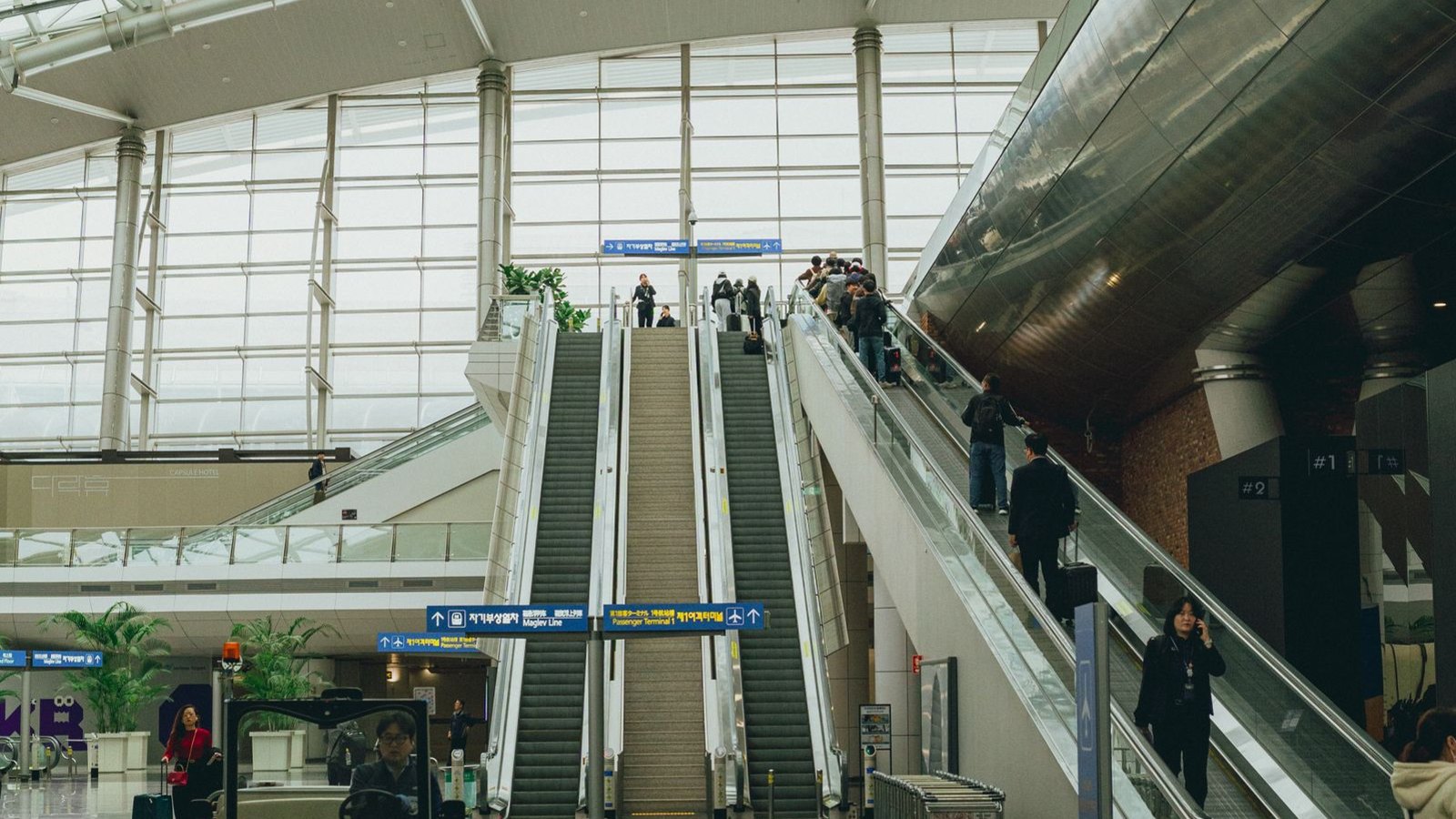
The payoff Jet-lagged and squinting at a wall of Korean signs → tapped through the gate and stepping off in central Seoul for about ₩4,150, with an hour of your first day still in your pocket.
📈 Trend signal: Incheon airport to Seoul transport demand 2026
You’ve just cleared immigration at Incheon (ICN), you’re jet-lagged, and there’s a wall of signs pointing at trains, buses, and taxis — all in a language you can’t read yet. This is the first real decision of your Korea trip, and the good news is there’s no wrong answer: Incheon is one of the best-connected airports in the world, and central Seoul is about an hour away no matter how you go. The trick is matching the option to your luggage, your budget, and how tired you are.
Here’s every route downtown, compared honestly on real 2026 fares and times, plus the small things nobody tells you until you’re already standing at the platform. The short version: the same 60-kilometre trip costs anywhere from ₩4,150 to ₩90,000 depending on which sign you follow — a 20-fold spread — and the most expensive option is often the slowest during Seoul rush hour. Getting this one decision right saves you both the money and the hour. This post contains affiliate links. If you book through them, I may earn a small commission at no extra cost to you.
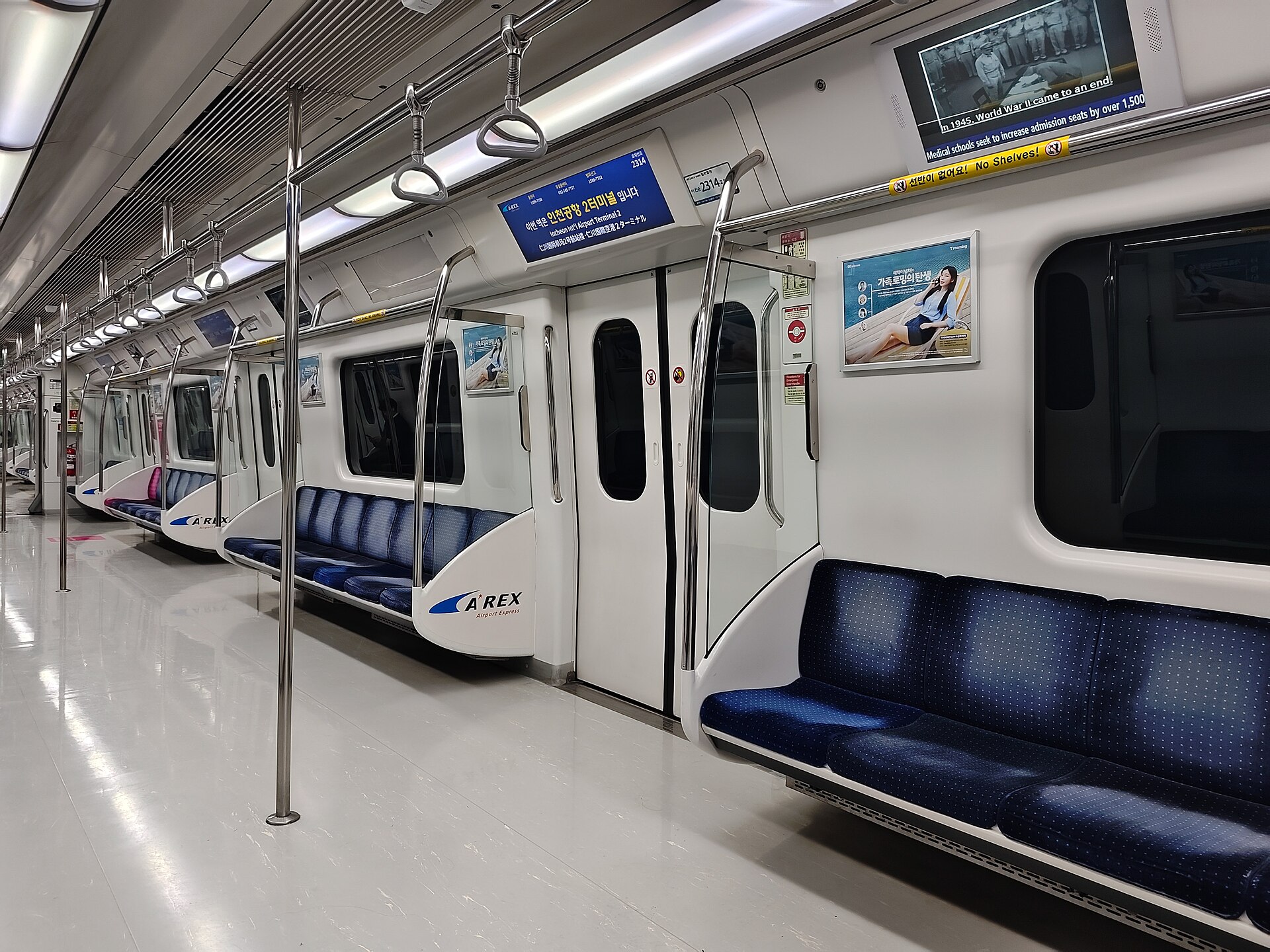
Inside an AREX Airport Express train from Incheon. Photo by TurnOnTheNight via Wikimedia Commons, CC BY-SA 4.0.
Landing at Terminal 1 vs Terminal 2? Make sure you know which terminal your airline uses, how the free 15-minute circular shuttle works, and how to use the ICN SmartPass app to skip 40-minute security queues — read our Incheon Airport Terminal 1 vs 2 Guide.
Landing early before 15:00 hotel check-in? Don’t drag heavy suitcases onto crowded subways — send your bags from Incheon Airport to your Seoul hotel for ~₩18,000 or book a fixed-rate private van transfer.
Which prepaid transit card should you buy at the airport? Check our comprehensive Korea Travel Cards Compared: T-Money vs Climate vs WOWPASS vs NAMANE or calculate your exact transit budget.
First, know your terminal: T1 or T2
Incheon has two passenger terminals, and they’re 15 minutes apart by shuttle, so this matters.
- Terminal 2 (T2) serves Korean Air, Delta, Air France, KLM, and their close partners. It’s the newer, cleaner one.
- Terminal 1 (T1) serves almost everyone else — most low-cost carriers and the majority of international airlines.
Every option below (train, bus, taxi) serves both terminals, so you don’t need to change anything — just note which terminal your ticket says, because the signs and pickup points are terminal-specific. If you ever need to hop between them, the free shuttle bus runs constantly and the AREX train connects them too.
At a glance: which one is for you
| Option | Approx. cost | Time to central Seoul | Best for |
|---|---|---|---|
| AREX All-Stop train | ~₩4,150–₩4,750 ($3–4) | ~65 min | Budget travelers, light luggage |
| AREX Express train | ₩13,000 (~$9.50) | ~43 min to Seoul Station | Fast, direct, no traffic |
| Airport Limousine bus | ~₩17,000 ($13) | 60–90 min | Big luggage, hotel near a stop |
| Standard taxi | ~₩65,000–90,000 ($50–70) | 60–90 min | Late arrivals, groups, door-to-door |
| Private transfer | fixed, book ahead | 60–90 min | Zero-stress, families, first-timers |
Prices are approximate 2026 amounts and shift with fuel surcharges, tolls, and time of day. Now the detail.
The AREX airport train: the default choice
Video: an English-language walkthrough of getting from Incheon Airport into Seoul — the train, the bus and the taxi, with real footage of each — embedded from its creator’s YouTube channel. A useful visual companion to the cost comparison below.
For most travelers, the Airport Railroad Express (AREX) is the smart pick — it skips all traffic, runs on a fixed schedule, and drops you in the heart of the city. There are two kinds of AREX train, and mixing them up is the classic first-timer mistake:
The All-Stop train (일반 / commuter) is the cheap workhorse. It stops at every station on the way and connects straight into the Seoul metro system, so if your hotel is near a subway line you can ride it all the way in for the price of a normal metro fare — roughly ₩4,150–₩4,750 depending on your final stop, tapped with a T-money card. It takes about 65 minutes to Seoul Station. This is the best value in the whole airport, full stop. And here’s the tip that matters most: if you’re staying in Hongdae, this is the train — it stops directly at Hongik University Station, so you step off right in the neighborhood with zero transfers. The pricier Express train skips Hongdae entirely and carries you past it to Seoul Station, meaning you’d have to double back. Paying more to end up further from your hotel is the classic rookie mistake.
The Express train (직통 / non-stop) runs non-stop from the airport to Seoul Station in about 43 minutes for ₩13,000 (All-Stop train is ₩4,150–₩4,750). Reserved, comfortable seats, luggage racks, no crowds. If you’re staying near Seoul Station (or connecting to a KTX high-speed train), it’s worth the extra few dollars. One gotcha: the Express needs its own separate ticket from the AREX counter or kiosk — a plain T-money tap won’t open the Express gate, and first-timers regularly get turned back at it.
✈️ Before you even board: check whether you need K-ETA. Twenty-two countries — including the US, UK, Japan and Australia — are exempt through the end of 2026, and people are still paying $75 to scam sites for a form they don’t need.
🗺 Planning the whole trip, not just the ride in? My Seoul travel guide for first-timers puts the airport, your base, the itinerary and the real daily budget in one place.
💡 Get a T-money card first. Before you tap into any train or bus, buy a T-money transit card at a convenience store in the arrivals hall (GS25, CU, 7-Eleven) and load it with cash. It works on the AREX all-stop train, every Seoul subway line, and city buses, and it saves you fumbling for tickets all trip. Our Seoul subway & T-money guide explains how the system fits together.
🎁 Reader Discount Alert: Save Money & Skip Airport Lines! ✨
- 🚆 AREX Express Direct Train: Book Instant Mobile QR Online — Check the current price for a pre-booked AREX Express ticket to scan straight at the turnstile gate.
- 📶 Korea Unlimited 5G eSIM: Get Airalo eSIM from $5.50 — Skip the 30-min airport counter queues and connect instantly.
- 💳 WOWPASS All-in-One Card: Enter invitation code
KOREAEASYon the WOWPASS app for 0.5% instant cashback on all foreign currency top-ups.
When the train is not ideal: if you land late (the last all-stop train leaves Incheon around 23:35, and the last Express goes even earlier, near 22:50 — first train back is about 05:20), if you’re hauling three big suitcases, or if your hotel is a long, subway-transfer-heavy trek from Seoul Station. In those cases, read on.
The two most common arrival-day regrets aired on Reddit’s r/KoreaTravel map exactly onto these traps: budget travelers who wrestled a 28-inch suitcase onto a jammed rush-hour all-stop train to save a few dollars, and people who landed near midnight assuming trains run all night — then paid a premium late-night taxi fare they hadn’t budgeted for. Both are avoidable if you match the option to your bags and your landing time before you leave the platform.
Airport Limousine buses: best when you’ve got luggage
The Airport Limousine buses are the underrated option. They’re comfortable coaches that leave from clearly numbered stops right outside arrivals, and each route runs a fixed loop through specific neighborhoods — often stopping directly in front of major hotels. If your hotel is on a bus route, you roll your suitcase off the plane, onto the bus, and off at your door with zero stairs or transfers.
Fares run about ₩17,000 ($13), and the trip takes 60–90 minutes depending on traffic. The catch is exactly that — traffic. During Seoul rush hour the bus can crawl, whereas the train never will. Check whether your hotel is on a route before committing; the airport’s information desks and the bus-stop signage list every destination, and staff will point you to the right numbered stand.
This is my pick for travelers with heavy bags who are staying somewhere the train would mean two subway transfers with a suitcase.
Taxis: for late nights and door-to-door ease
A standard taxi from Incheon to central Seoul costs roughly ₩65,000–90,000 ($50–70) including expressway tolls, and takes 60–90 minutes. It’s the most expensive per person but the least effort — you get in, show the driver your hotel address (have it written in Korean, or on your phone), and you’re delivered to the door.
Taxis make the most sense when you land late and the train has stopped, when you’re a group of three or four splitting the fare, or when you simply have no energy left to navigate. Use the official taxi stands outside arrivals — ignore anyone approaching you inside the terminal offering a ride, which is the one scam to know here. Regular taxis are more than fine; the “international” and “deluxe” (black) taxis cost noticeably more for the same trip.
Two money details worth knowing. First, taxis got slightly cheaper at the end of 2025: the Incheon Bridge toll was cut to about ₩2,000 (from roughly ₩5,500), and it’s added to your meter automatically. Second — and this is the one that bites late arrivals — a late-night surcharge kicks in from 22:00, adding around 20%, and rising to as much as 40% in the small hours. That can push a run out to Gangnam close to ₩100,000. If you’re landing near midnight, that surcharge is exactly why splitting a taxi between three or four people, or checking the 24-hour night buses (routes N6000 / N6001 / N6002, roughly ₩16,000–17,000), can be the smarter call.
A quick note: fares are metered, tipping is not expected in Korea, and most taxis take card and T-money as well as cash.
Private airport transfer: the zero-stress option
If it’s your first time in Korea, you’re traveling with kids or elderly parents, or you just want to remove every ounce of arrival-day friction, a pre-booked private transfer (Kia Carnival / Jumbo Van) is worth the premium. A driver meets you in the arrivals hall holding a sign with your name, helps with your bags, and takes you straight to your accommodation for a fixed price you agreed to in advance — no meter anxiety, no language barrier, and no wondering if you’re being overcharged during midnight hours.
For vehicle sizing, midnight arrival strategies, and luggage capacities, read our dedicated Incheon Airport Private Van & Taxi Transfer Guide (2026).
👉 Compare private airport van and taxi transfers on Klook — check each listing for the price, luggage capacity, waiting time, and cancellation terms. Or browse all verified discount codes on our Korea Travel Pocket Perks Hub!
So which should you pick?
- Traveling light and on a budget? AREX all-stop train. Nothing beats $3–4.
- Staying near Seoul Station or want the fastest ride? AREX Express.
- Heavy suitcases and a hotel on a bus route? Airport Limousine bus.
- Landing after midnight, or a group of 3–4? Taxi.
- First time in Korea, kids in tow, or zero patience for logistics? Private transfer.
Whichever you choose, do two things before you leave the airport: grab a T-money card and pick up a local SIM or eSIM so you have maps and translation from minute one. (Our best Korea eSIM guide compares the options — set one up before you fly and it activates the moment you land.)
Once you’re in the city, a few guides pick up where this one leaves off: where to stay in Seoul breaks the neighborhoods down by budget and vibe, the DMZ day trip from Seoul is the single excursion most first-timers end up adding, and if you’re moving here rather than visiting, the real cost of living in Seoul lays out a monthly budget in actual won.
Departing from southern Seoul is often faster via SRT from Suseo Station; read our walkthrough on booking SRT trains with a foreign credit card.
FAQ
How long does it take to get from Incheon Airport to Seoul? Between about 43 minutes and 90 minutes, depending on how you travel. The AREX Express train is the fastest fixed time at ~43 minutes to Seoul Station because it never sits in traffic; buses and taxis run 60–90 minutes and vary with road conditions.
What’s the cheapest way from ICN to Seoul? The AREX all-stop train, at roughly ₩4,150–₩4,750 ($3–4) with a T-money card. It connects directly into the Seoul subway, so if your hotel is near a metro station you can ride in for little more than a normal fare.
Can I get to Seoul from Incheon at night? Yes. The last all-stop train leaves Incheon around 23:35 and the first is back near 05:20. After that your options are the 24-hour night buses (routes N6000 / N6001 / N6002 into central Seoul and Gangnam, roughly ₩16,000–17,000), a taxi (~₩65,000–90,000, plus a late-night surcharge of 20–40% from 22:00), or a pre-booked private transfer. For a group, splitting a taxi is often the easiest; solo and on a budget, check whether a night bus stops near your hotel first.
I’m heading straight to Busan — anything I should know? Yes, and it changes on 1 September 2026, when KTX and SRT merge into a single service: fares drop about 10% (Seoul–Busan to roughly ₩54,400) and both are booked in one app. Here’s what the merger changes, including the account step that stops people booking.
Do I need cash, or can I use a card? Both work. Buy and reload a T-money card with cash at an airport convenience store for trains and buses; taxis and private transfers generally accept cards. Korea is very card-friendly overall, but having a T-money card topped up makes the whole trip smoother.
Is Uber available at Incheon? Yes, though it works differently than you may expect: in Korea Uber dispatches licensed metered taxis, not private drivers, so the car that arrives is the same kind of cab waiting at the stand. Your existing account and card work, which is exactly why it’s the reliable fallback for arriving visitors. The bigger local app is Kakao T, and it’s better outside Seoul — but see the next question before you rely on it.
Why won’t Kakao T let me finish signing up? Because of the Korean identity check behind it, and this catches a lot of people on arrival day. Signing up with a Korean number makes the app query your mobile carrier’s subscriber records for a name, birth date and registration number. A prepaid tourist SIM isn’t registered under a verified identity, so there’s nothing to match and the app keeps asking for an ID number you don’t have. Signing up with your home-country number normally skips that step entirely — do it before you buy a Korean SIM. If registration of a foreign card fails, set payment to pay the driver directly and settle by card or cash at the end; booking and dispatch still work. Full walkthrough in the Naver Map and KakaoMap setup guide.
Honestly, do I even need a taxi app at the airport? No. The official taxi stand outside arrivals is queued, metered and staffed, and it is the simplest option after a long flight — no app, no account, no verification. Apps matter more later in the trip than on arrival day.
Planning Your Korea Trip? Compare Your Options
Compare transport, mobile data, and attraction options. Prices and eligibility depend on your selected date and package.
AREX Incheon ↔ Seoul Express
Express train between Incheon Airport and Seoul Station. Follow the selected voucher’s seat reservation and redemption instructions.
Check AREX Express Tickets →Korea eSIM Options
Compare Korea eSIM search results. Check data allowance, supported network, device compatibility, activation, and speed limits.
Compare Korea eSIM Options →WOWPASS Card (Pay + T-Money)
Compare WOWPASS and T-money. Payment and transit balances are separate; check issuance, top-up, exchange, and withdrawal fees.
Read WOWPASS vs T-money →Top Seoul Passes & Day Tours
Browse general Seoul activity search results. This is not a guaranteed-entry pass or a fixed-discount offer; check each product’s inclusions.
Browse Seoul Activity Options →Sources
- https://www.arex.or.kr/main.do
- https://english.visitkorea.or.kr/svc/contents/contentsView.do?vcontsId=88762
- https://www.airport.kr/ap_en/index.do
- https://www.seoulmetro.co.kr/en/page.do
Search-trend data from Google Trends (KR) and Naver DataLab. This article is independent commentary and is not affiliated with any broadcaster, agency, or the individuals mentioned.