Travel
Seoul Climate Card for Tourists: 1, 3, & 5-Day Passes vs T-Money (2026 Honest Guide)
The payoff Confused between T-Money, Wowpass, and unlimited day passes → knowing your exact break-even transit math and avoiding the ₩3,000 gate fine at non-supported lines like Shinbundang.
📈 Trend signal: Seoul Climate Card tourist pass adoption 2026
If you are planning a trip to Seoul in 2026, you will inevitably face a major transit dilemma: should you stick with the classic T-Money card, get an all-in-one Wowpass, or buy Seoul’s new unlimited Climate Card Tourist Pass (기후동행카드 단기권)?
The promise sounds irresistible: unlimited subway and city bus rides starting at just ₩5,000 ($3.70) a day.
However, there is fine print that travel brochures rarely explain clearly. If you tap into the wrong line (like the Shinbundang Line to Gangnam or try to board at Incheon Airport), the gate will buzz red and lock you out.
This guide gives you the unfiltered breakdown: the 2026 prices for all 5 tourist passes, the exact break-even math, the 3 fatal transit traps, and a straightforward decision tree on whether you should buy it.
This post contains affiliate links. If you buy through them, I may earn a small commission at no extra cost to you.
1. The 2026 Tourist Pass Options & Pricing
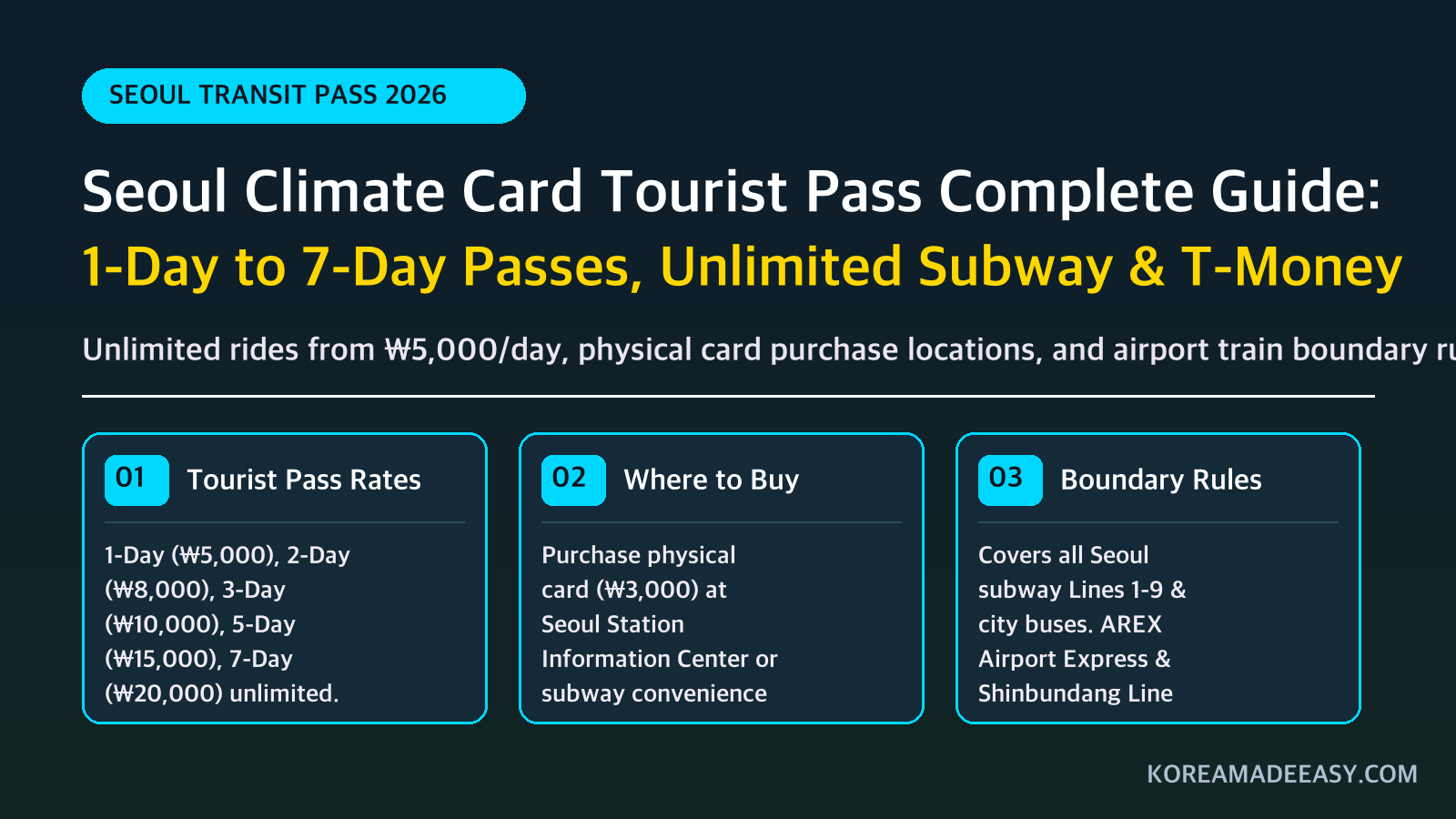
Seoul offers 5 duration tiers for short-term visitors. Unlike the monthly ₩62,000 commuter pass used by locals, tourist passes require no resident ID and no Korean bank account.
| Pass Tier | Price (KRW) | Price (USD) | Break-Even: Pass Only (Card Owned) | Break-Even: First-Time Buyer (+₩3,000 Card) | Best For |
|---|---|---|---|---|---|
| 1-Day Pass | ₩5,000 | ~$3.70 | 4 rides (4/day) | 6 rides total (ceil(₩8,000 ÷ ₩1,550)) | Intense single-day sightseeing blitz (4+ stops) |
| 2-Day Pass | ₩8,000 | ~$5.90 | 6 rides (3/day) | 8 rides total (4/day) | Weekend city break |
| 3-Day Pass | ₩10,000 | ~$7.40 | 7 rides (2.3/day) | 9 rides total (3/day) | ⭐ The Sweet Spot for most first-timers |
| 5-Day Pass | ₩15,000 | ~$11.00 | 10 rides (2/day) | 12 rides total (2.4/day) | Standard Seoul vacation |
| 7-Day Pass | ₩20,000 | ~$14.80 | 13 rides (1.9/day) | 15 rides total (2.1/day) | Week-long exploration / slow travel |
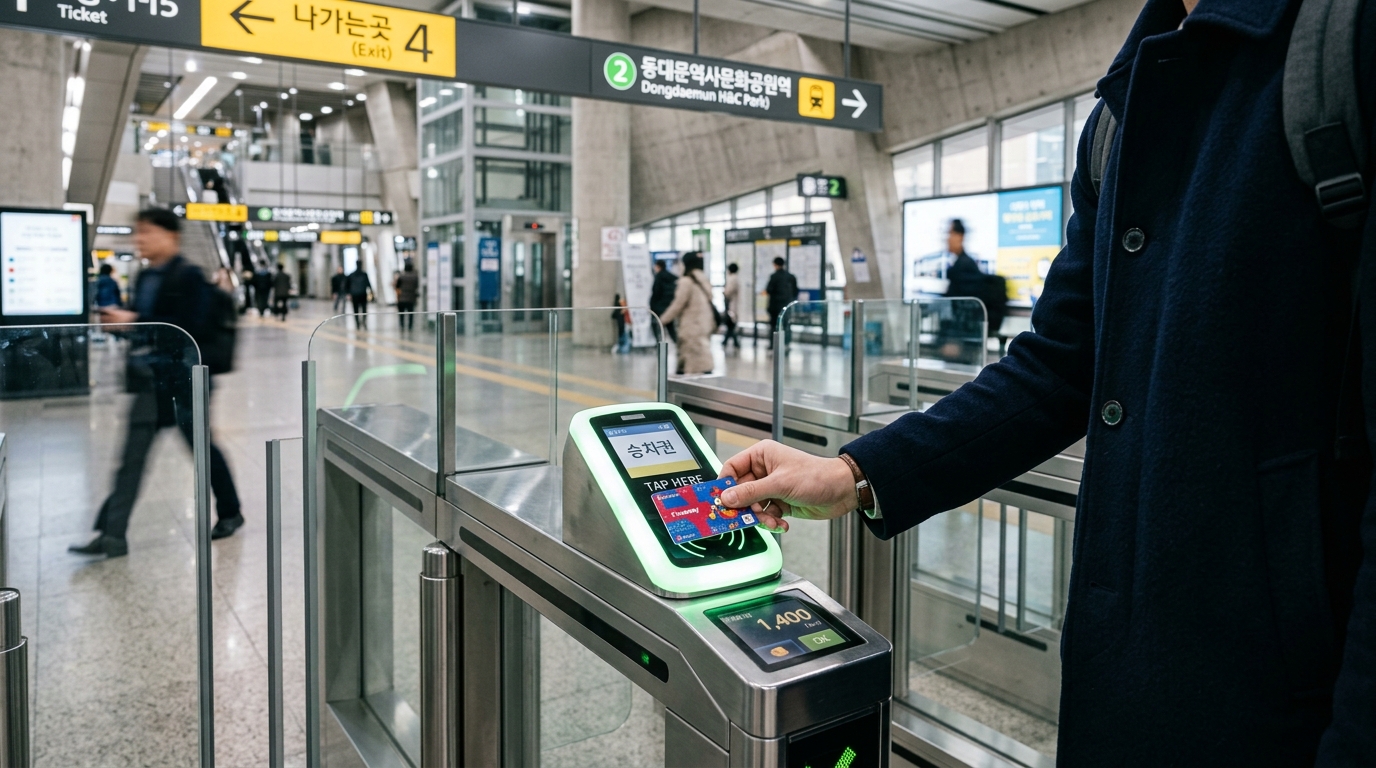
Tapping in at a Seoul subway gate: unlimited rides begin the moment your physical pass touches the sensor.
⚠️ One-Time Card Cost: In addition to the pass duration fee, you must buy a physical Climate Card for ₩3,000 ($2.20) at subway customer service centers or nearby convenience stores (GS25, CU, 7-Eleven, Emart24). The card itself is reusable for future trips.
2. The 3 Fatal Traps: Where the Card DOES NOT Work
The biggest mistake foreign visitors make is assuming “Seoul Unlimited” means every train in the country. Korea’s transit system is divided between municipal lines, state-owned Korail tracks, and private consortiums.
Here are the 3 major traps you must know:
Trap #1: The Incheon Airport Asymmetry (Drop-off OK, Pick-up NO)
- Leaving Seoul to Airport: If you take the AREX All-Stop Train from Seoul Station, Hongdae, or Gimpo Airport to Incheon Airport (Terminal 1 or 2), you CAN tap out with the Climate Card with zero extra surcharge.
- Arriving at Airport to Seoul: You CANNOT board the train at Incheon Airport using the Climate Card. The card is not recognized at Incheon departure turnstiles.
- 👉 The Rule: Use T-Money or the AREX Express Train from Incheon Airport into the city. Activate your Climate Card once you arrive in Seoul.
Trap #2: The Shinbundang Line (신분당선) Blackout
The shiny red Shinbundang Line connecting Gangnam to Yangjae, Pangyo (techno valley), and Bundang is a privately-owned express subway. The Climate Card is 100% invalid on the Shinbundang Line. If you accidentally transfer into it, the turnstile will alarm and display an error code. You must use standard T-Money or credit cards for this line.
Trap #3: Day Trips Outside Seoul City Limits
The Climate Card covers Seoul city buses and Subways Lines 1 through 9, Ui-Sinseol, Sillim, and Gyeongui-Jungang only within Seoul boundaries.
- Not Covered: Trains to Suwon (Hwaseong Fortress), Chuncheon / Nami Island, Yongin (Everland), or Busan KTX.
- Red Buses: Red suburban express buses (광역버스) connecting Gyeonggi-do to Seoul are excluded.
3. The Math: Is the Climate Card Actually Cheaper Than T-Money?
Standard adult single-ride subway fares in Seoul cost ₩1,550 with transit card (cash single-journey ticket ₩1,650, base rate up to 10km).
Let’s look at two real traveler scenarios:
📊 Scenario A: The “Fast-Paced Explorer” (3-Day Trip)
- Morning: Myeongdong Hotel → Gyeongbokgung Palace (₩1,550)
- Lunch: Gyeongbokgung → Bukchon Hanok Village → Anguk (₩1,550)
- Afternoon: Anguk → Seongsu-dong Cafe Street (₩1,550)
- Evening: Seongsu → Dongdaemun Design Plaza & Night Market (₩1,550)
- Night: Dongdaemun → Myeongdong Hotel (₩1,550)
- Daily Transit Cost on T-Money: ₩7,750/day = ₩23,250 for 3 days
- Cost on 3-Day Climate Card: ₩10,000 + ₩3,000 card = ₩13,000
- 🎉 Net Savings: You save ₩10,250 (~$7.50) + complete freedom to hop on and off without checking balances.
📉 Scenario B: The “Relaxed Traveler” / Out-of-Town Explorer
- Day 1: 2 subway rides around Hongdae (₩3,100)
- Day 2: Day trip to Nami Island / Gapyeong (Climate card invalid; paying out of pocket)
- Day 3: 2 subway rides to Gangnam (₩3,100)
- Total in-city subway spend: ₩6,200
- ❌ Climate Card Cost: ₩13,000
- 👉 Result: You lose ₩6,800. Stick to standard pay-as-you-go T-Money.
4. Step-by-Step: How to Buy, Load, and Activate in English
Buying and loading your tourist pass takes less than 3 minutes at any subway station in central Seoul.
📍 The 4-Step Activation Process:
- Buy the Card (₩3,000): Ask the station attendant at the Customer Safety Center (고객안전실) for a “Gi-hu Dong-haeng Card” or buy it from a convenience store.
- Go to the Ticket Vending Machine: Look for the multilingual transit card reloading machines inside the subway lobby.
- Select English & Climate Card: Tap “English” on the touch screen, place your card on the charging cradle, and select “Recharge Climate Card”.
- Choose Duration & Start Date: Select your desired pass (1, 2, 3, 5, or 7 days) and choose whether you want it to activate Immediately or on a Specific Future Date.
💡 Pro Payment Tip (Cash vs. Foreign Cards)
Newer automated kiosk terminals in central tourist hubs (Myeongdong, Seoul Station, Hongdae, Dongdaemun) allow you to recharge using foreign Visa and Mastercard.
However, foreign card transactions incur a ~3.7% international processing fee. If you want to pay exact face value, feed crisp Korean ₩1,000, ₩5,000, or ₩10,000 banknotes into the cash slot (surcharge: ₩0).
5. The Verdict: Who Should Buy What?
🧭 Quick Decision Guide:
- Taking 3+ subway/bus rides per day on a multi-day stay (3-Day or 5-Day Pass, or card already owned)? 👉 Buy the Climate Card (first-time 1-day buyers need 6 rides to cover the ₩3,000 card + pass).
- Taking 1–2 rides per day or staying within walking distance? 👉 Stick to T-Money (pay-as-you-go).
- Taking day trips outside Seoul (DMZ, Nami Island, Suwon, Everland)? 👉 Use T-Money or Wowpass (Climate Card is invalid outside Seoul limits).
- Buy the Climate Card Tourist Pass if: You are staying in Seoul for 2 to 7 days, visiting multiple tourist districts per day (e.g., Hongdae + Seongsu + Gangnam + Myeongdong), and taking buses and subways liberally without worrying about wallet top-ups.
- Stick to T-Money / Wowpass if: You plan to take day trips outside Seoul (DMZ, Nami Island, Suwon), rely heavily on taxis, or walk between nearby attractions.
If you tap into the wrong platform direction on the subway, you can use the Seoul subway 15-minute free reentry rule to switch sides without double-paying.
FAQ
Does the Climate Card cover the Seoul City Tour Bus or Han River Water Bus? No. The Climate Card covers standard municipal blue, green, and village (Maeul) buses. Hop-on hop-off commercial sightseeing buses and express intercity buses are excluded.
Can two people share one Climate Card? No. Unlike some prepaid transit cards that allow multi-passenger tapping with an attendant, the Climate Card is strictly one pass per individual traveler. Each passenger must tap their own card upon entry and exit.
Do I need to tap out when getting off buses and subways? Yes, always tap out. Failing to tap out upon exiting may lock your card from recording seamless transfers and could apply a penalty freeze on subsequent trips.
Can I get a refund on unused days if my plans change? Partial refunds on unused days for short-term tourist passes are generally not provided once the activation date begins. Only buy the exact number of days (e.g., 3-day pass) that match your active sightseeing schedule.
Does the Climate Card work on airport limousine buses (6001, 6015, etc.)? No. Airport limousine express buses connecting Incheon and Gimpo Airports to Seoul hotels require standard T-Money, credit cards, or separate cash boarding tickets.
Planning Your Korea Trip? Compare Your Options
Compare transport, mobile data, and attraction options. Prices and eligibility depend on your selected date and package.
AREX Incheon ↔ Seoul Express
Express train between Incheon Airport and Seoul Station. Follow the selected voucher’s seat reservation and redemption instructions.
Check AREX Express Tickets →Korea eSIM Options
Compare Korea eSIM search results. Check data allowance, supported network, device compatibility, activation, and speed limits.
Compare Korea eSIM Options →WOWPASS Card (Pay + T-Money)
Compare WOWPASS and T-money. Payment and transit balances are separate; check issuance, top-up, exchange, and withdrawal fees.
Read WOWPASS vs T-money →Top Seoul Passes & Day Tours
Browse general Seoul activity search results. This is not a guaranteed-entry pass or a fixed-discount offer; check each product’s inclusions.
Browse Seoul Activity Options →Sources
Search-trend data from Google Trends (KR) and Naver DataLab. This article is independent commentary and is not affiliated with any broadcaster, agency, or the individuals mentioned.