Travel
DMZ Tour from Seoul in 2026: Real Prices ($40–65), What's Actually Open, and Is It Worth It?
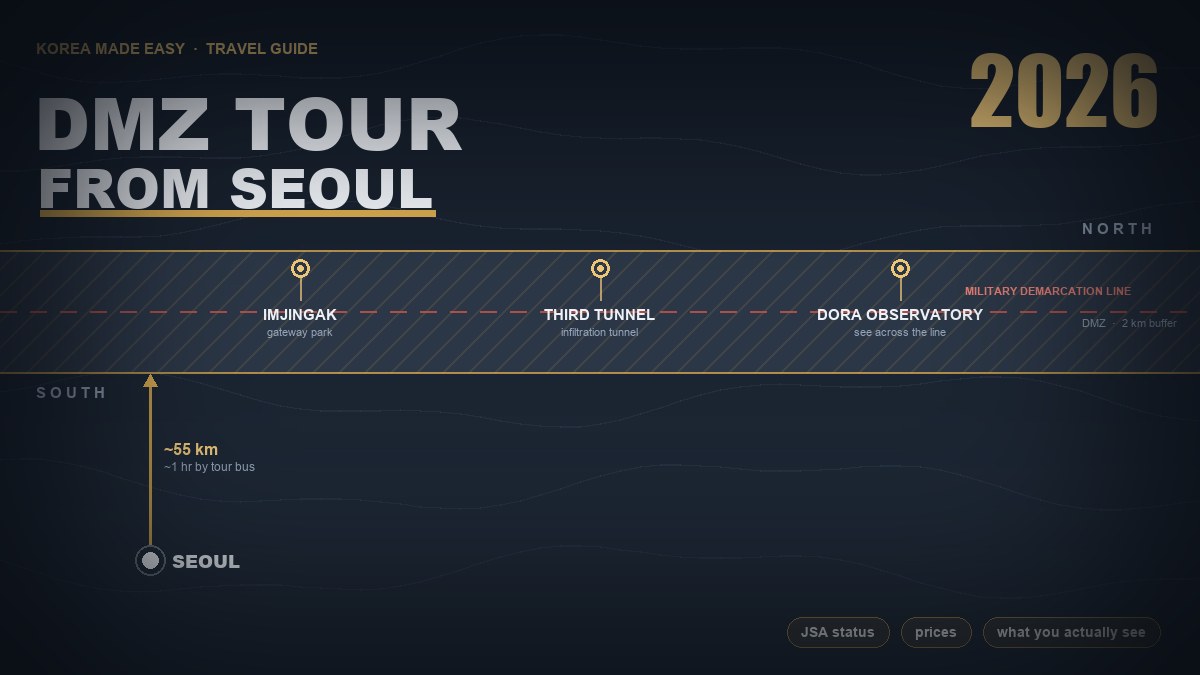
The payoff Daydreaming of stepping into the blue JSA huts and half-afraid you'll book a bus-tour dud → passport packed for a reputable $40–65 tour, knowing exactly what's open and seeing the Third Tunnel and Dora Observatory without the letdown.
📈 Trend signal: DMZ tour Seoul / Panmunjom JSA status 2026 search demand
I’ve lived in Seoul for five years, and the DMZ is the one day trip I get asked about more than any other — usually with the same wrong expectation baked in. Most people picture themselves standing inside those pale-blue conference huts, one foot technically in North Korea, a stone-faced soldier a few meters away. That image is everywhere in older travel blogs. In 2026, it’s also largely fiction. So before you book anything, let me save you the disappointment I’ve watched friends walk into: here’s what a DMZ tour from Seoul is actually like right now, what it costs, and how to tell a good tour from a bus-tour cash grab.
This post contains affiliate links. If you book through one, I may earn a small commission at no extra cost to you.
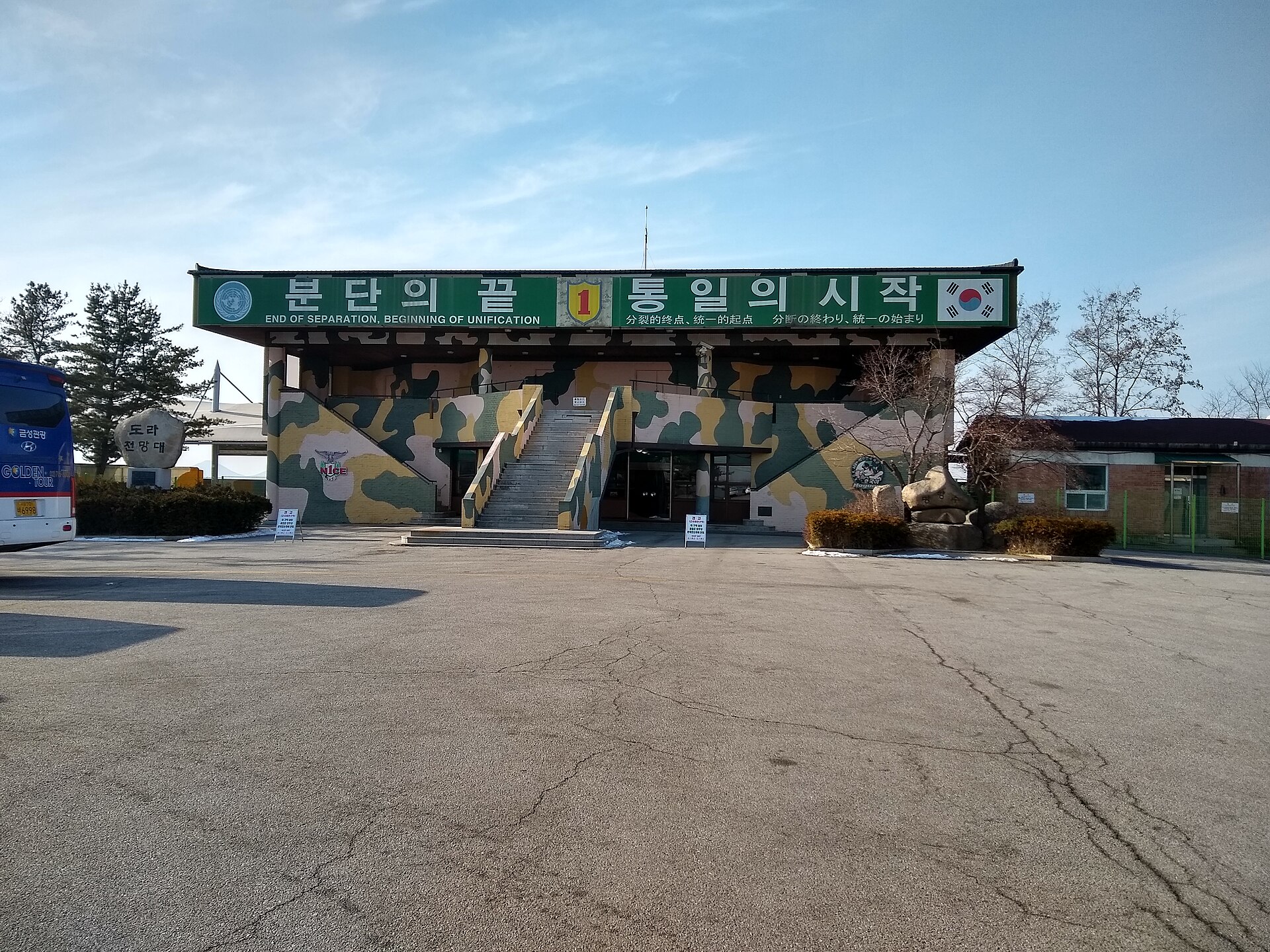
Dora Observatory at the DMZ. Photo by Lance Vanlewen via Wikimedia Commons, CC BY-SA 4.0.
First, untangle three words everyone confuses
This trips up almost everybody, so let’s get it straight up front — I’ve read entire Reddit threads where travelers argue past each other purely because they’re using these interchangeably.
- The DMZ (Demilitarized Zone) is the whole 4-km-wide, 248-km-long buffer strip that separates the two Koreas. This is what you can visit.
- The JSA (Joint Security Area) is one small spot inside the DMZ where the two sides meet face to face — Panmunjom.
- Panmunjom / the “blue buildings” are those famous conference huts straddling the border line, the ones in every documentary.
Here’s the crux: when people say “I want to step into North Korea,” they mean the JSA. When tour companies sell a “DMZ tour” today, they mean the Third Tunnel, an observatory, and a memorial park. Those are two different experiences, and the first one is mostly closed. If you only remember one thing from this article, make it that.
Why the JSA is not the tour you think (a 2026 timeline)
This is the part nearly every English-language guide gets wrong, because they were written years ago and never updated. Here’s the actual sequence of events:
- July 2023 — a U.S. soldier, Private Travis King, bolted across the border line during a regular tourist visit to the JSA. Civilian Panmunjom tours were suspended immediately.
- November 2023 — tours briefly restarted, then stopped again after eight days when North Korea re-armed its guard posts.
- March–May 2025 — after about 18 months of suspension, South Korea announced a limited reopening of Panmunjom.
- October 2025 — tours were paused yet again around a high-profile U.S. presidential visit.
- Late 2025 — and this is the big one: the UN Command redesigned the JSA orientation tour to remove access to the blue conference buildings on the border. Even when it runs, you no longer step across into the northern side.
Put simply: the “walk into North Korea” experience that made Panmunjom famous has effectively been retired for regular tourists. A traveler on r/koreatravel summed up the confusion perfectly last year: “The highlight for a lot of people is stepping into North Korea at Panmunjom, so without that, I’m not sure if it’s just going to feel underwhelming.” That’s the honest question, and the answer is: it depends what you came for.
Korean search interest tracks the same story from the other side. On Naver — the search engine most Koreans actually use — interest in 판문점 (Panmunjom) is event-driven rather than seasonal: it sits quiet for months, then jumps sharply whenever a border incident makes the news, before settling again. Locals follow the JSA’s on-again, off-again status in real time, which is exactly why a tour that’s “running” one week can be paused the next.
As of publication (July 2026), the JSA blue buildings remain closed to general tourists, and any special JSA-inclusive tour runs only a handful of days a month and can be cancelled same-day. JSA status is genuinely fluid — it opens and shuts with the political weather. Always confirm live availability with the operator before you count on it.
If you don’t know the DMZ’s history yet, watch this short English primer before you book — it explains exactly what that mine-strewn, soldier-watched strip is and why it exists, which makes the tour hit far harder when you’re standing at the observatory:
Video: “What is the Korean Demilitarized Zone?” by HISTORY — a clear English explainer of what the DMZ is and how it came to be, embedded from YouTube. Useful background before you stand at the wire yourself.
What you can actually book right now
Good news: the standard DMZ day trip is running normally, and it’s still one of the most singular half-days you can have anywhere on earth. A typical route covers:
- The Third Infiltration Tunnel — one of several attack tunnels North Korea dug under the border (this one found in 1978). You walk down into it. More on that below, because it’s not for everyone.
- Dora Observatory — binoculars pointed north toward Kaesong.
- Imjingak Park / Dorasan — the memorial park and the “last station before North Korea.”
- Many tours add the Majang suspension bridge, a gondola, or — the one I’d pay extra for — a talk by a North Korean defector.
Prices as of mid-2026 run roughly from $40 for a bare-bones half-day up to about $65 for a full option with the defector talk, transport and an English guide included. Treat those as ballpark; rates move with season and exchange rates, so check the live price before booking. If you want the version Reddit consistently raves about, look for a full-day option that bundles the 3rd Tunnel, suspension bridge and a North Korean defector talk; if you just want the essentials, the standard DMZ + 3rd Tunnel half-day is the efficient pick. The one booking mistake to avoid: don’t pay up for a JSA-billed tour expecting to step into North Korea — the blue conference buildings are closed to general tourists as of mid-2026, so that premium and the pre-dawn start buy you a border you can only photograph from a distance, not stand on. You can compare both, with live dates and prices, on Klook’s DMZ tours or GetYourGuide’s DMZ listings. Most of these tours offer free cancellation up to 24 hours out, which matters here because bad-air days can genuinely ruin the observatory.
One thing you cannot do: drive or walk in yourself. The DMZ is an active military control zone, so entry is only by an approved tour on a military-run shuttle, with soldiers checking your passport at the gate. That checkpoint isn’t theater — it’s a real security procedure.
The Third Tunnel: read this before you go down
This is the part tours undersell, and the part I most often hear complaints about afterward. The tunnel involves a steep 5–10 minute walk down an incline, a low ceiling (around 1.5 m in stretches), a mandatory hard hat, and a lung-busting climb back up. If you’re tall, claustrophobic, or have any heart or breathing condition, take this seriously.
The first-hand warnings from travelers are vivid and consistent. One 6’4” visitor on r/koreatravel wrote that walking to the end “was murder as it’s about 5 feet high, not to mention the long walk downhill to even get there.” Another cautioned that “the hard hats are terrible and I gashed my head when I clipped my hat on one of the supports.” If that’s not your idea of fun, no shame — many tours let you wait at the top, and you won’t have missed the scenery, since photography is banned inside anyway.
Which brings me to the biggest expectation-killer: you can’t take photos at the Third Tunnel or Dora Observatory. Only Imjingak park is a free-for-all camera zone. At the observatory you look through the windows, and lately the view can be hazy and quiet — as one traveler noted, North Korean soldiers are rarer at the fence these days. Go on a clear day if you can.
So is it actually worth it?
Honestly, it splits people, and I’d rather you go in clear-eyed than annoyed. The travelers who love it are the ones curious about history and geopolitics. “Just did it two weeks ago. It was a highlight of my trip, even without the JSA visit… I learned a LOT about the Korean War that I really was oblivious to beforehand,” one wrote — a sentiment I’ve heard echoed dozens of times.
The ones who regret it wanted the checklist thrill. “If you are not into history, I would say pass,” wrote one Korean commenter bluntly; another traveler admitted, “I wanted the checklist item… I am not that type of person and was bored. It was a lot of travel.” If that’s you, honestly consider Seoul’s excellent (and free) War Memorial of Korea instead — you’ll learn a surprising amount without the 5 a.m. wake-up.
My take after five years here: if you find the world’s last Cold War frontier fascinating, it’s genuinely unlike anywhere else, and a good guide makes it unforgettable. Which is the whole game.
How to pick a tour that isn’t a dud
Guide quality decides everything here, and reviews can lie. Multiple travelers report tours where the guide “basically asked everyone one by one to leave a 5-star review after the tour was over” — so those glowing ratings aren’t all organic. Read the 3- and 4-star reviews, where the real texture lives, and specifically look for comments praising the guide by name.
A few booking notes I’d give a friend:
- Book 2–3 weeks ahead for weekends and peak season; anything JSA-adjacent needs even more lead time for nationality clearance.
- Bring your physical passport. Not a photocopy, not a phone photo — soldiers check the original at the checkpoint, and no passport means no entry and no refund.
- Pickup is usually near Myeongdong or Hongik University stations. If you’re still sorting accommodation, it’s worth choosing where to stay in Seoul with these pickup points in mind — it saves you a bleary-eyed cross-town cab at dawn.
- Book direct through GetYourGuide or a Korean operator. As one well-upvoted traveler pointed out, Klook is popular but “not even a Korean travel website; it’s based in Hong Kong.” I stick with GetYourGuide’s DMZ listings so I can compare live dates and prices side by side.
Fitting the DMZ into a real Seoul trip
Most standard tours pick up around 7–8 a.m. and drop you back in central Seoul by early-to-mid afternoon — one traveler noted their tour “left at 7 and was back in Seoul by 2,” leaving “plenty of time to check out a palace or two.” (If you do, ask at the palace ticket window for the stamp — Korea runs four separate free stamp-passport programmes and the heritage one covers the Seoul palaces.) That half-day rhythm is exactly why the DMZ slots neatly into a tight itinerary. Once you’ve made it from Incheon Airport into the city and settled in, a single DMZ morning is very doable even on a short trip. Before any of it, check whether you even need K-ETA — most nationalities currently don’t, and make sure you have a working eSIM sorted before the day — tour operators send pickup-point messages and last-minute changes, and you do not want to be hunting for Wi-Fi at 6:45 a.m. And if you’re building a bigger loop, plenty of travelers pair Seoul and the DMZ with a KTX run south — our Busan 3-day itinerary picks up from there.
If you stay out past midnight when the subway closes, return to your hotel cheaply using the Seoul Owl Bus night transit network.
FAQ
Is the JSA / Panmunjom open to tourists in 2026? Largely no. After the 2023 border-crossing incident, JSA tours were suspended, reopened on a limited basis in 2025, and then had access to the border’s blue conference buildings removed in the late-2025 redesign. As of July 2026, general tourists cannot step into the northern side, and any JSA-inclusive tour runs rarely and can be cancelled with no notice. Confirm live status with the operator before assuming it’s on.
What’s the shortest DMZ tour if I only have 2–3 days in Seoul? Go for a standard half-day tour: most pick up around 7 a.m. and return by early afternoon, so you still get a full sightseeing evening. A standard DMZ + 3rd Tunnel half-day — easy to compare on Klook or GetYourGuide — is a good efficient option, putting you back in the city with time for a palace or a market.
Can I visit the DMZ on my own, without a tour? No. The core DMZ sites sit inside a military control zone reachable only by approved tour buses with passport checks. If you specifically want a do-it-yourself, transit-friendly alternative, the free Odusan Unification Observatory lets you look across the border on your own schedule — but it’s a very different, lower-key experience than a guided DMZ day.
Written by Yongwoo, a Seoul-based writer covering Korea travel for newcomers. Tour access and prices change frequently — always confirm current availability and rates with the operator before booking.
Planning Your Korea Trip? Compare Your Options
Compare transport, mobile data, and attraction options. Prices and eligibility depend on your selected date and package.
AREX Incheon ↔ Seoul Express
Express train between Incheon Airport and Seoul Station. Follow the selected voucher’s seat reservation and redemption instructions.
Check AREX Express Tickets →Korea eSIM Options
Compare Korea eSIM search results. Check data allowance, supported network, device compatibility, activation, and speed limits.
Compare Korea eSIM Options →WOWPASS Card (Pay + T-Money)
Compare WOWPASS and T-money. Payment and transit balances are separate; check issuance, top-up, exchange, and withdrawal fees.
Read WOWPASS vs T-money →Top Seoul Passes & Day Tours
Browse general Seoul activity search results. This is not a guaranteed-entry pass or a fixed-discount offer; check each product’s inclusions.
Browse Seoul Activity Options →Sources
- https://en.wikipedia.org/wiki/Travis_King
- https://www.nknews.org/2025/05/south-korea-resumes-limited-tours-to-panmunjom-after-18-month-suspension/
- https://www.stripes.com/theaters/asia_pacific/2025-10-21/jsa-dmz-tours-trump-south-korea-19493571.html
- https://www.stripes.com/theaters/asia_pacific/2025-03-19/south-korea-dmz-jsa-tours-17192509.html
- https://www.getyourguide.com/korean-demilitarized-zone-l89058/
Search-trend data from Google Trends (KR) and Naver DataLab. This article is independent commentary and is not affiliated with any broadcaster, agency, or the individuals mentioned.
,_South_Korea.jpg)