K-Culture
Amal Clooney Eats Korea's 'Birthday Soup' for Breakfast — Here's What Miyeok-guk Actually Means to Koreans
The payoff Reading 'Amal Clooney's bizarre seaweed breakfast' headlines like everyone else → being the one at the table who explains why that bowl means birth, birthdays and mothers in Korea — and knowing exactly which day to never order it.
📈 Trend signal: Daily Mail's 2026-07-23 piece naming miyeok-guk as Amal Clooney's daily breakfast ricocheted through Korean portals within days (Naver lifestyle sections picked it up by 07-27), spiking global searches for 'Korean seaweed soup' — while English coverage skips everything the soup actually means in Korea
Last week the Daily Mail ran a piece on Amal Clooney’s diet and dropped one detail that made half the English-speaking internet go “…seaweed soup? For breakfast?” — she reportedly starts every day with a bowl of miyeok-guk, Korea’s brown-seaweed soup (Daily Mail). Vogue had already confirmed the seaweed habit back in 2023 (Vogue).
Korean news portals picked the story up within days, and I want you to understand why we reacted so differently. Western outlets filed it under bizarre celebrity wellness. Koreans read the exact same headline and felt something closer to warmth — because in Korea, that bowl isn’t a superfood trend. It’s the most sentimental dish we have. I’ve eaten it on every birthday of my life, and my mother ate it for weeks after I was born. Let me explain.
First, what miyeok-guk actually is
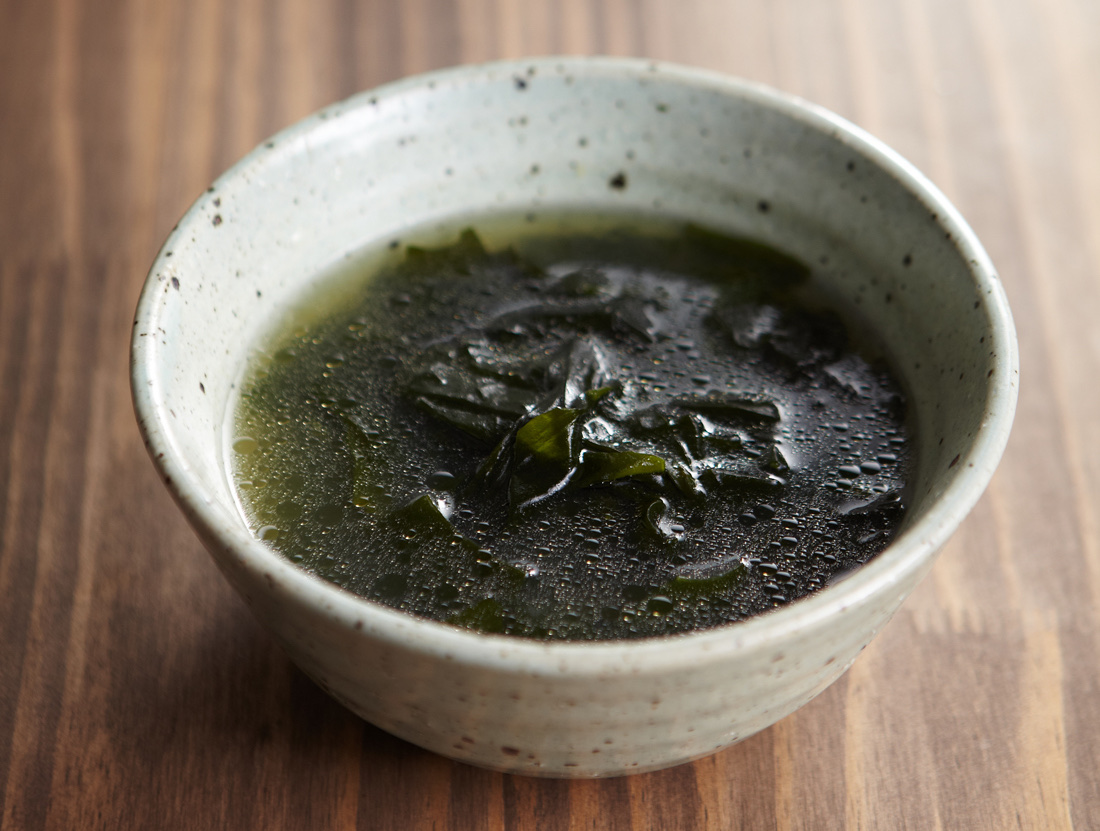
Miyeok-guk (미역국) is a clear, savory soup of miyeok — the brown seaweed English speakers usually call wakame — simmered with sesame oil and garlic, most commonly with slices of beef brisket, or on the coast with mussels or croaker. It tastes like the ocean rounded off with toasted sesame: gentle, briny, deeply comforting. Nothing about it is exotic to us; it’s the taste of home kitchens, hospital meal trays and birthday mornings.
One honest note, since I promised you accuracy: the “recipe” floating around the celebrity coverage — seaweed in a blended celery-cucumber-apple broth — is a Western wellness remix, not miyeok-guk. A Korean bowl is savory, garlicky and hot, never juiced. If you make the tabloid version and hate it, you haven’t tasted the real thing.
Meaning #1 — the birth soup
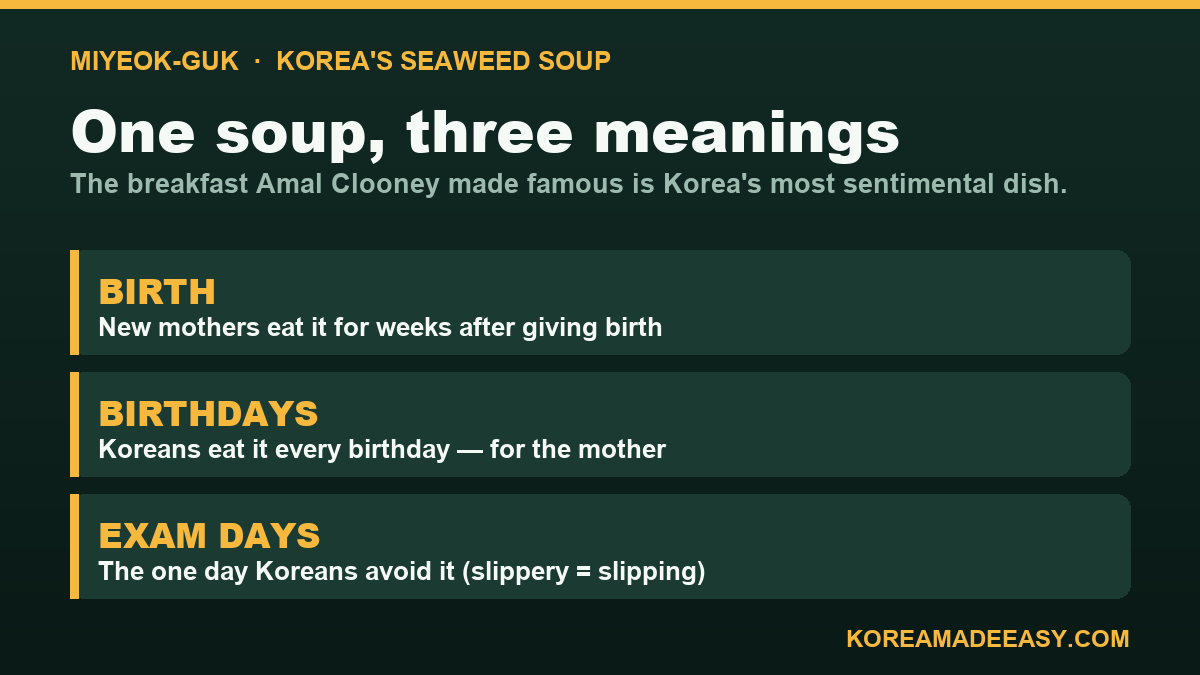
In Korea, a new mother’s first meal after giving birth is almost always miyeok-guk, and she’ll keep eating it — often two or three times a day — for weeks postpartum. The tradition is centuries old and surprisingly practical: seaweed is rich in iodine, calcium and iron, exactly what a recovering, breastfeeding mother needs. Hospitals and postpartum care centers (sanhujoriwon) serve it as a matter of course.
So when a Korean hears “she eats miyeok-guk every morning,” the mental image isn’t a biohacking celebrity. It’s our mothers. That’s the warmth Western coverage completely missed.
Meaning #2 — why it’s the “birthday soup”
Here’s the part I find genuinely beautiful. Koreans eat miyeok-guk on their birthday — not as a treat for ourselves, but as a quiet act of remembering. The logic: your mother ate this soup while she recovered from bringing you into the world, so on the day you were born, you eat it too. The birthday bowl honors her labor, not your cake.
It runs so deep that the standard birthday-morning text between Korean friends is “미역국 먹었어?” — “Did you eat your seaweed soup?” It functions exactly like our “have you eaten?” greeting (which is its own story): the words are about soup, the meaning is you are loved and remembered. Forgetting to eat it feels vaguely like skipping your own birthday; plenty of Koreans living abroad make a lonely little pot of it just to keep the ritual.
Meaning #3 — the one day you must NOT eat it
Now the fun inversion. Before a big exam — especially the suneung, Korea’s famously brutal college entrance test — miyeok-guk is taboo. Seaweed is slippery, and in Korean the verb for slipping (미끄러지다) doubles as slang for failing an exam. Serving a student seaweed soup on test morning reads like wishing them a faceplant. Superstitious? Completely. Followed anyway? Almost universally — the same way test-day families hand out sticky taffy (yeot) so the pass will “stick.”
So the etiquette map looks like this:
| Occasion | Miyeok-guk? | Why |
|---|---|---|
| Birthday morning | Absolutely — the whole point | Honors your mother |
| After giving birth | Daily, for weeks | Recovery tradition + nutrition |
| Any random Tuesday | Of course — it’s everyday food | It’s delicious and cheap |
| Day before/of an exam or interview | Never | Slippery soup = slipping the test |
Is it actually healthy, or is this celebrity fluff?
The nutrition case is real, if less magical than the headlines: miyeok is one of the better natural sources of iodine (thyroid function), with meaningful calcium, iron and fiber for very few calories. That’s why the postpartum tradition has survived modern medicine largely intact. One caveat your doctor would want me to add: iodine is a “right amount” nutrient — a daily Amal-sized habit is fine for most people, but it’s not a case where ten bowls beat one.
How to actually try it in Korea

- Cheapest: virtually any gukbap or home-style diner (baekban place) serves it — often ₩7,000–9,000 with rice and side dishes, or free as a side at bunsik joints.
- Best versions: look for sagol miyeok-guk (beef-bone broth) specialty shops in Seoul, or mussel/sea-urchin miyeok-guk down on the coast — Busan does glorious seafood versions (my Busan food list pairs well here).
- Convenience hack: every Korean supermarket and convenience store sells instant miyeok-guk pouches for about ₩1,500–3,000 — a genuinely good souvenir that survives any suitcase.
- Say it right: mee-yeok-gook, and if a Korean friend’s birthday comes around, deploy “미역국 먹었어?” — then watch their face light up. (For more of these small-words-big-meaning moments, my oppa and Korean honorifics guide is the same energy.)
FAQ
What is the seaweed soup Amal Clooney eats for breakfast? Per the Daily Mail’s July 2026 report, it’s miyeok-guk — Korean brown-seaweed (wakame) soup traditionally made with sesame oil and garlic. Note the claim traces to celebrity reporting (“is said to”), though Vogue independently confirmed her daily seaweed habit in 2023.
Why do Koreans eat seaweed soup on their birthday? Because mothers eat miyeok-guk while recovering after childbirth, eating it on your birthday honors your mother’s labor on the day you were born. It’s less “birthday treat” and more quiet gratitude ritual — and skipping it feels genuinely wrong to many Koreans.
Why can’t you eat seaweed soup before an exam in Korea? Superstition: seaweed is slippery, and “slipping” (미끄러지다) is Korean slang for failing a test. Students avoid it before big exams — especially the college entrance exam — and eat sticky foods like taffy instead, so success “sticks.”
Does miyeok-guk taste fishy? Barely. Good miyeok-guk is gentle and savory — soft seaweed, garlicky sesame-scented broth, usually beef. It’s one of the most beginner-friendly Korean soups; if you can enjoy miso soup, this is an easy step, not a dare.
Can I make miyeok-guk at home outside Korea? Easily. Dried miyeok/wakame is in any Korean or Japanese grocery (and online): soak a handful, sauté briefly with sesame oil, garlic and sliced beef, add water or broth, season with soup soy sauce, simmer 20 minutes. Skip the celebrity “juiced celery broth” version — that’s not the dish.
Celebrity diet details come from the cited reporting and include “reportedly” for a reason — the cultural half of this guide is simply how I’ve lived every birthday of my life.
Photo credits: miyeok-guk bowl by the National Institute of Korean Language (CC BY-SA 2.0 KR); stone-pot beef miyeok-guk by 대경라이프 (CC BY-SA 4.0), both via Wikimedia Commons.


Planning Your Korea Trip? Don't Pay Full Price! ✨
Save $20–$50 per person with our verified reader perks & skip the long ticket booth queues:
AREX Incheon ↔ Seoul Express
Non-stop 43-min direct train with guaranteed reserved seats & free Wi-Fi. Scan your mobile QR straight at the gate!
Get 20% Off AREX Ticket →Korea Unlimited 5G eSIM
Skip the 30-min airport counter line. Scan the QR code to connect instantly for smooth Naver Maps navigation.
Get Instant eSIM QR (From $2.80) →WOWPASS Card (Pay + T-Money)
Pay anywhere in Korea with zero FX fees + subway card. Use code KOREAEASY for 0.5% cash top-up bonus!
Top Seoul Passes & Day Tours
Guaranteed entry for Lotte World, Nami Island tours, CIMER Spa, and Hanbok palace rentals with instant mobile vouchers.
Browse Top Seoul Deals →Sources
- https://www.dailymail.com/tvshowbiz/article-15999857/Amal-Clooney-diet-fitness-regime-seaweed-soup.html
- https://www.vogue.com/article/amal-clooney-diet-breakfast
- https://www.hellomagazine.com/cuisine/828286/amal-clooney-will-divide-opinion-breakfast-helps-curb-cravings/
Search-trend data from Google Trends (KR) and Naver DataLab. This article is independent commentary and is not affiliated with any broadcaster, agency, or the individuals mentioned.

Korea Duty-Free Shopping Guide 2026: Airport vs Downtown Duty-Free vs Instant Tax Refund
Korean Cafe Etiquette 2026: The 1-Drink-Per-Person Rule, 2-Hour Laptop Limits & Rooftop Secrets in Seoul