K-Culture
Why Koreans Say 'Did You Eat?' Instead of 'I Love You'
The payoff Reading 'Did you eat?' in your subtitles as flat small talk and missing why the scene suddenly feels heavy → hearing 밥 먹었어? for what it really is — I love you, said in the only language the family speaks — and knowing how to say it back.
📈 Trend signal: K-drama & Korean-learner search demand 2026 (did you eat / 밥 먹었어 / jeong)
I’m going to tell you something that took me twenty-something years and one confused American roommate to fully understand: no one in my family has ever said “I love you” out loud. Not my mom, not my dad, not my grandmother. Not once that I can remember.
And yet I have never, for one second, doubted that they love me. Because they told me — constantly, daily, obsessively — in the only language my family speaks fluently: food.
If you watch K-dramas or you’re learning Korean, you’ve probably noticed this weird thing where characters ask “밥 먹었어?” — “Did you eat?” — at moments that clearly aren’t about food. A mother says it to a grown son who just got dumped. A cold male lead texts it to the woman he can’t admit he likes. It sounds like small talk. It is absolutely not small talk. So let me, as an actual Korean who grew up drowning in this, translate what’s really being said.
The phrase your K-drama keeps mistranslating
밥 먹었어? · bap meogeosseo? · literally: “Did you eat rice?”
Here’s the first thing to understand. In Korean, 밥 (bap) technically means “cooked rice,” but it really means “a meal,” which really means “are you okay, are you taken care of, is someone looking after you.” The word does a lot of quiet work.
So when your subtitles say “Did you eat?” and the scene feels oddly heavy, it’s because the line was never a question about digestion. It’s a status check on your entire wellbeing, disguised as a question about lunch. The English subtitle is correct word-for-word and completely wrong in spirit.
I once counted, half as a joke, the number of ways the people in my life tell me they love me. I got to 47 phrases. Zero of them contain the word “love.” All of them contain rice. Let me walk you through the greatest hits.
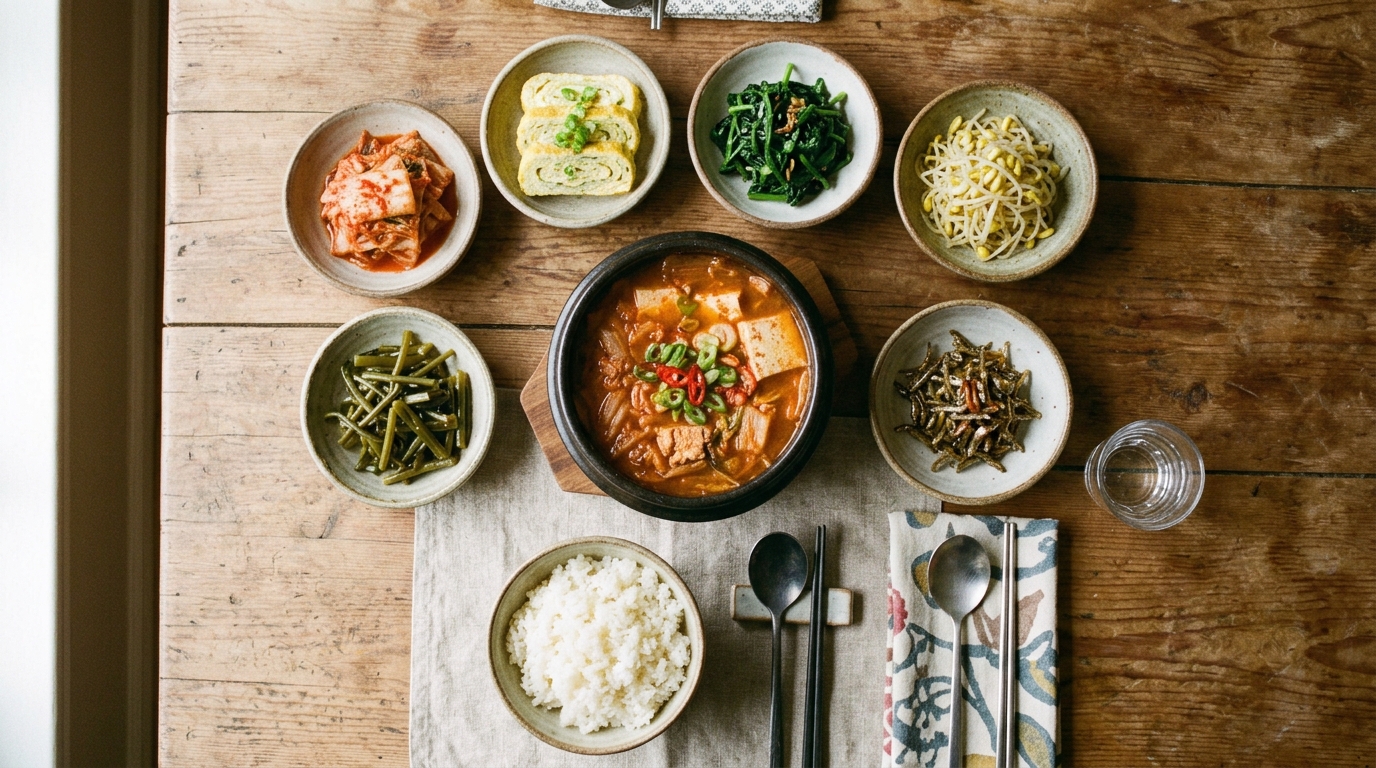
In Korea, a full table like this — rice, a bubbling stew, and a spread of banchan — is often how care gets said out loud, without the word “love” ever coming up.
밥 먹었어? — my mother’s 11 p.m. text
Every night, without fail, my phone lights up around 11 p.m. with the same three characters from my mom: 밥 먹었어?
She knows I ate. I’m an adult. I feed myself. That is not the point. The text is not requesting information — it’s her reaching across the city to put a hand on my shoulder in the only way she knows how. If I answer “응, 먹었어” (“yeah, I ate”), she’s satisfied. If I make the mistake of typing “아니 아직” (“no, not yet”), I will receive a phone call, a lecture, and possibly a delivery.
When my mother texts 밥 먹었어?, the actual translation is: “You’ve been on my mind all day and I need to know you’re alright before I can sleep.” That’s the whole message. It just came wearing a bowl of rice as a disguise.
밥은 먹고 다니냐 — my father, who has never hugged me
밥은 먹고 다니냐 · bab-eun meokgo daninya · “Are you eating, out there?”
My dad is a man of roughly nine words per week. He has never said 사랑해 (saranghae), “I love you,” and I would probably faint if he did. What he says instead, gruffly, not quite looking at me, when I visit home and I’m about to leave, is: “밥은 먹고 다니냐.”
Roughly: “Are you eating properly out there in the world?” But the 은 (eun) particle in there adds this specific worried weight — out there, away from us, on your own. It’s the sentence a Korean father reaches for when “I worry about you, I hope the world is treating you well, I wish I could still take care of you” is far too much to ever say.
There’s a famous Korean film line — “밥은 먹고 다니냐?” — that gutted an entire country precisely because every Korean instantly recognized it as the sound of buried love. My dad says it in the doorway. I say “어, 먹고 다녀” (“yeah, I’m eating”). We both know exactly what just happened, and neither of us will ever mention it.
밥 챙겨 먹어 — the one a lover says
밥 챙겨 먹어 · bap chaenggyeo meogeo · “Make sure you eat / take care of yourself with food.”
Now the romantic one, because this is the one the K-drama fans are really here for. Between couples, the phrase upgrades slightly. 챙겨 (chaenggyeo) means “to look after, to take care of, to make sure you don’t skip it.” So 밥 챙겨 먹어 is not “did you eat” — it’s a soft command: “promise me you’ll take care of yourself when I’m not there to do it.”
This is why a Korean love interest who has never once said saranghae will text 밥 챙겨 먹었어? at midnight and Korean viewers scream. Because in our emotional grammar, that IS the confession. Caring whether you ate is caring whether you live. The cold chaebol heir who gruffly mutters “밥은 먹었어?” to the heroine has, by our standards, basically gotten down on one knee.
If you’ve been trying to figure out why your Korean partner keeps asking about your meals like a very concerned nutritionist — that’s it. That’s the love. You’re being loved right now.
얼른 밥 무라 — my grandmother’s whole vocabulary
얼른 밥 무라 · eolleun bap mura · “Hurry up and eat” (Gyeongsang dialect)
My grandmother is from the Gyeongsang region in the south, where 먹어라 (meogeora), “eat,” becomes the blunter, warmer 무라 (mura). And I swear this phrase was 80% of everything she ever said to me. “얼른 밥 무라.” Hurry up and eat. Sit down and eat. Eat more. Why aren’t you eating. Eat this too.
To an outsider it sounds like nagging. To me it was a love so total it could only fit into imperatives about food. My grandmother lived through a war and a hunger most of us can’t imagine, and for her generation, making sure the people you love are fed wasn’t a chore — it was the highest form of devotion available. Feeding you was how she said everything she couldn’t. When she pushed one more spoonful of rice into my bowl that was already overflowing, that was I love you, repeated until it stuck.
So what’s actually going on? Meet 정 (jeong)
Here’s the cultural engine under all of this: a concept called 정 (jeong).
Jeong is famously untranslatable, but the closest I can get is: a deep, sticky, almost involuntary bond of affection and attachment that builds up between people (and even places) over time. It’s not the fireworks of romantic love. It’s the slow, warm accumulation of having taken care of each other. You build jeong with your family, your old friends, the ajumma at the restaurant you’ve gone to for ten years.
And the number-one way Koreans express jeong is — you guessed it — through food. Feeding someone, worrying about whether they’ve eaten, pushing side dishes toward them, refusing to let them leave hungry: this is the physical language of jeong. It’s why a Korean grandmother’s greatest weapon is a full table, why “did you eat?” replaces “how are you?” as the default greeting, and why we simply do not need to say saranghae very often. We’re saying it in rice, three times a day.
Once you understand jeong, Korean culture stops looking emotionally reserved and starts looking like one of the most quietly affectionate cultures on earth. We’re not cold. We’re just saying “I love you” in a code that happens to be edible.
Want to actually understand what your Korean family (or K-drama) means when they ask if you ate? KoreanClass101 has short, native-audio lessons built exactly around this kind of real, between-the-lines Korean — the stuff textbooks skip.
Why “I love you” (사랑해) feels almost too big to say
To be clear: Koreans do say saranghae (사랑해). Couples say it. Parents say it to little kids. It’s in every K-pop song. But in everyday adult family life, saying it out loud can feel strangely heavy, almost embarrassingly direct — like turning on all the lights in a room where everyone had a quiet, comfortable understanding in the dark.
The food phrases do the emotional work without the exposure. My dad will never say saranghae because it would require both of us to acknowledge, out loud, the enormous thing we usually keep politely wrapped in a question about lunch. “밥은 먹고 다니냐” lets him love me while both of us keep our dignity. That’s not repression — it’s a whole different design for intimacy, one where the deepest feelings travel through the smallest, safest words.
If this dynamic — big feelings hidden inside tiny everyday words — fascinates you, it’s the exact same reason a single word like oppa can carry a hidden confession. I broke down that whole tonal game in what does oppa mean: Korean honorifics explained, and it pairs perfectly with this one.
How to actually respond (a mini survival guide)
If a Korean person asks you 밥 먹었어?, here’s how not to fumble the moment:
- If you’re fine: 네, 먹었어요 (ne, meogeosseoyo) — “Yes, I ate.” Polite, warm, done. You’ve reassured them.
- To warm it up: ask it back. “밥 드셨어요?” (“Have you eaten?”) returns the care, and returning care is the whole point of jeong.
- If you want to melt a Korean parent or grandparent: tell them what you ate, in detail. Nothing signals “I am safe and thriving” like “네, 김치찌개 먹었어요” (“yes, I had kimchi stew”). They will be so happy.
- The one wrong answer: a flat “no.” Unless you enjoy being fed against your will, do not tell a Korean elder you haven’t eaten. You have been warned.
And if you ever visit and someone’s grandmother pushes a mountain of food at you saying “많이 먹어” (“eat a lot”) — you’re not being pressured. You’re being adopted.
Get my free Korean slang cheat sheet → One printable page covering these food-love phrases plus the everyday expressions your subtitles quietly skip. Grab it here.
The takeaway
Somewhere out there, right now, a Korean mom is typing 밥 먹었어? to a kid who’s perfectly capable of feeding themselves. It looks like a question about dinner. It is, in fact, an “I love you” that has been traveling in disguise for a thousand years, because in Korean culture, love was never something you said — it was something you fed someone.
So the next time a K-drama character asks “did you eat?” and the music swells for no obvious reason, you’ll finally know: that’s not small talk. That’s the biggest thing they know how to say. (Speaking of which — have you eaten? I mean it.)
If you want more of this real, family-table Korea, our Busan food guide is basically jeong you can taste — full of the exact meals these phrases are protecting.
FAQ
What does “밥 먹었어?” (did you eat?) really mean in Korean? Literally it means “Did you eat rice?”, but it functions as a caring greeting closer to “Are you okay / are you taken care of?” Koreans use it the way English speakers use “How are you?” — it’s a check-in on your wellbeing, not really about food.
Why do Koreans ask if you’ve eaten instead of saying I love you? Because of a cultural concept called jeong (정) — a deep bond expressed through caretaking, especially food. Making sure someone has eaten is the everyday, low-pressure way Koreans show love, so “did you eat?” often carries the emotional weight that “I love you” would in English.
Do Koreans actually say “I love you” (사랑해)? Yes — couples, and parents to young children, do say saranghae (사랑해). But in everyday adult family life it can feel very direct or heavy, so many families express love indirectly through food phrases and constant caretaking instead.
What is jeong (정) in Korean culture? Jeong is a hard-to-translate word for the deep, sticky affection and attachment that builds between people over time through shared care. It’s less about romantic passion and more about the warm bond of having looked after each other — and food is its main love language.
How should I answer when a Korean person asks “밥 먹었어?” Say 네, 먹었어요 (“yes, I ate”) to reassure them, and ideally ask it back — “밥 드셨어요?” (“have you eaten?”) — to return the care. Bonus points for naming what you ate. Just don’t tell a Korean elder you haven’t eaten unless you want to be fed immediately.
Loved this little window into how Koreans really talk? That’s the whole vibe of @seoulreactions on Instagram — follow for daily Korean you’ll actually understand, one addictive clip at a time.
Sources
- https://en.wikipedia.org/wiki/Jeong_(Korean_culture)
- https://www.90daykorean.com/have-you-eaten-in-korean/
- https://www.koreanclass101.com/
Search-trend data from Google Trends (KR) and Naver DataLab. This article is independent commentary and is not affiliated with any broadcaster, agency, or the individuals mentioned.