Travel
What to Eat in Busan: 8 Dishes Locals Actually Order (and the One Noodle Bowl Born From a War)
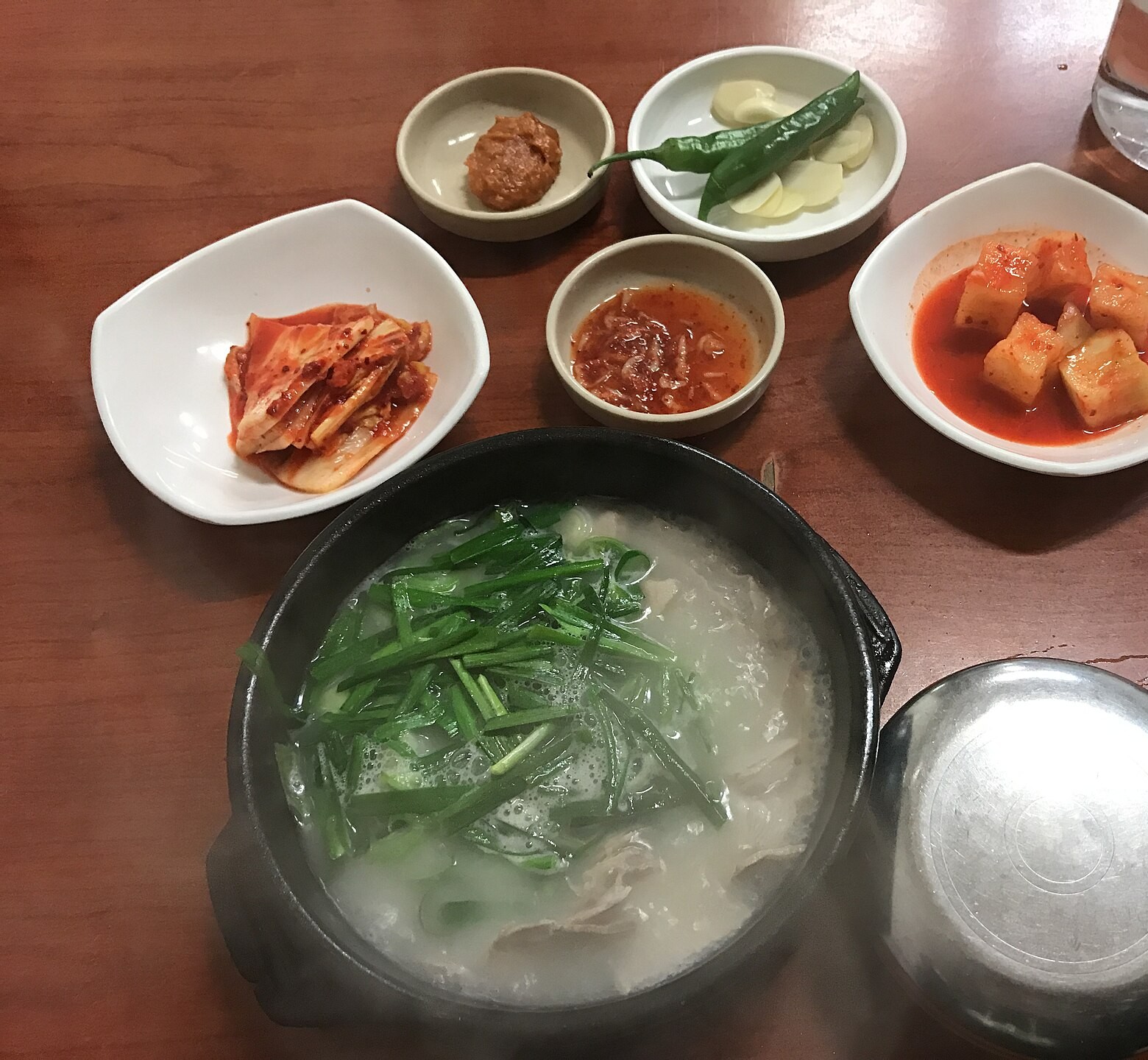
The payoff Pointing blindly at a menu and quietly bracing to be overcharged at the fish market → ordering the eight dishes locals actually eat, from a ₩8,000 dwaeji gukbap to Jagalchi flounder, knowing the fair price of each.
Research context: Busan food / what to eat in Busan search + Pinterest demand 2026
I’ve lived in Seoul for five years, and whenever friends ask me where in Korea they should actually eat, my answer is the same: get on the KTX and go to Busan. Seoul is where you eat fashionable food; Busan is where you eat food with a story, at prices that still make sense. This is the guide I wish someone had handed me before my first trip down — what locals order, what it really costs in 2026, and how to not get quietly overcharged at the fish market.
Quick note before we start: our own readers voted for this post without knowing it. Busan is by far the most-saved Korea destination among people who follow us — our Busan travel pin has pulled roughly ten times the saves of anything else we’ve published. So if you’re here trying to figure out what to eat, you’re in very good company.
This post contains affiliate links. If you book a tour through one, I may earn a small commission at no extra cost to you.
Still deciding the shape of the whole trip? My Busan travel guide for first-timers covers how to get there, how many days, where to base yourself and what it all costs.
Dwaeji gukbap: the bowl Busan is built on
If you eat one thing in Busan, make it dwaeji gukbap (돼지국밥) — pork-and-rice soup. It’s a milky pork-bone broth simmered for hours until it turns white and rich, poured over sliced boiled pork and rice. It arrives fairly plain on purpose: you season it yourself at the table with saeujeot (salted shrimp) for salt, buchu (raw chives) for bite, and a spoon of gochujang if you want heat. That first bowl is a rite of passage. (If soup is your way into Korean food, the other one worth knowing is miyeok-guk, the seaweed soup Koreans eat on their birthday — a different kind of rite entirely.)
Head to Seomyeon’s “Dwaeji Gukbap Alley” (돼지국밥 골목), a cluster of shops that have been doing one thing for decades. A bowl runs about ₩8,000–12,000 (US$6–9) — a full, hot, protein-heavy meal for the price of a coffee-and-pastry in Seoul.
Redditors don’t hold back about this one. On r/KoreanFood, one poster wrote: “First time in my life that I go to the same restaurant, 3 times in a week, ordering the same dish… It’s that good! The broth is both rich and light at the same time.” Another summed up a Busan food crawl with: “famous pork soup! not a drop was left.” Honest newcomer warning, though — the pork-bone funk is polarizing. You’ll either fall for it hard or find it “too porky.” There’s rarely a middle.
Milmyeon: the noodle born from a war
Here’s the dish nobody explains, and the reason Busan food tastes like history. Milmyeon (밀면) is a cold bowl of springy wheat-and-potato-starch noodles in chilled beef-and-pork-bone broth (mul-milmyeon), or tossed in a sweet-spicy sauce (bibim-milmyeon). It’s the chewier, cheaper cousin of naengmyeon, and it’s Busan’s summer soul food at about ₩7,000–10,000 a bowl.
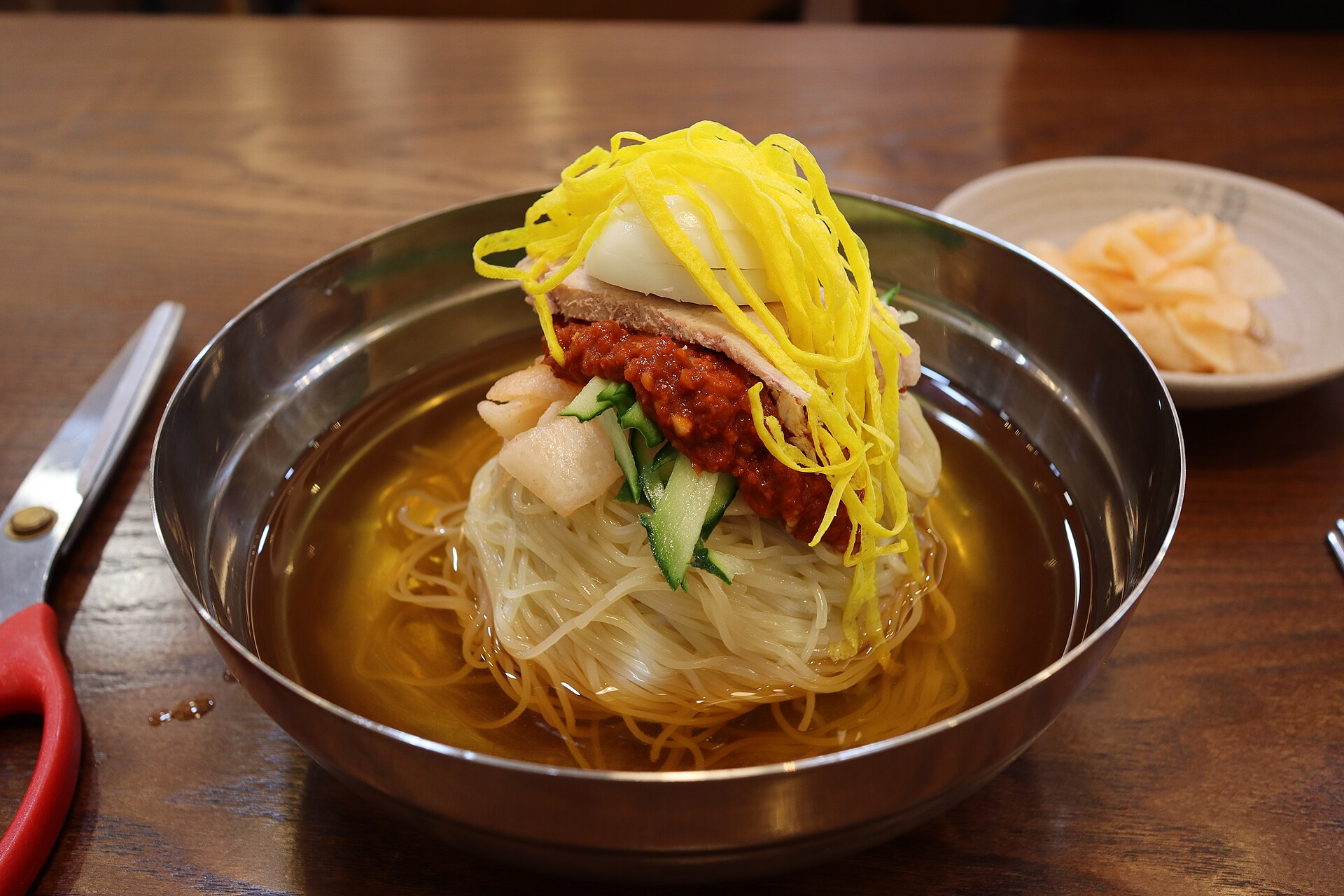
Busan milmyeon (cold wheat noodles). Photo by Mobius6 via Wikimedia Commons, CC BY-SA 4.0.

But why does it only exist here? During the Korean War (1950–53), Busan was the country’s temporary capital, and hundreds of thousands of refugees from the North poured in. They ached for the buckwheat naengmyeon of Pyongyang and Hamgyong — but buckwheat was scarce in wartime Busan. What was available, in sacks, was cheap wheat flour handed out as U.S. Army food aid. So they swapped it in. “Mil” means wheat; “myeon” means noodle. Milmyeon is, quite literally, a bowl of homesickness improvised from what an occupying army left behind. No English food listicle bothers to tell you that, and it’s exactly why the dish still means something to older Busanites. Naeho Naengmyeon is widely cited as its birthplace.
Eat a bowl knowing that story and it stops being “cold noodles” and becomes the most Busan thing on the table.
Jagalchi Market: how to eat raw fish without getting fleeced
Jagalchi (자갈치시장) is Korea’s biggest fish market, right on the waterfront by Nampo-dong, and it runs on a system that surprises every first-timer: buy downstairs, eat upstairs. You pick a live fish from the tanks on the ground floor, then carry it to a second-floor restaurant that preps and plates it for you.
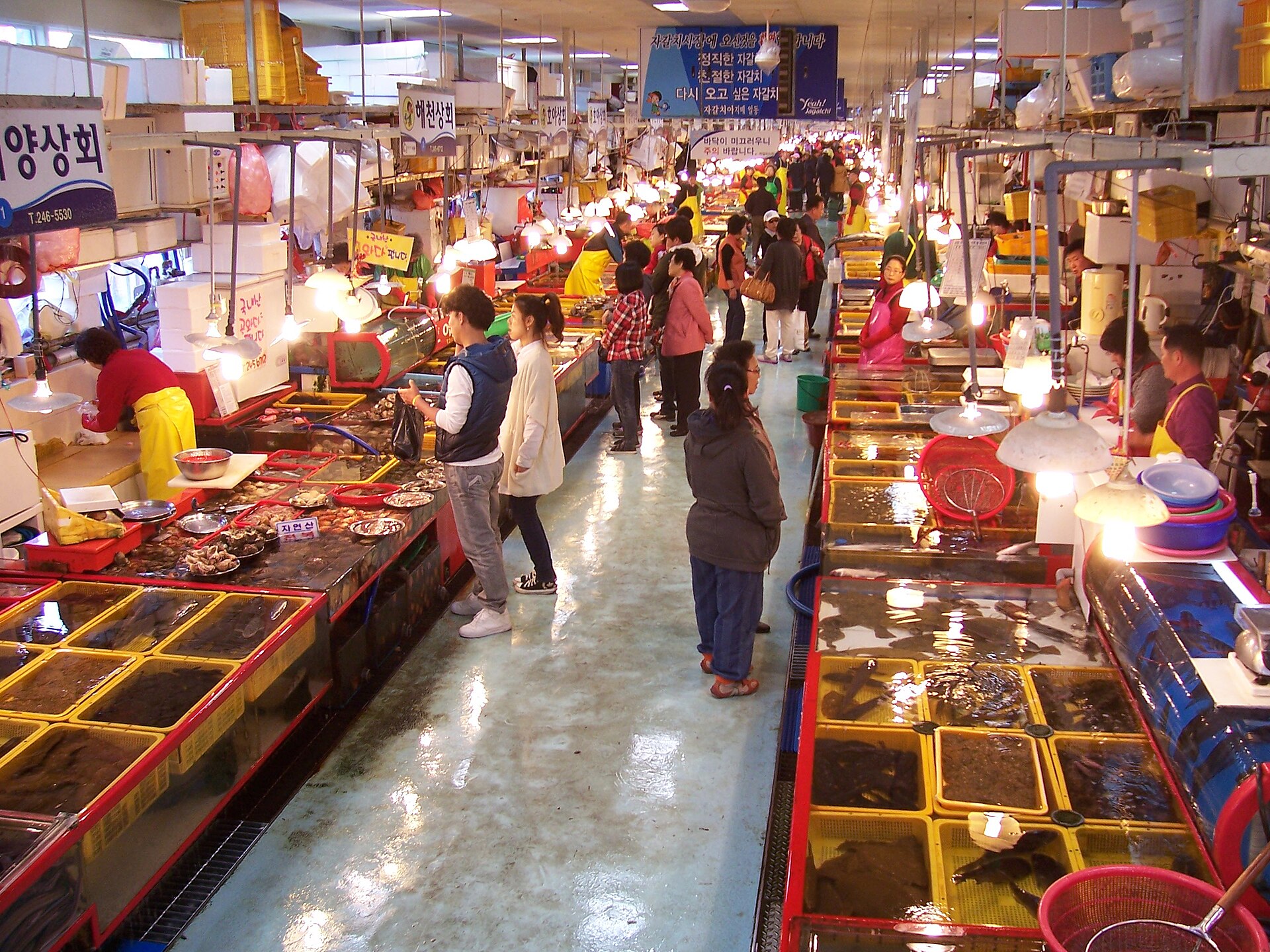
Inside Jagalchi Fish Market, Busan. Photo by Weli’mi’nakwan via Wikimedia Commons, CC BY 2.0.

A few things that will save you money and stress:
- Agree the price before they scoop the fish. This is the single most important rule. Point, ask “얼마예요?” (eol-ma-ye-yo, “how much?”), and get a number first.
- The safe, affordable picks are flounder (gwang-eo) and rockfish (u-reok) — a raw-fish platter runs about ₩30,000–40,000.
- Expect a table-setting fee (sang-charim) of ₩5,000–6,000 per person upstairs. This is normal in 2026, not a scam — it covers all the side dishes.
- Bring cash. Many stalls still don’t love cards. Wear closed-toe shoes (wet floors), and come between 5–10 AM for the freshest catch.
One thing to understand about Korean hoe (회): it isn’t Japanese sashimi. It’s cut and eaten almost immediately for a firm, springy chew rather than the buttery melt of aged fish. Different goal, different pleasure.
And if you’re feeling brave, Jagalchi is also where you’ll find san-nakji (산낙지) — live octopus, cut and served with the pieces still wriggling, dipped in sesame oil and salt. Reddit is genuinely split on it. The fans: “Yess!!! Love 산낙지 san nak ji!!!” and “Super yummy. Hardest part is getting it off the plate (sometimes the suction cups don’t want to let go).” The skeptics: “Personally always thought this type of dish is really inhumane.” My honest advice: chew thoroughly and don’t rush it — the still-active suction cups are a real (small) choking risk.
If you’d rather have a local do the ordering, translating, and price-negotiating for you, a guided market crawl is the low-stress option:
👉 Book the Gukje & Jagalchi Market Food Tour on GetYourGuide — about 2.5 hours, hits the exact dishes in this post.
Ssiat hotteok: the ₩2,000 icon of BIFF Square
Walk two minutes from Jagalchi Station to BIFF Square in Nampo-dong and you’ll smell it before you see it: ssiat hotteok (씨앗호떡), Busan’s own take on the sweet fried pancake. It’s slit open and stuffed with a mix of sunflower, pumpkin and sesame seeds, pine nuts, and molten brown-sugar syrup. The seeds soak up the syrup, so it’s less greasy than the mainland version — crispy outside, nutty and warm inside. The original stall has been on Korean TV shows like Running Man and draws long lines by evening.
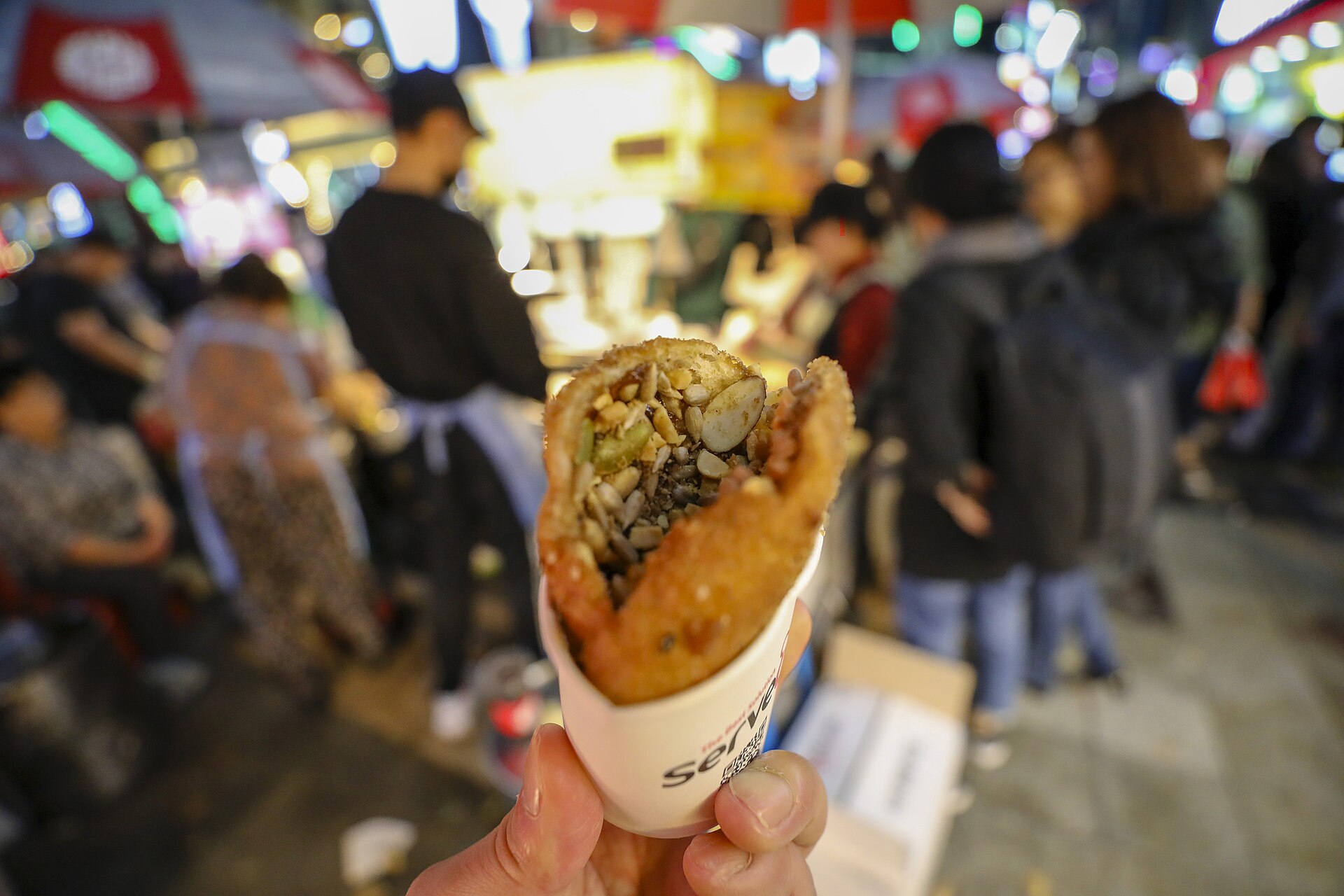
Ssiat-hotteok, a Busan street-food staple. Photo by bryan via Wikimedia Commons, CC BY-SA 2.0.

Price: about ₩1,500–2,000 a piece. It’s still the cheapest “wow” bite in the city, though be aware — BIFF Square and nearby Gukje Market street-food prices have crept up as Busan dining costs rose over 5% in the past year. It’s cheap, not free-fall cheap anymore.
Busan fish cake and the market snacks worth a detour
Busan eomuk (어묵) — fish cake — is considered the best in Korea, thicker and richer than what you get elsewhere. Grab a skewer from a hot broth pot for ₩1,000–2,000, or hit a flagship like Samjin Eomuk (est. 1953, Busan’s oldest maker), which also has a big grab-and-go outlet inside Busan Station — perfect for stocking up before your KTX home. For a lighter market snack, look for bibim dangmyeon (비빔당면): cold, chewy glass noodles tossed with seaweed and a mild-spicy sauce, around ₩3,000–5,000.
When the sun goes down, Bupyeong Kkangtong Night Market near Nampo-dong is the best street-food crawl in the city — younger crowd, everything from tornado potatoes to fusion bites. It’s the ideal place to graze if you couldn’t decide on one dish.
What Busan food actually costs in 2026
| Dish | Where | Approx. 2026 price |
|---|---|---|
| Dwaeji gukbap (pork soup) | Seomyeon | ₩8,000–12,000 |
| Milmyeon (cold noodles) | Seomyeon / Gwangan | ₩7,000–10,000 |
| Flounder/rockfish hoe platter | Jagalchi | ₩30,000–40,000 |
| Table-setting fee (per person) | Jagalchi upstairs | ₩5,000–6,000 |
| Ssiat hotteok | BIFF Square | ₩1,500–2,000 |
| Eomuk skewer | Any market | ₩1,000–2,000 |
| Bibim dangmyeon | Gukje / Jagalchi | ₩3,000–5,000 |
The bigger picture, straight from travelers: on r/travel, one much-upvoted post said “Busan was probably our favourite… food, stays and souvenir prices were roughly 15–20% cheaper than Japan.” The best pro tip in that thread is one I’d repeat to anyone: eat where the older ajummas and ajusshis cook. “Restaurants run by middle-aged or older folks had the most authentic taste, without a lot of sugar.” Trendy youth spots look better on Instagram; the aunties’ shops taste better.
Planning your days too? Pair this with our Busan 3-day itinerary so you know exactly where to slot each of these meals — and before you book a bed, see which beach to sleep on (Haeundae vs Gwangalli); the price gap will surprise you. If Seoul’s your base first, here’s where to stay in Seoul.
 Read next →Now don’t waste the days either — the perfect 3-day Busan route, under $550
When enjoying local markets and seafood restaurants, keep in mind essential table manners covered in our Korean restaurant dining etiquette guide.
FAQ
How much does food cost in Busan? Budget realistically. A big local meal like dwaeji gukbap or milmyeon runs ₩7,000–12,000, street snacks are ₩1,000–5,000, and a shared raw-fish platter at Jagalchi lands around ₩30,000–40,000 plus a ₩5,000–6,000-per-person table fee. Two people can eat very well for well under ₩50,000 a day if you stick to soups and markets.
Is dwaeji gukbap good, or too “porky” for first-timers? It’s Busan’s signature for a reason, but it’s divisive. The pork-bone broth has a distinct funk. Season it yourself with the salted shrimp and chives on the table, and if you’re unsure, order it at a busy Seomyeon shop where the turnover keeps everything fresh. Most people who “get it” get it on the first spoonful.
How do I avoid getting overcharged at Jagalchi Market? Always confirm the price before they net your fish, compare a couple of vendors, stick to affordable flounder or rockfish, and bring cash. Expect a legitimate table-setting fee upstairs. If negotiating in Korean feels daunting, a guided food tour removes the guesswork entirely.
Hero photo: dwaeji-gukbap by CYAN via Wikimedia Commons, CC BY-SA 4.0.

Sources
- https://www.getyourguide.com/explorer/busan-ttd32281/food-in-busan/
- https://www.hapskorea.com/eat-like-a-local-a-look-at-busans-affordable-spots/
- https://www.scmp.com/lifestyle/food-drink/article/3246384/
- https://en.wikipedia.org/wiki/Milmyeon
- https://artsandculture.google.com/story/busan-milmyeon-a-dish-made-by-refugees-provisional-capital-memorial-hall/wQUB62z01LkgBw
- https://www.hapskorea.com/street-food-in-busan-why-prices-have-risen-at-biff-square-and-gukje-market/
- https://www.hapskorea.com/busan-dining-prices-rise-over-5-as-household-costs-increase/
- https://thesoulofseoul.net/inside-jagalchi-fish-market/
- https://english.visitkorea.or.kr/svc/contents/contentsView.do?vcontsId=66245
This is independent guidance, not an official operator or government publication. Evidence and check dates vary by article. See our editorial and corrections policy for the distinction between source checks, personal visits and planning advice.

Incheon Airport Layover Guide (2026): Stay Airside, Join a Free Transit Tour, or Go Into Seoul

Korean Floor Heating & Airbnb Boiler Guide (2026): Navien, Kiturami, Rinnai Buttons, Hot Water & Troubleshooting