Food & Dining
Eating Alone in Korea: How to Avoid Getting Rejected at Restaurants (2026 Solo BBQ Guide)
The payoff From feeling anxious and eating convenience store cup noodles in your hotel room → To confidently walking into any Korean restaurant and grilling authentic K-BBQ alone.
You walk into a sizzling Korean BBQ restaurant or a bustling dakgalbi spot in Hongdae or Myeongdong. The room smells incredible. You hold up one finger to the server: “Table for one, please.”
The host pauses, waves both hands in an ‘X’ shape, and says: “No, sorry. Two people minimum.”
You walk back out onto the street, embarrassed, confused, and wondering why a restaurant would turn away a paying customer. Many solo travelers in South Korea end up retreating to their hotel rooms to eat convenience store cup noodles after getting turned down once or twice.
Here is the truth: You can eat almost anything in South Korea as a solo traveler — including Korean BBQ. You just need to understand the cultural math behind the rejection and know the phrase that can help you get seated at many grill tables in Seoul.
1. Why Korean Restaurants Reject Solo Diners (The “2-Portion Rule”)
Korean dining is historically rooted in communal eating; our guide explores why Koreans say ‘Did you eat?’ as a caring greeting. When a restaurant serves traditional grilled meat (Samgyeopsal, Hanwoo beef) or hot pot stews (Budaejjigae, Dakgalbi), the table setup includes:
- Lighting real charcoal or gas burners
- Washing a heavy cast-iron grill plate
- Setting out several complimentary refillable side dishes (banchan), dipping sauces, and fresh lettuce wraps
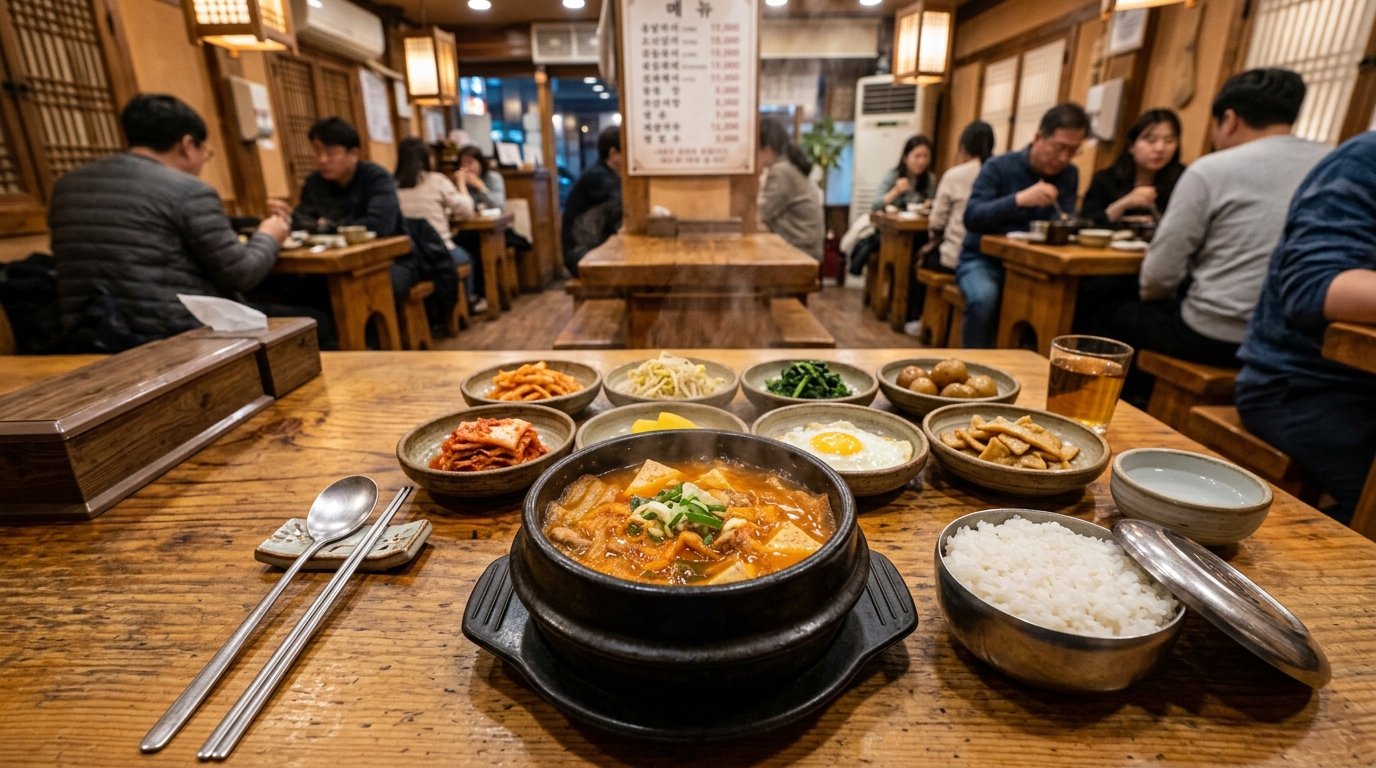
Solo dining (Honbap) in Seoul: ordering single-portion stews or taking a counter seat usually makes solo dining easy.
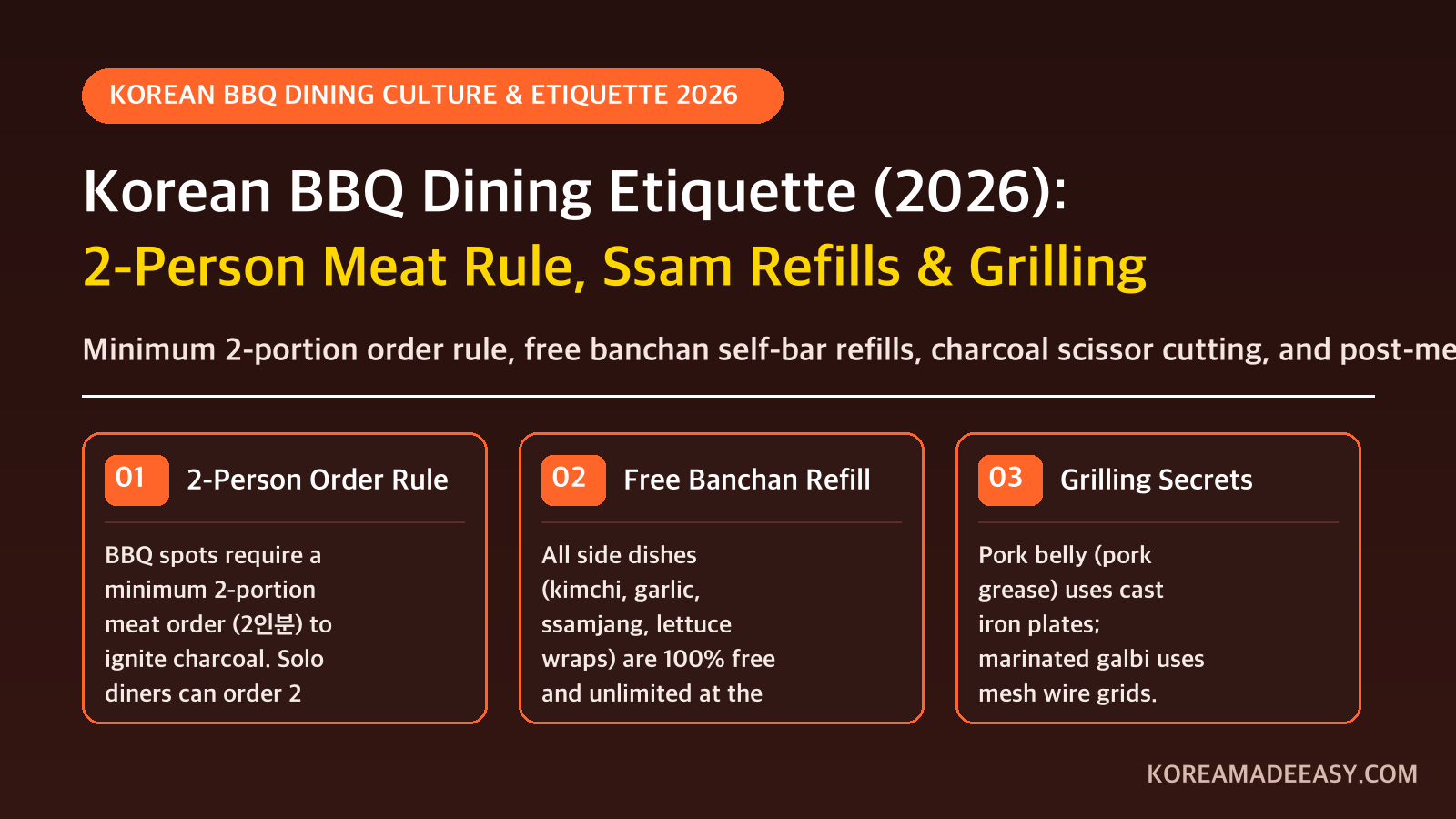
Because the side dishes and grill preparation costs are fixed, serving a single portion (often around ₩15,000 or more) can be a financial loss for a busy BBQ restaurant. They are not rejecting you; they are rejecting a 1-portion table.
🥩 The Magic Workaround for Solo Korean BBQ:
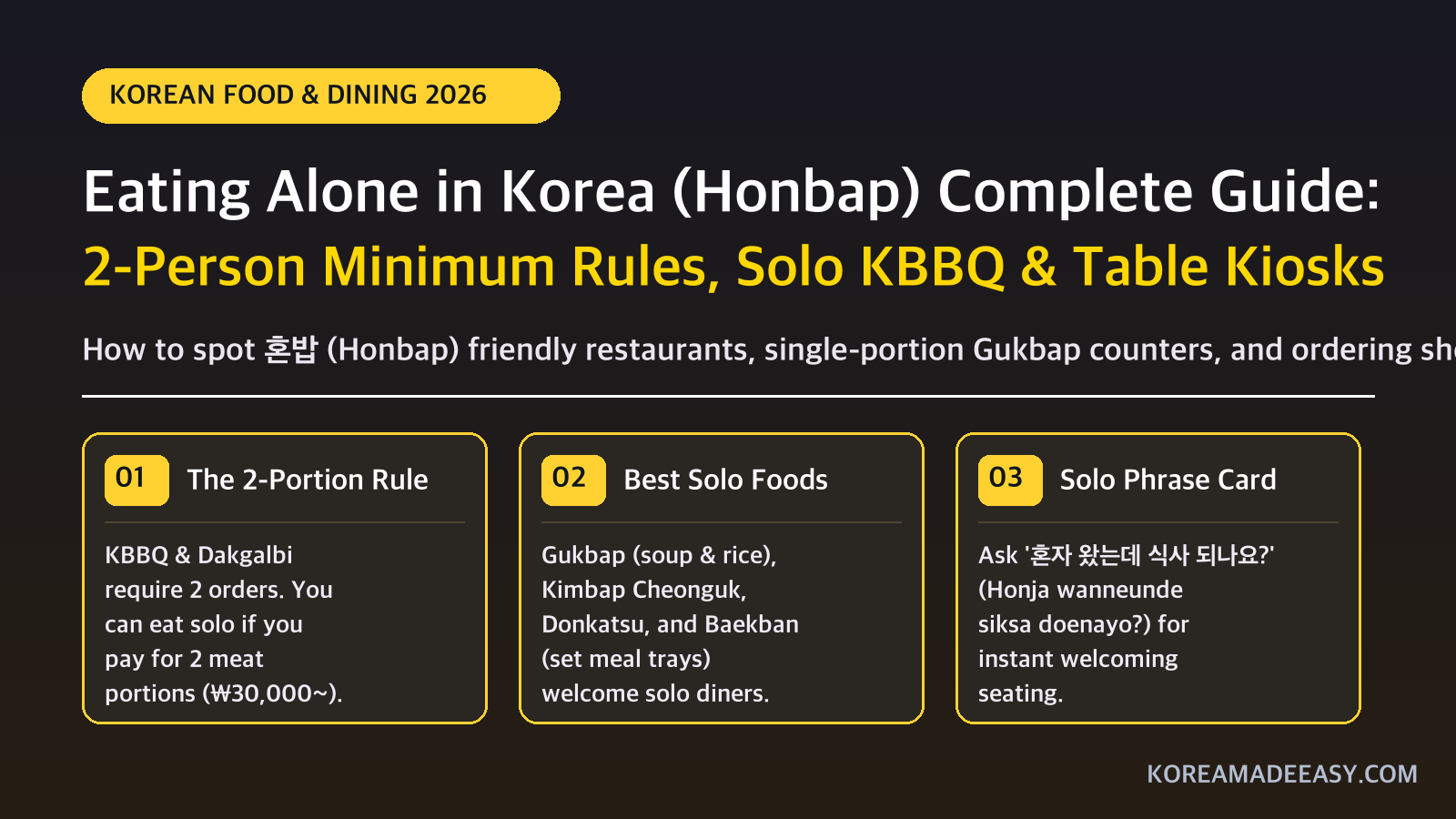
If you want to eat Korean BBQ alone, do not ask for a 1-person table. Instead, walk in and tell the host: “I am alone, but I will order two portions.”
In Korean:
“혼자인데 2인분 시킬게요.”
(Hon-ja-in-de i-in-bun sikil-geyo.)
Two portions of pork belly (삼겹살) typically total 300g to 400g of meat and often cost roughly ₩30,000 to ₩36,000, though prices vary by restaurant and city. For an authentic Korean BBQ feast with side dishes and fresh lettuce, it can be a solid dining value.
Once the owner hears you are ordering two portions, many restaurants will happily fire up the grill and seat you, though peak-hour policies vary by shop.
2. 4 Restaurant Categories That Usually Welcome Solo Diners
If you don’t want to eat two portions of BBQ and just want a quick, delicious single-person meal (Honbap / 혼밥), look for these 4 restaurant styles:
1. Gukbap & Stew Specialists (국밥집 / 찌개집)
- What they serve: Dwaeji-gukbap (pork soup), Seolleongtang (ox bone soup), Sundae-guk (blood sausage soup), Kimchi-jjigae, and Sundubu-jjigae (soft tofu stew).
- Solo Friendly Rating: ⭐⭐⭐⭐⭐ (10/10)
- Every dish is served in an individual boiling stone pot (뚝배기) with rice and side dishes on a personal metal tray. Many local office workers dining here are eating alone.
2. Bunsik Snack Bars (분식집)
- Top Chains: Kimbap Cheonguk (김밥천국), Kimgane (김가네), School Food.
- What they serve: Kimbap rolls (often around ₩3,500–₩5,000 depending on the shop), Rabokki (ramen tteokbokki), pork cutlets (donkkaseu), and bibimbap.
- Solo Friendly Rating: ⭐⭐⭐⭐⭐ (10/10)
- Designed specifically for fast, solo dining. You write your order on a paper slip or order from a touchscreen kiosk.
3. Department Store & Mall Basement Food Courts
- Top Locations: The Hyundai Seoul (Yeouido), Shinsegae Department Store (Myeongdong), COEX Mall (Gangnam).
- Solo Friendly Rating: ⭐⭐⭐⭐⭐ (10/10)
- Clean, premium dining floors with English touchscreen ordering kiosks and dozens of dedicated single-person bar counter seats.
4. Gisa Sikdang / Drivers’ Diners (기사식당)
- What they serve: Unlimited side dishes with bulgogi (돼지불백) or spicy grilled pork on personal platters.
- Solo Friendly Rating: ⭐⭐⭐⭐⭐ (10/10)
- Originally built for Seoul taxi drivers taking fast lunch breaks, these diners offer fast service, generous portions, and zero judgment for solo eaters.
3. How to Spot a Solo-Friendly Restaurant in 3 Seconds
When walking down a Korean street, glance at the front window and exterior menu:
| Visual Sign | Solo Verdict | What It Means |
|---|---|---|
| Individual prices per bowl (e.g. ₩9,000 / ₩11,000) | ✅ Usually solo friendly | Soups, noodles, rice bowls, kimbap |
| Window bar seats or small 2-top tables | ✅ Usually solo friendly | Space designed for singles and pairs |
| Menu lists sizes: “소 / 중 / 대” (S / M / L) | ⚠️ Group Dining | Large sharing hot pots (Jeongol, Braised chicken) |
| Every table has a built-in exhaust pipe & grill | ⚠️ BBQ (Needs 2-portion rule) | Use the magic card above to get seated |
4. Korean Table Manners Every Solo Diner Must Know
Korean restaurant tables have built-in systems designed to save space:
1. Where Are the Chopsticks and Napkins?
Do not search the tabletop. Reach under the right or left edge of your table and pull the hidden wooden drawer. Inside, you will find sanitized metal chopsticks, spoons, napkins, and bottle openers.
2. How to Call the Server (The “Ding-Dong” Bell)
Do not wave your arms frantically or shout across the room. Look at the corner of your table for a round call bell. Press it once — a chime will ring and a server will usually come to your table.
3. Water and Side Dishes Are “Self-Service” (셀프)
If the server brings your food but no water cup, look around the dining room for a sign reading “물은 셀프” (Water is Self-Service). Walk up to the stainless-steel water purifier, grab a small metal cup from the UV sterilizer rack, and pour your own water.
FAQ
Is solo dining culturally weird or frowned upon in South Korea? Not anymore. The modern Korean cultural trend of Honbap (혼밥 — eating alone) and single-person dining is common across Seoul and Busan. You will see many locals eating alone in cafes, ramen shops, and soup restaurants every day.
What is the worst time to try solo dining in Seoul? Between 12:00 PM and 1:00 PM on weekdays, when office workers fill local neighborhood restaurants in groups. During this peak lunch hour, small mom-and-pop shops may ask solo diners to wait until after the rush so they don’t tie up a 4-person table.
Can I order takeout (포장 / Po-jang) if a restaurant won’t seat me? Often, yes. Many Korean restaurants offer takeout (though some hot-pot or BBQ spots may not). If you say “Po-jang hae-juseyo” (포장해 주세요 — “Please pack it to go”), they will usually pack your food into sealed containers to enjoy at your accommodation or in a park.
How do I pay at the end of the meal? Grab your bill paper slip (usually left clipped to your table or in the under-table drawer) and walk up to the front counter register near the exit door. You can pay with most credit cards, Wowpass, or T-Money where accepted.
Sources checked
- VISITKOREA — 1330 Korea Travel Helpline & Complaint Center (the national travel helpline, if you need travel information or help).
- Note: Individual restaurant solo-dining policies, minimum portion rules, and menu prices vary by shop and neighborhood and were not individually surveyed; confirm on site.
Sources
This is independent guidance, not an official operator or government publication. Evidence and check dates vary by article. See our editorial and corrections policy for the distinction between source checks, personal visits and planning advice.