Travel
Bamdokkaebi Night Market Isn't Running in 2026 — the 4 Korean Night Markets That Actually Open Tonight
The payoff Standing on an empty Han River lawn at 19:00 because a blog promised a night market that closed years ago → walking into one that's genuinely open and eating six or seven things for ₩15,000–30,000 (~$10–21).
📈 Trend signal: Seoul Bamdokkaebi Night Market attendance collapse — 5.0M (2018) → 3.41M (2019) → 520,000 (2022) → 6 Sundays (2023) → no 2026 schedule announced
Here’s a sentence I didn’t expect to write about the most famous night market in Korea: the address doesn’t exist any more. Type bamdokkaebi.org — the official site of Seoul Bamdokkaebi Night Market — and the server answers HTTP 410 Gone. Not “moved,” not “under construction.” 410 is what you return when something has been deliberately, permanently retired.
Yet the top English results for “Seoul night market” still tell you it runs Fridays and Saturdays, 18:00–23:00, at Yeouido, Banpo, Cheonggyecheon and DDP. That’s the 2019 schedule. The precise “24 March–29 October, five locations” line that AI answers now repeat traces back to a Seoul city magazine issue stamped 2017.04.
So this piece is a correction, not a listicle. What actually happened to Bamdokkaebi, then four markets whose 2026 hours I checked against official Korean sources — and what Seoul is running instead this August, which is free.
Some links below are affiliate links. If you book through them I may earn a small commission at no extra cost to you. I only link to things I’d send a friend to.
What I can and can’t prove about Bamdokkaebi
Precision matters here, because precision is the whole point. As of 30 July 2026: there is no 2026 opening announcement from Seoul city. The official domain returns 410. The market appears nowhere in Seoul’s own 2026 Han River events programme, which lists a walking festival, a drone light show and night-view tours — but no night market. Korean press now uses the past tense: a 29 July 2026 newspaper column describes it as having “briefly revived in shrunken form as the Hangang Moonlight Night Market in 2022,” and frames Seoul’s current night push as a new attempt.
What I did not find is a formal abolition notice. So the honest word is unannounced, not cancelled — but don’t build an evening around it.
The collapse curve nobody has put together in English
It didn’t vanish overnight. Every figure below comes from Seoul’s own press releases or Korean reporting:
| Year | What it was | Attendance |
|---|---|---|
| 2015 | Pilot, Yeouido only, 120 teams | ~200,000 |
| 2016 | Made permanent, 4 sites, 332 teams | ~3,300,000 |
| 2017 | 5 sites, 505 teams | ~5,000,000 |
| 2018 | 6 sites | ~5,000,000 |
| 2019 | Apr 5–Oct 27, 6 sites, Fri–Sun | 3,410,000 — 125 food trucks + 206 vendor teams, ₩9.7bn (≈$6.7M) in sales |
| 2020–21 | Suspended (COVID) | 0 |
| 2022 | Rebranded, shrunk to Banpo only | ~520,000 |
| 2023 | Six Sundays, 16:00–21:00, Banpo | ~40 trucks + ~50 booths |
| 2024–2026 | No opening announcement found | — |
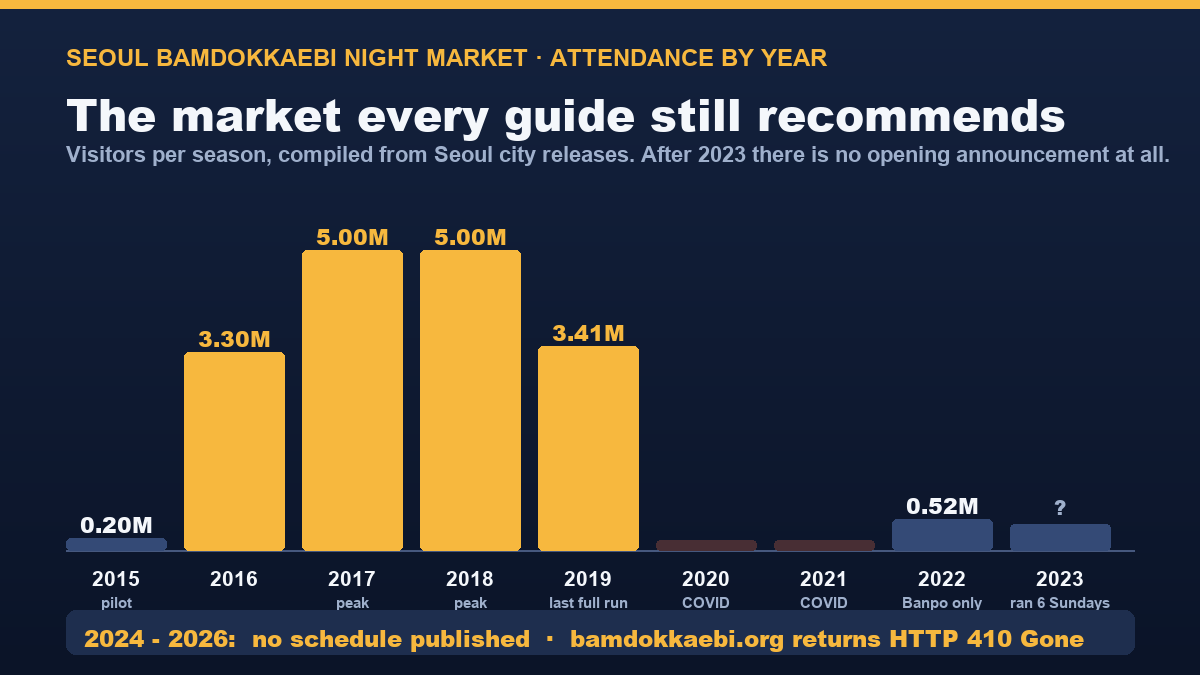
Five million visitors, then six Sundays, then nothing. This wasn’t a minor programme: foreign residents in Seoul voted Bamdokkaebi the city’s best policy in both 2016 and 2018, and because food trucks were effectively illegal in Korea until deregulation began around 2014, it was the market that legitimised them — GoPizza, now operating in India, Japan and Thailand, started as a truck at Yeouido Bamdokkaebi in 2016.
Korea is not Taiwan, and that’s why you keep being disappointed
I’ll let a Korean explain, from a 2025 thread where someone asked where Seoul’s night market was:
“Traditional markets are wholesale-oriented, so they are mostly closed in the evening… Seoul does not have the Taiwanese-style or Thai-style street night market that foreigners think is active at night. Most night markets in Seoul are tourist events and are seasonal food truck night markets… The street food vendors (Pojangmacha) you saw in the old drama are now gone. It was illegal.” — r/KoreaSeoul, 22 August 2025
That’s the right mental model. 야시장 (ya-sijang) covers two different animals in Korea: 상설 permanent markets, where carts roll in every night of the year — there’s essentially one worth travelling for, and it’s in Busan — and 정기·시즌 scheduled ones, city-run events on fixed days. The name tells you which Bamdokkaebi was: 도깨비 (dokkaebi) is a goblin from Korean folklore, so 밤도깨비 means “night goblin,” a market that appears after dark and vanishes by morning. It was always an event, never a place.
The four that actually open in 2026
| Market | City | 2026 days | Hours | Confidence |
|---|---|---|---|---|
| Bupyeong Kkangtong | Busan | Every day | 19:30 – 00:00 | High — official Busan tourism |
| Seomun | Daegu | Fri · Sat · Sun | Fri/Sat 19:00–23:30 · Sun to 22:30 | High — official market site, 2026-dated |
| Nambu | Jeonju | Fri · Sat | 17:00 – 23:00 | Medium — city notice, none 2026-dated |
| Daein Art | Gwangju | 12 dates only, 19 Jun–31 Oct | 16:00 – 21:00 | High — but check the date list |
Busan — Bupyeong Kkangtong: the one you can’t get wrong
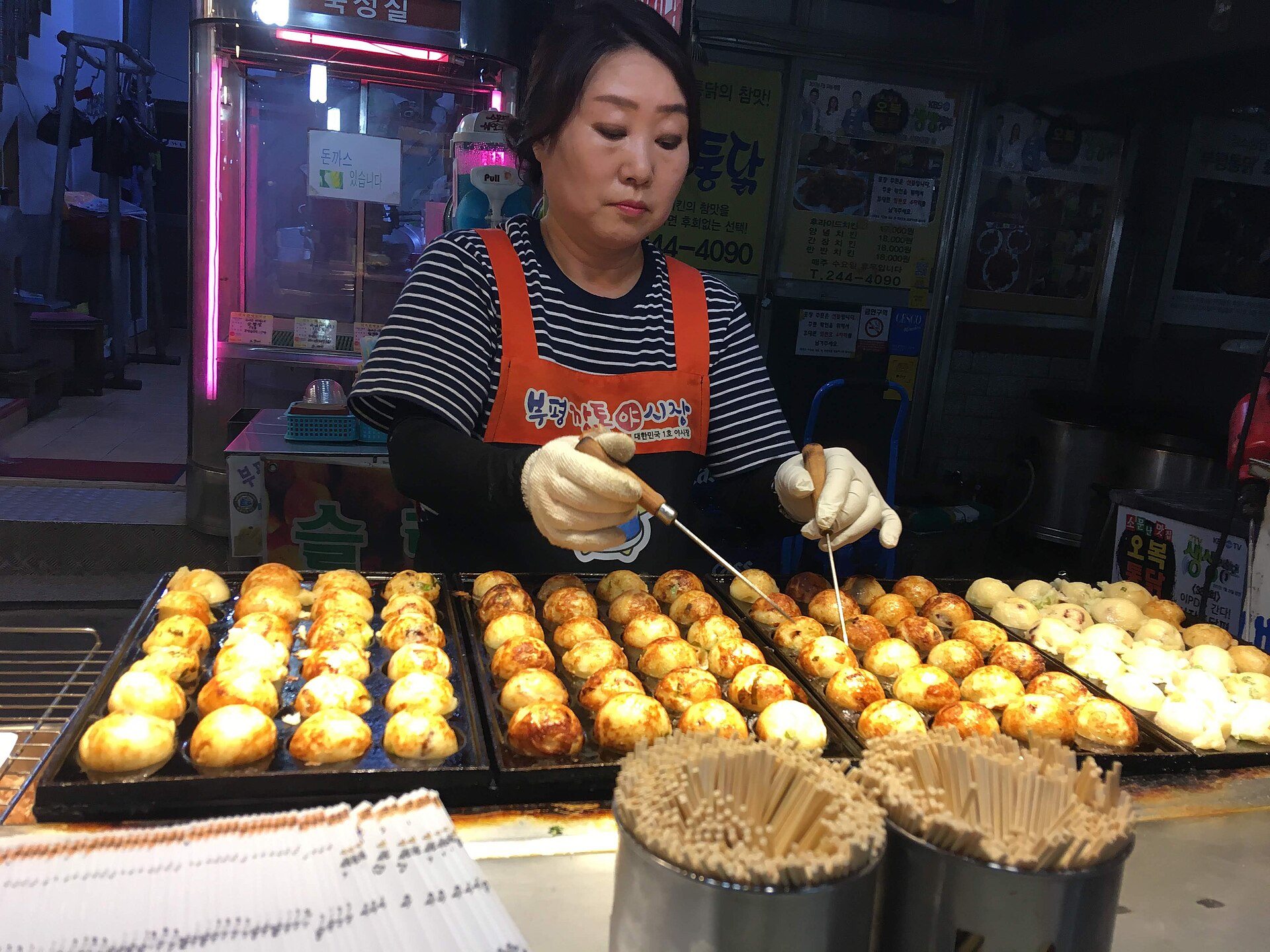
One night, one real night market? Go here. It opened on 29 October 2013 as Korea’s first permanent night market and still runs daily 19:30 to around midnight, except major holidays. Busan’s tourism office describes the moment well: at 7:30pm wheeled carts roll in a line into the alley and the place becomes a food market within minutes. A Busan city bulletin counts about 27 carts along a 110-metre stretch.
The line-up is deliberately un-Korean — grilled pork belly beside okonomiyaki, kebabs and Vietnamese bánh xèo — because vendor licences were allocated to multicultural families and disabled residents from day one. For local classics: ssiat-hotteok (seed-stuffed sweet pancake), Busan fish cake and muldeok skewers, and bibim-dangmyeon (cold spicy glass noodles). Most items are ₩2,000–4,000 (~$1.40–2.75). It’s 5–10 minutes on foot from Jagalchi Station (Line 1), wedged between Gukje Market and BIFF Square.
One thing to plan for: the market runs to midnight, Busan’s metro doesn’t. Either sleep near Nampo-dong or budget a taxi, or you’ll cut a good evening short at 22:30 chasing a last train.
Rather have the alley explained than guess at signage? This half-day Gukje Market & BIFF Square food experience covers this exact cluster, and KKday lists a Busan night market walking tour worth price-checking against it. Then slot the market into night two of our 3-day Busan itinerary.
Daegu — Seomun: closed on the days you’d assume it’s open
Seomun’s 2026 season opened 27 March after a three-month winter closure and runs March–December on Friday, Saturday and Sunday only. From the market’s own site: Fri & Sat 19:00–23:30, Sunday 19:00–22:30, closed Monday–Thursday.
That closure is the most common wasted evening in Korea. One traveller posted from the empty lane on Sunday 24 March 2024 — a valid day, but still inside the January–March winter shutdown. Two facts had to line up, and no English page gave him either.
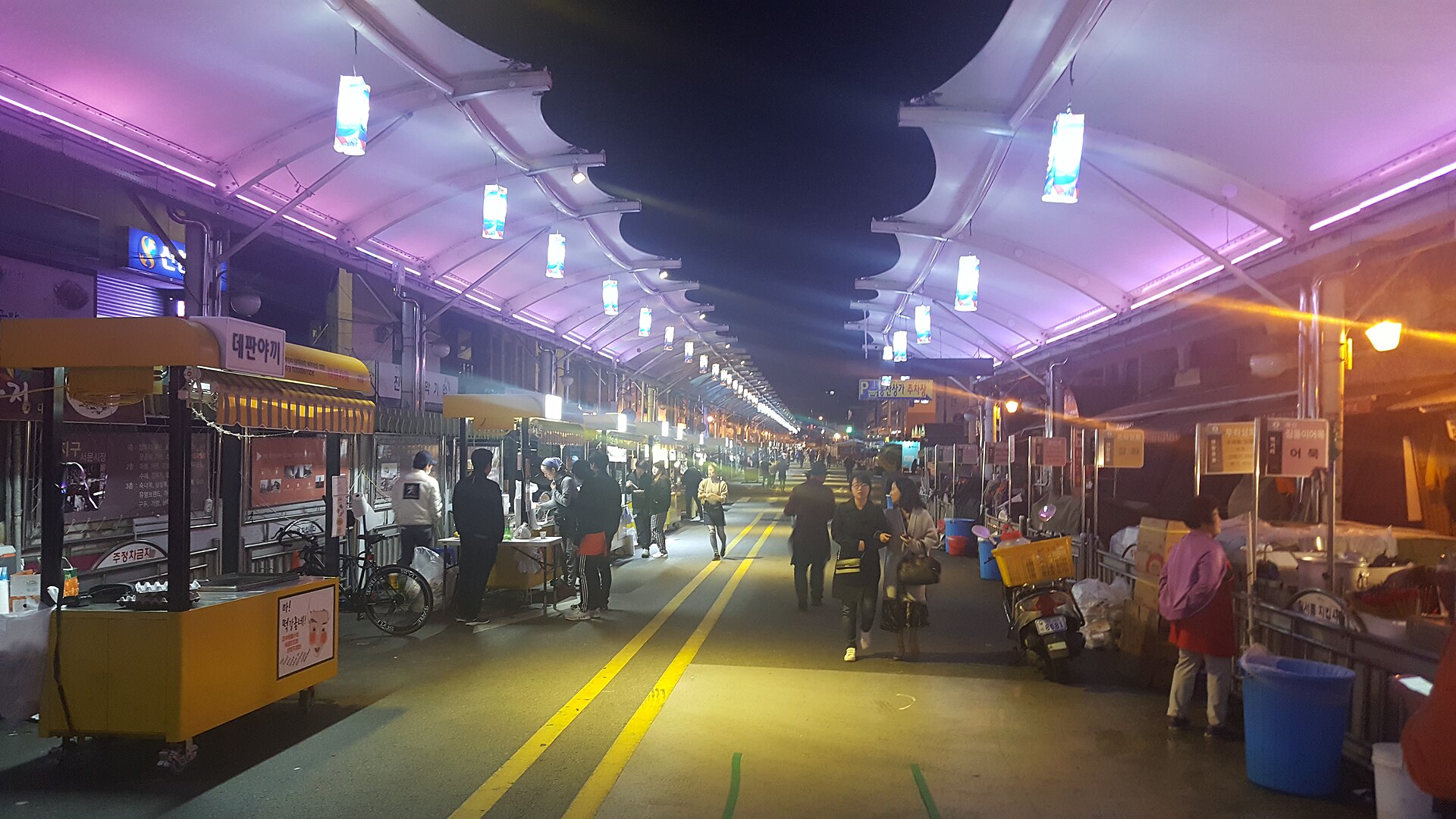
Expect roughly 20–30 food stalls plus food trucks on one lane; 2026 vendor recruitment called for 30 operators (24 carts, 6 trucks). Blogs claiming “80 stalls” aren’t backed by any official source I could find, so treat that as folklore. Hunt makchang (grilled pork intestine, genuinely a Daegu thing), cheese-grilled lobster and yakisoba; the recurring review line is ₩5,000 (~$3.45) for a generous portion. Exit 2 or 3 at Seomun Market Station (Line 3). And rain closes it — the official notice board has a plain, dated entry for a closure on 17 July 2026.
Jeonju — Nambu: five minutes from the Hanok Village
Jeonju City lists Nambu Market Night Market as Fridays and Saturdays, 17:00–23:00, at Pungnammun-1-gil 19-3 — just south of Pungnammun Gate, five minutes from the Hanok Village. It restarted post-COVID on 28 October 2022 and the pattern has held since. Full honesty: I found no 2026-dated Jeonju notice, and the city itself says hours “may be adjusted.” Well established, unconfirmed for this season — verify before you commit the evening.
Gwangju — Daein Art Market: the biggest trap here
Daein Art Night Market is running: 19 June – 31 October 2026. Now read this twice. It opens on a total of 12 dates across those four and a half months, on a Friday or a Saturday — usually not both — 16:00–21:00. Do the arithmetic: someone who “goes on a Friday” has roughly a one-in-three chance of finding it open, so check the published date list before buying a bus ticket to Gwangju. When it’s on it’s the loveliest of the four and the least food-driven — busking, magic, DJ sets, about 24 sellers, craft workshops — because it’s funded as a culture programme.
Briefly on the rest: Chilsung Night Market in Daegu runs March–November, Fri–Sun (older Reddit posts listing Monday and Thursday hours are out of date). Pohang’s Jungang district market and Mokpo’s new “Byeolbyeol” market at Dongbu Market (opened 20 June 2026) are alive, but I found no authoritative hours, so I won’t print any. And if you google “bamdokkaebi 2025” you may hit a one-off Sokcho event run by local daycare centres in October 2025 — unrelated.
Gwangjang Market is not a night market
This is the category error that costs people money. Gwangjang is a permanent daily market founded in 1905 — a covered building of fixed shops, not carts that appear at a set hour. Shops run roughly 09:00–18:00; the famous food alley goes to about 22:00–23:00, though Korean sources themselves say it varies stall by stall and most non-food shops shut Sunday. Check the individual stall on Naver Map rather than trusting one blanket figure.
It also has a price problem. The sharpest complaint I’ve read came from a Korean visiting for the first time after twenty years in Seoul:
“I had the worst tteokbokki of my life — six tiny pieces for 3,000 won. A jeon that was obviously already pre-fried and just re-fried again — 5,000 won. … The most shocking part was the 5,000-won jjajangmyeon. They literally microwaved one of those cheap 3-minute instant jjajang sauces… I strongly recommend not spending more than 10,000 won on food there.” — r/koreatravel, 15 June 2025, 2,177 upvotes
I’d add one nuance, because Gwangjang’s loudest defender names the actual variable: a traveller who called the tourist-trap crowd wrong said the highlight of his Seoul trip was the market tours — “jokes and conversations with the table mates that could not be replicated had I gone there by myself.”
That’s the split. Wander in alone with no Korean and you’re a mark at the tourist-facing stalls; go with someone who orders for you and you get the version people rave about. Skip that distinction and you’ll pay ₩5,000 for microwaved instant noodles and decide Korean food is overrated. The two guided options worth comparing are this Gwangjang night market food tour and this Gwangjang unique food tour — same market, different pacing, so price-check both.
What Seoul is running instead this August
Here’s the part no English guide has caught up with. On 23 July 2026 Seoul launched a night-economy programme on the Han River, and the headline item is 한강 밤핑 (Hangang Bampping), “night camping”: free pop-up campgrounds for one month in August 2026 at Yeouido Hangang Park (the Mulbit Stage lawn) and Ttukseom Hangang Park. 100 tents at each site, 200 total, open 17:00 through to 09:00 the next morning, free during the pilot, first-come-first-served online, 100 sites per location per day. Consecutive nights and cooking are banned; renting a tent on site costs money.
Alongside it, poolside DJ nights at the Yeouido Hangang Park swimming pool every Fri/Sat/Sun, 24 July–30 Aug 2026, 19:00–21:00, with Saturday sets at the Nanji water-play area from 8 August. Seoul’s stated aim is to push evening spending out into surrounding traditional markets rather than concentrating it in one event — which, reading between the lines, is roughly why a city-run food-truck market isn’t coming back. If you wanted night-market energy in Seoul this August, that’s the real answer, and it’s free, like a lot of Seoul.
If what you actually wanted was the Bamdokkaebi feeling — food, the river, the city lit up — the closest honest substitute is a combined Han River cruise and Gwangjang night tour . It isn’t a night market. It’s what the night market used to give you.
What an evening costs, and the three ways it goes wrong
Budget ₩15,000–30,000 (~$10–21) per person to eat properly. Entry is free everywhere on this list.
Cards. Seoul’s organised markets took cards at every stall; regional carts are another world, and Korean reviewers plainly advise cash because some can’t process cards — foreign cards fail more often here than anyone warns you. Carry ₩1,000/₩5,000/₩10,000 notes and keep a topped-up T-money card for the ride home.
Rain. Both Seoul (2019) and Daegu (17 July 2026, on the record) cancel for weather. Check the notice board the afternoon you plan to go, not the morning.
Timing. These are standing, walking markets — Seomun’s own framing is that you eat while watching performances in the queue. Seating is a feature, not a default. Peak is 20:00–22:00 in Daegu, from 19:30 in Busan; arrive at opening and half the carts are still setting up.
One more: Google Maps won’t walk you there — it has no walking directions in Korea at all, a separate mess I’ve written up in full. Use Naver Map or KakaoMap, which means data the moment you land, so sort the eSIM before you fly.
FAQ
Is Bamdokkaebi Night Market still open in 2026? There’s no published 2026 schedule. As of 30 July 2026 the official site returns HTTP 410 Gone, the market is absent from Seoul’s 2026 Han River programme, and Korean press discusses it in the past tense. No formal abolition notice exists, so the accurate answer is “unannounced” — but plan as if it isn’t running. Any guide quoting Fri/Sat 18:00–23:00 is copying 2019.
Which Korean night market is open every night? Bupyeong Kkangtong in Busan — daily, 19:30 to around midnight, all year except major holidays, a 5–10 minute walk from Jagalchi Station. It’s the only genuinely permanent one on this list.
Is Gwangjang Market a night market? No. It’s a permanent daily market from 1905 — fixed shops, roughly 09:00–18:00, with a food alley to about 22:00–23:00 (varies by stall; most non-food shops close Sunday). English guides list it as a night market, which sets the wrong expectation about both atmosphere and price.
How much should I budget for a Korean night market? ₩15,000–30,000 (~$10–21) per person to eat well. Items run about ₩2,000–4,000 in Busan, and the recurring line in Daegu reviews is ₩5,000 for a generous portion. Entry is always free.
Does Korea have night markets like Taiwan or Thailand? Not really — worth knowing before you land. Korean traditional markets are wholesale-first and mostly shut by 18:00–20:00, and the drama-style 포장마차 street tents were largely regulated out of existence. What Korea has instead is a handful of city-organised night markets on set days, plus Busan’s permanent one.
Photo credits, via Wikimedia Commons: Seomun Night Market, Daegu by Choi2451 (CC BY-SA 3.0); Bupyeong Kkangtong vendor by Christophe95 (CC BY-SA 4.0). Attendance chart is my own rendering of figures published by the Seoul Metropolitan Government.


Planning Your Korea Trip? Don't Pay Full Price! ✨
Save $20–$50 per person with our verified reader perks & skip the long ticket booth queues:
AREX Incheon ↔ Seoul Express
Non-stop 43-min direct train with guaranteed reserved seats & free Wi-Fi. Scan your mobile QR straight at the gate!
Get 20% Off AREX Ticket →Korea Unlimited 5G eSIM
Skip the 30-min airport counter line. Scan the QR code to connect instantly for smooth Naver Maps navigation.
Compare Korea eSIM Options →WOWPASS Card (Pay + T-Money)
Pay anywhere in Korea with zero FX fees + subway card. Use code KOREAEASY for 0.5% cash top-up bonus!
Top Seoul Passes & Day Tours
Guaranteed entry for Lotte World, Nami Island tours, CIMER Spa, and Hanbok palace rentals with instant mobile vouchers.
Browse Top Seoul Deals →Sources
- https://hangang.seoul.go.kr/www/contents/817.do?mid=734
- https://mediahub.seoul.go.kr/archives/1220366
- https://mediahub.seoul.go.kr/archives/2005407
- https://mediahub.seoul.go.kr/archives/2007826
- https://mediahub.seoul.go.kr/archives/2018853
- https://www.nightseomun.com/
- https://dgmbc.com/NewsArticle/831691
- https://www.visitbusan.net/kr/index.do?menuCd=DOM_000000202003001000&uc_seq=1861&lang_cd=ko
- https://www.busan.go.kr/news/storyreport/view?dataNo=56491
- https://tour.jeonju.go.kr/board/view.jeonju?boardId=BBS_0000046&menuCd=DOM_000000113001000000&dataSid=14764
- https://www.asiatoday.co.kr/kn/view.php?key=20260618010006365
- https://english.visitseoul.net/area/Gwangjang-Market/ENP000286
Search-trend data from Google Trends (KR) and Naver DataLab. This article is independent commentary and is not affiliated with any broadcaster, agency, or the individuals mentioned.
Korea's Coin Laundromats: Foreign Card Failures, Detergent Dispensers & the Change Machine Trap
Incheon Airport Tax Refund: Customs Inspection vs. Cash Kiosk — The Walkthrough Most Guides Get Wrong