Travel
Is It a Hotel or a Love Motel? The 10-Second Naver Check Before You Book (Korea 2026)
The payoff Booking something called “The Hotel” from a listing photo and finding out what it is at 11pm with your luggage → knowing exactly what you booked in ten seconds, and choosing it deliberately.
📈 Trend signal: A 100-comment r/koreatravel thread on avoiding an accidental love-motel booking, in which every suggested method was guesswork from listing photos
This guide contains an affiliate link. If you book through it I may earn a small commission at no extra cost to you — it doesn’t change what I recommend.
A traveller asked on r/koreatravel how to avoid accidentally booking a love motel, and got a hundred replies. Almost all of them were the same advice: study the listing photos. Look for mirrors. Count the PCs. Check if the bed is enormous and the window is missing.
That advice is guesswork, and it fails on the properties most likely to catch you out — the renovated ones with clean, modern photos. There is a much better method, it takes about ten seconds, and it works because it doesn’t rely on the photos at all.
The problem in one line: the name is not the category
Korean love motels overwhelmingly call themselves hotels. Not to trick foreigners — the word simply carries better in Korean marketing. The result is that the English-language name you see on Booking.com or Agoda tells you nothing.
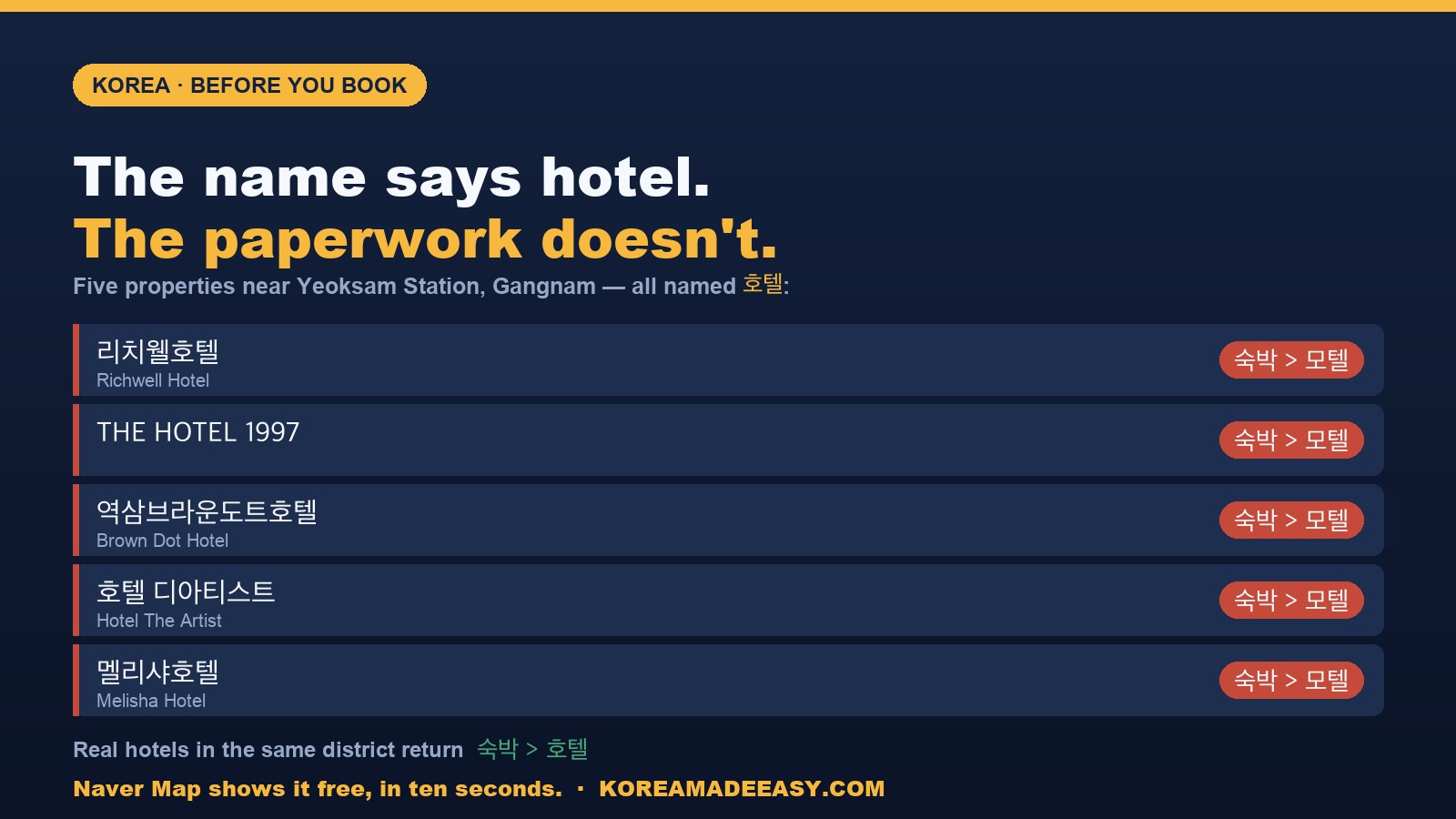
Here’s what that looks like in practice. I pulled the five nearest accommodations to Yeoksam Station in Gangnam that Naver returns for a motel query, and looked at what each one is called versus what it is registered as:
| Property name | Registered business type |
|---|---|
| 리치웰호텔 (Richwell Hotel) | 숙박 > 모텔 |
| THE HOTEL 1997 | 숙박 > 모텔 |
| 역삼브라운도트호텔 | 숙박 > 모텔 |
| 호텔 디아티스트 (Hotel The Artist) | 숙박 > 모텔 |
| 멜리샤호텔 (Melisha Hotel) | 숙박 > 모텔 |
Five for five. Every single one has “hotel” in its name. Every single one is registered as a motel.
And for contrast, the same query run against actual hotels — Novotel Ambassador Gangnam, Andaz Seoul Gangnam, Grand InterContinental Parnas — returns 숙박 > 호텔 every time.
That gap is the whole trick.
The check itself
Open Naver Map, search the property’s Korean name, and read the small grey line directly under the name in the result. It says one of:
- 숙박 > 호텔 — a hotel
- 숙박 > 모텔 — a motel
- 숙박 > 게스트하우스 / 펜션 / 호스텔 — exactly what it says
That grey line is not a description someone wrote. It’s the registered business category, the classification the business filed with the authorities. A property can name itself anything it likes; it can’t quietly file itself as a hotel.
You don’t need an account, an app, or Korean. You need to be able to tell 호텔 from 모텔, and those two words look different enough that you’ll manage after reading this once.
If you only have the English name, copy the address from your booking listing into Naver Map instead — the pin will come up with the Korean name and category attached. (If Naver Map is new to you, here’s the full setup — Google Maps can’t do this, and can’t do directions here either.)
Two honest caveats
I’d rather you know the limits of this than trust it blindly.
Categories can be stale or generous. A property that renovated and repositioned itself years ago may still carry an old classification, and a small number file themselves loosely. It’s a strong signal, not a legal guarantee.
A 모텔 classification doesn’t mean what you think it means. This is the part most guides get wrong, so it gets its own section.
Why you might actually want the motel
Here’s the thing nobody tells first-time visitors: a Korean motel is often the best-value private room in the country.
Forget the American roadside association. A typical Korean motel room is private, has its own bathroom, is usually clean and well-equipped, and runs roughly ₩45,000–70,000 a night. In Seoul a proper hotel room starts closer to ₩70,000–110,000. That’s hostel money for a private room, and for a solo traveller or a couple it’s frequently the smart choice rather than the compromise.
What genuinely differs, so nothing surprises you:
- Two rate types. 대실 (daesil) is a short-stay block of a few hours; 숙박 (sukbak) is overnight. Book 숙박. International sites only sell the overnight rate anyway.
- Check-in is often minimal. Sometimes a screen or a small window rather than a lobby conversation. This is normal, not sinister.
- No breakfast, no bell desk, and the room may have no window or a frosted one.
- Parking curtains at some properties — strips of plastic over the car park entrance, for privacy. Harmless, and a reliable giveaway from the street.
- Amenities can be surprisingly good. Large TV, decent toiletries, fast wifi, occasionally a computer or a huge bath.
The real reason to run the check isn’t to avoid motels. It’s so that you’re never the person standing outside at 11pm with a suitcase, working out what you booked.
When you actually should avoid one
Three situations where the category genuinely matters:
- Travelling with kids or older parents. Not because anything is wrong, but the atmosphere, the lack of a proper lobby and the late-night foot traffic aren’t what a family wants after a flight.
- You need a receipt or an address for a visa or reimbursement. Some smaller properties are informal about paperwork.
- You booked expecting hotel service. No concierge, no luggage storage before check-in, no help when something goes wrong in English.
If any of those apply, run the check and pay the extra ₩30,000. If none do, you may have found the best-value room of your trip.
👉 Compare actual hotels in central Seoul on Booking.com — and if you’re not sure which district suits your trip, our where to stay in Seoul guide picks the neighbourhood first, which matters more than the star rating.
The signals that don’t work
Since the Reddit thread was full of them, briefly:
- Mirrors and mood lighting in photos. Renovated motels photograph like boutique hotels now. Plenty of genuine boutique hotels have moody lighting.
- A cheap price. Business hotels outside the centre are cheap too. Price tells you about location as much as category.
- “Hotel” in the name. Demonstrably useless — see the table above.
- Being near a station. Both cluster near stations, because both sell convenience.
- English reviews. The properties that catch people out are exactly the ones with polished English listings.
One signal that does work, if you’re already standing there: look for the car park curtains, and look for a rate board showing two prices — a short-stay one and an overnight one. That board is definitive.
FAQ
Is it embarrassing to stay in a Korean love motel? No. They’re a normal, mainstream part of the accommodation market used by domestic travellers of every kind, including families on road trips. Nobody at the desk will react to you.
Are they safe and clean? Generally yes, and often cleaner than a comparable budget hotel because rooms turn over frequently. As anywhere, read recent reviews and avoid the ones with complaints about smell or noise.
Why don’t most motels show up on Booking.com? Because the domestic booking apps that carry them — Yanolja and Yeogi-eottae — require a Korean phone number and a domestically issued card, and have no English interface. The inventory exists; it’s just effectively closed to short-stay visitors, which is why your search results skew to hostels and apartments.
Can I do this check on Google Maps instead? Not reliably. Google’s Korean business data is thin and it doesn’t surface the registered category the same way. Use Naver Map, or KakaoMap as a second opinion.
What if the listing has no Korean name at all? Copy the street address into Naver Map. The pin resolves to the property with its Korean name and category. If the address doesn’t resolve either, that’s its own warning sign.
Does the same check work outside Seoul? Yes — the category system is national. It’s arguably more useful in smaller cities, where the ratio of motels to hotels near the station is higher.
Sorting the rest of your stay? Where to stay in Seoul breaks the city down by traveller type, and getting in from Incheon covers the ₩4,150 route most people miss.
Planning Your Korea Trip? Compare Your Options
Compare transport, mobile data, and attraction options. Prices and eligibility depend on your selected date and package.
AREX Incheon ↔ Seoul Express
Express train between Incheon Airport and Seoul Station. Follow the selected voucher’s seat reservation and redemption instructions.
Check AREX Express Tickets →Korea eSIM Options
Compare Korea eSIM search results. Check data allowance, supported network, device compatibility, activation, and speed limits.
Compare Korea eSIM Options →WOWPASS Card (Pay + T-Money)
Compare WOWPASS and T-money. Payment and transit balances are separate; check issuance, top-up, exchange, and withdrawal fees.
Read WOWPASS vs T-money →Top Seoul Passes & Day Tours
Browse general Seoul activity search results. This is not a guaranteed-entry pass or a fixed-discount offer; check each product’s inclusions.
Browse Seoul Activity Options →Sources
Search-trend data from Google Trends (KR) and Naver DataLab. This article is independent commentary and is not affiliated with any broadcaster, agency, or the individuals mentioned.