Food & Dining
Korean Restaurant Dining Etiquette: Chopsticks, Free Banchan Refills, Drinking Rules & How to Pay
📈 Trend signal: Persistent tourist confusion over Korean restaurant customs—utensil drawer locations, free side dish refills, drinking etiquette hierarchies, and payment procedures (r/koreatravel)
You walk into a lively, fragrant local restaurant (sikdang) in Seoul. You slide into a wooden booth, look around, and immediately hit your first three surprises:
There is no cutlery on the table, no server approaching with water, and not a single menu in sight.
A moment later, a bustling staff member drops off six colorful small dishes you never ordered. When you pick up your drink, your Korean dinner companion subtly glances at how you are holding your glass. And when your meal is over, you sit waiting at your table for fifteen minutes expecting a check—and nobody comes.
Dining out in South Korea is one of the greatest travel joys in the world. It is social, remarkably fast-paced, and generous—so central to our culture that our most common everyday greeting is literally asking if you have eaten. But it also runs on a distinct set of physical mechanics and cultural norms that confuse almost every first-time visitor (especially if you are dining solo).
As a Seoul native, I want to demystify these customs. Korean restaurant manners are not stuffy aristocratic rituals meant to trap outsiders; they are practical habits designed for communal dining and mutual respect.
Here is the straightforward guide to navigating Korean restaurant dining like a seasoned local—from hidden cutlery drawers to the sacred rule of rice bowls, free side dish refills, modern drinking etiquette, and how splitting the bill actually works today.
1. Finding Your Utensils: The Secret Table Drawer
When you first sit down at almost any modern Korean casual restaurant, you will notice the tabletop is completely bare. There are no napkin dispensers or chopstick holders.
Before you wave down a server to ask for a fork, look beneath your tabletop:
- The Side Drawer (Seorap-hyeong Sujeo-tong): Slide your hand along the underside of the table rim on either the right or left edge. Over 80% of casual diners and barbecue joints in Korea feature a pull-out wooden or metal drawer.
- What Is Inside: You will find neat rows of stainless steel spoons (sudgarak), metal chopsticks (jeotgarak), a stack of paper napkins, and frequently a small hand-held bottle opener (ttung-gae).
- The Setting Habit: In Korea, whoever sits closest to the drawer customarily opens it, pulls out a paper napkin to lay on the table as a clean placemat, and sets down a spoon and pair of chopsticks for everyone at the table. Doing this for your companions is an effortless way to demonstrate warmth and attentiveness.
2. Chopsticks & Spoon Etiquette: The 3 Golden Rules
In Korean culinary culture, the spoon and chopstick pair has its own collective name: Sujeo (수저). Unlike in China or Japan where wooden chopsticks dominate and spoons are reserved strictly for soup broth, Koreans use flat, dense stainless steel chopsticks paired with a long-handled stainless steel spoon for every single meal.
Here are the three rules that actually matter:
Rule 1: Never Stick Chopsticks Upright in a Bowl of Rice
This is the single most serious taboo in Korean table manners.
In traditional Korean culture, sticking utensils vertically into a mound of steamed white rice closely mirrors Sapsi (삽시)—the ritual act performed during ancestral memorial rites (jesa / charye) where a spoon is planted upright in the center of the ceremonial rice bowl (me) to invite the spirits of deceased ancestors to feast. Sticking chopsticks vertically also resembles burning incense sticks (hyang) at a funeral altar.
Doing this during an ordinary meal evokes images of death and is considered an ominous bad omen. Always lay your chopsticks flat across the side of your dish or directly on a paper napkin on the table.
Rule 2: Keep Your Rice Bowl Grounded on the Table
If you have traveled in Japan or southern China, you were likely taught that lifting your small rice bowl (chawan) or soup bowl close to your mouth with one hand while eating is polite and prevents spills.
In Korea, the exact opposite is true: leave your rice bowl flat on the table.
Historically, lifting your bowl off the table to eat was frowned upon as geoji-sik (eating like a beggar). Because traditional Korean rice bowls are made of heavy brass or heat-conductive stainless steel, they are designed to stay grounded. Rest the bowl on the table, use your long-handled spoon to scoop up the rice, and bring the food up to your mouth.
Rule 3: Use the Spoon for Liquids & Rice, Chopsticks for Solids
Korean table etiquette clearly separates utensil roles:
- The Spoon: For steamed rice, stews (jjigae), and soups (guk / tang).
- Chopsticks: For picking up meat, noodles, and side dishes (banchan).
Avoid holding both your spoon and chopsticks together in the same hand simultaneously. If you are switching from eating rice to picking up a piece of kimchi, set down your spoon first before using your chopsticks.
3. Are Banchan (Side Dishes) Really 100% Free and Unlimited?
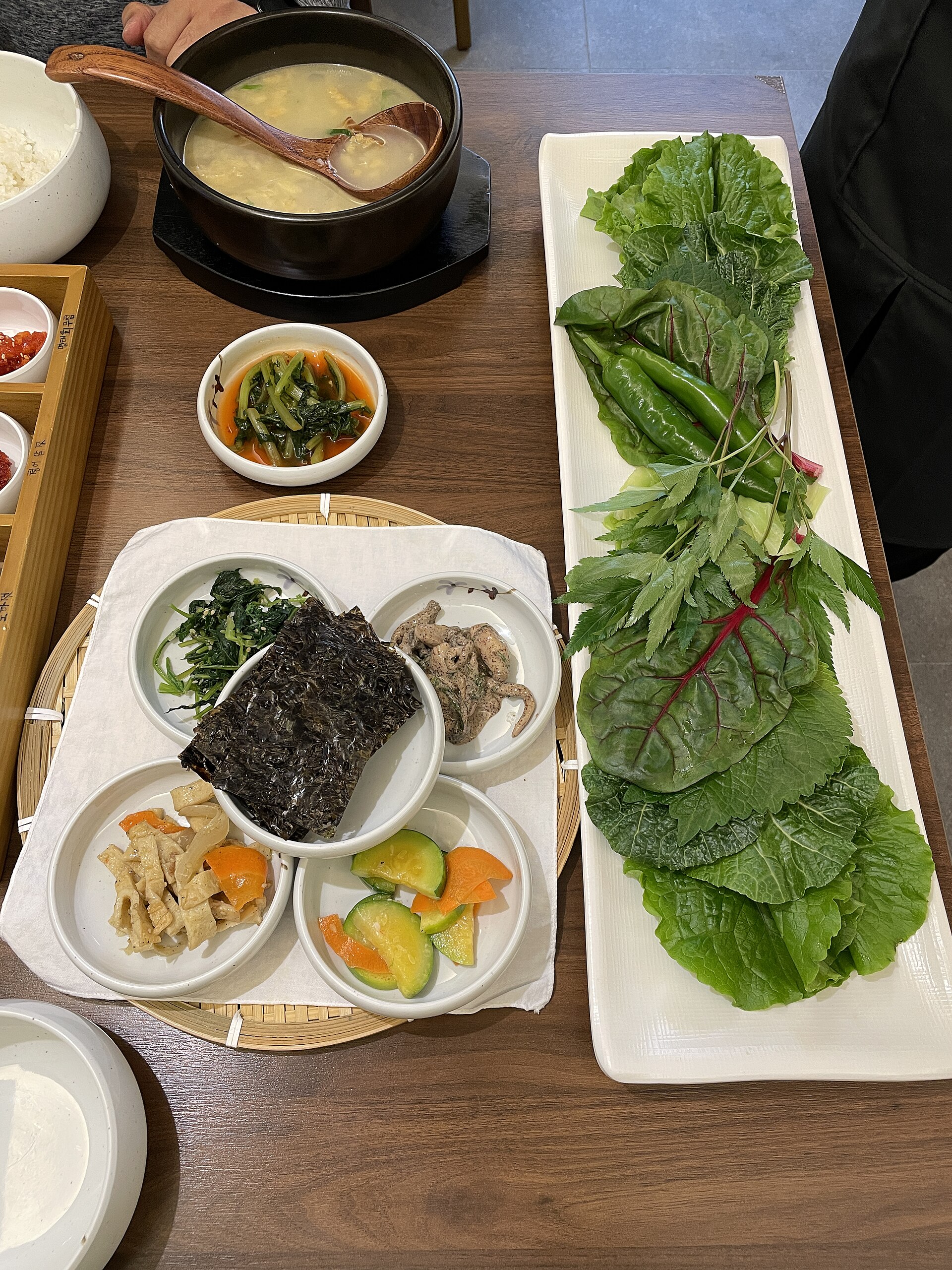
One of the first things that shocks foreign travelers in Korea is the arrival of Banchan (반찬): an assortment of anywhere from 4 to 12 small dishes featuring aged kimchi, seasoned soybean sprouts (kongnamul), savory fish cakes (eomuk bokkeum), pickled radish, and seasoned spinach.
You did not order them, and they are not an appetizer scam: Banchan is 100% free, included with every meal, and fully refillable.
Here is how banchan refills work in practice:
Scenario A: The Table-Service Restaurant
In traditional neighborhood diners (baekban-jip) or stew spots, when a side dish dish is empty, you can simply ask the staff for more.
Press the call bell on your table (or make polite eye contact with the server) and say:
“Imo-nim, kimchi jom deo juseyo.” (이모님, 김치 좀 더 주세요. / “Auntie, could we please have a little more kimchi?”)
Staff will gladly take your small plate and return with a fresh portion at zero extra cost.
Scenario B: The Self-Bar (Selp-ba / 셀프바)
In many modern casual eateries, noodle shops, and barbecue houses, you will spot a refrigerated stainless steel counter lined with open containers of kimchi, pickled garlic, fresh lettuce wraps (ssam), and dipping sauces.
If you see a sign marked 셀프 코너 (Self Corner) or 셀프바 (Self Bar), do not call the server. Walk up with your empty side dish and serve yourself. This is especially standard at Korean barbecue houses (see our complete Korean BBQ dining and grilling guide).
Local Tip: Koreans treat food waste seriously. Take only the portion size you genuinely intend to finish.
Are There Any Exceptions?
While everyday vegetable, tofu, and kimchi side dishes are completely free and unlimited, certain high-value specialty proteins are not.
If a restaurant serves soy-marinated raw crab (ganjang gejang), a whole grilled mackerel, or sliced boiled pork (bossam) as an accompaniment, these premium dishes usually carry a nominal fee for additional servings (typically ₩3,000 to ₩6,000, clearly marked on the menu as banchan chuga / 반찬 추가). When in doubt, ask before ordering a second round.
4. Pouring & Drinking Etiquette: Myth vs. Modern Reality
If you read older guidebooks, you might think drinking alcohol in Korea requires navigating a terrifying social obstacle course. The internet often claims that if you don’t bow at 90 degrees and cover your mouth, your Korean hosts will be deeply offended.
Here is the real truth about how drinking manners operate in 2026:
When Drinking With Friends & Peers
If you are sharing cold beers or soju with friends, fellow travelers, or colleagues of the same age, drinking is completely relaxed and casual. You do not need to turn your head, hold your cup with two hands, or stress over protocol. Clink your glasses, shout “Gunbae!” (Cheers!), and enjoy yourself.
When Drinking With Elders, Superiors, or In-Laws
If you are dining with an older relative, a senior business client, a university professor, or your boss at a company dinner (Hoesik / 회식), traditional manners are still universally observed and deeply respected:
| Etiquette Action | Proper Local Execution | Why It Matters |
|---|---|---|
| Receiving a Drink | Hold your glass with both hands (or hold the glass with your right hand while resting your left fingers gently against your right forearm or wrist). | Demonstrates humility and gratitude toward someone older or higher in status. |
| Pouring for an Elder | Hold the soju or beer bottle with your right hand, supporting the base or your right forearm with your left hand. Never let an elder pour their own drink if you can help it. | Shows that you are serving them with undivided attention. |
| Taking a Sip | Slightly turn your head and upper body to the side (away from the oldest person at the table) and lightly cover your mouth or glass with your free hand as you swallow. | Staring directly into an elder’s eyes while gulping alcohol is considered brash and confrontational. |
While modern corporate dining has grown much more relaxed—with many companies adopting the “1-1-9 rule” (1 venue, 1 type of alcohol, ending before 9 PM)—showing these classic courtesies to an older Korean host will earn you immense respect and instant smiles.
5. The Bill: Why You Never Pay at the Table & The Truth About “Dutch Pay”
At the end of your meal, you might find yourself sitting at your table for twenty minutes waiting for the server to bring your check.
Do not wait: In Korea, you virtually never pay at the table.
The Counter Checkout Rule
When your food was first brought out, the server placed a small printed paper receipt on a plastic clip or wooden board (bil-ji / 계산서) at the corner of your table or slid it into a pocket on the wall divider.
When you are ready to leave:
- Pick up that paper receipt from your table.
- Walk toward the front entrance of the restaurant where the cashier counter (Gyesan-dae / 계산대) and POS terminal are located.
- Hand the paper slip to the cashier and pay by credit card or cash.
(Note: The only common exception is restaurants equipped with tabletop touchscreen ordering tablets that have built-in card readers attached to each screen.)
Who Pays? The Cultural Shift to “더치페이” (Dutch Pay)
For decades, Korean dining operated under a rigid rule: whoever was the oldest or invited the group paid 100% of the bill (“Naega ssalke” / “My treat”). Splitting coins at the table was seen as petty.
Today, that culture has fundamentally transformed:
- The Reality of Dutch Pay: According to a nationwide study of 1,000 Korean adults conducted by Hankook Research (여론 속의 여론), 89% of respondents now view Dutch pay (더치페이) as “clean, fair, and rational,” and 86% consider it convenient. Only 32% perceived it as cold or lacking warmth.
- Equality Across Demographics: The same research revealed that 83% believe dining costs should be shared equally regardless of gender, and 64% believe costs should be split regardless of age.
- How Modern Groups Settle Up: Rather than holding up a crowded cashier counter with six individual credit cards, modern Koreans have one person charge the entire bill to their card at the front desk. Within 30 seconds, everyone else in the group uses mobile banking apps like KakaoPay or Toss to send their exact 1/N share directly to the payer’s bank account.
- For Foreign Travelers: If you and your travel companions are using foreign credit cards without Korean mobile banking, you can ask the cashier: “Ttaro gyesan halgeyo” (따로 계산할게요 / “We would like to pay separately”). In mid-afternoon or quiet hours, cashiers will gladly swipe separate cards. However, during high-volume weekday lunch rushes, paying on one card and settling up among yourselves in cash outside is common courtesy.
Absolute 0% Tipping
South Korea has a strict 0% tipping culture. There is no tip line on your credit card slip, and tipping jars do not exist. Excellent service, side dishes, iced water, and table setup are all included in the listed menu price. If you leave cash behind on your table, the waitstaff will run out into the street to return your “forgotten” money.
6. Seasonal Travel Alert: Chuseok & Major Holiday Dining Closures
If you are traveling in South Korea during major traditional holidays—most notably Chuseok (추석 / Korean Harvest Thanksgiving) in autumn or Seollal (설날 / Lunar New Year) in winter—you need to plan your dining itinerary carefully.
During these 3-to-4-day national holidays, millions of Seoul residents travel to their provincial hometowns (gohyang) for family ancestral gatherings. As a result:
- Independent & Mom-and-Pop Closures: Traditional neighborhood eateries, family-run soup shops (gukbap-jip), historic dining spots (nopo), and traditional street markets (like Gwangjang Market and Namdaemun Market) frequently shut down completely for 2 to 3 days.
- What Remains Open: Major chain restaurants, fast-food franchises, 24-hour convenience stores, department store food courts (which typically close only on the day of the holiday itself), and high-density tourist districts like Myeongdong and Hongdae remain operational.
- How to Avoid Being Stranded: Never take a 45-minute subway ride across town for a specific famous restaurant during holiday weeks without checking first. Search for the restaurant on Naver Map or KakaoMap and check their operating hours notice (“추석 연휴 휴무” = Closed for Chuseok holiday; “정상 영업” = Operating normally).
Frequently Asked Questions (FAQ)
Can I ask for scissors to cut my food in a Korean restaurant?
Yes, absolutely. Kitchen shears (gawi) are a staple utensil in Korean dining. They are routinely provided for barbecue, cold noodles (naengmyeon), kimchi, and whole pieces of braised meat. If you need scissors, simply ask: “Gawi jom juseyo” (가위 좀 주세요).
What if I cannot use metal chopsticks?
Korean metal chopsticks are notoriously thin and flat, making them slippery and tricky for beginners. You can politely ask the restaurant staff for wooden disposable chopsticks (namu jeotgarak) or a fork: “Namu jeotgarak isseoyo?” (나무 젓가락 있어요?) or “Pokeu isseoyo?” (포크 있어요?). Most restaurants keep them behind the counter.
Can I ask for a doggy bag to take leftover banchan home?
In general, Korean restaurants happily pack leftover main dishes (such as whole pizzas, fried chicken, or large stews) into takeout containers (pojang). However, packing up leftover free banchan (side dishes) to take home is considered bad form. Because banchan is provided generously and free of charge for the table experience, it is meant to be enjoyed on-site.
Summary Checklist: Korean Table Etiquette at a Glance
- Before eating: Pull open the table’s side drawer to find utensils; set a napkin and cutlery for your dining partners.
- Utensil safety: Never plant chopsticks or spoons upright in your rice bowl (associated with death rituals). Keep rice and soup bowls resting flat on the table.
- Side dishes: Banchan is 100% free and refillable. Ask the server or visit the self-bar, but only take what you can finish.
- Drinking etiquette: With peers, relax. With elders or superiors, pour and receive with two hands, and turn your head away to take a sip.
- Paying the bill: Take your paper table slip to the front cashier counter by the door. 0% tipping is strictly observed everywhere.
- Holiday planning: During Chuseok and Seollal, confirm whether independent restaurants are open on Naver Map before making long trips.
Planning Your Korea Trip? Don't Pay Full Price! ✨
Save $20–$50 per person with our verified reader perks & skip the long ticket booth queues:
AREX Incheon ↔ Seoul Express
Non-stop 43-min direct train with guaranteed reserved seats & free Wi-Fi. Scan your mobile QR straight at the gate!
Get 20% Off AREX Ticket →Korea Unlimited 5G eSIM
Skip the 30-min airport counter line. Scan the QR code to connect instantly for smooth Naver Maps navigation.
Compare Korea eSIM Options →WOWPASS Card (Pay + T-Money)
Pay anywhere in Korea with zero FX fees + subway card. Use code KOREAEASY for 0.5% cash top-up bonus!
Top Seoul Passes & Day Tours
Guaranteed entry for Lotte World, Nami Island tours, CIMER Spa, and Hanbok palace rentals with instant mobile vouchers.
Browse Top Seoul Deals →