Food & Dining
Korean Convenience Store Ramen at the Han River: Cooking Machines, CU Hongdae & 10 Noodles to Try
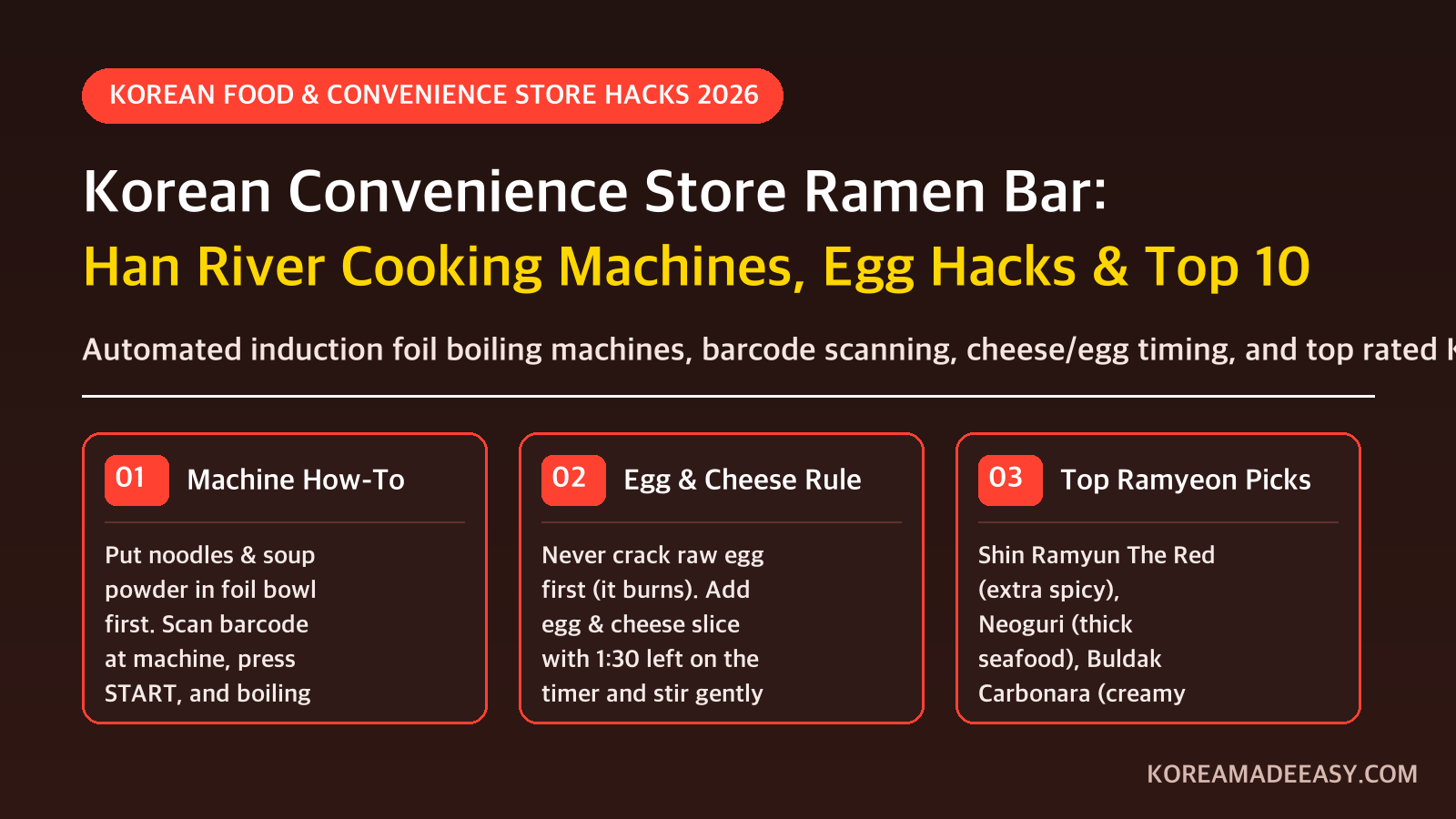
The payoff Unsure how the Korean buttons and machines work → A hot bowl of Hangang ramyeon by the river.
Research context: Foreign visitors' questions about cooking instant ramen at convenience stores in Han River parks
Sitting on a bench at dusk, watching the city lights reflect across the Han River, and slurping a hot bowl of Hangang Ramyeon (한강 라면).
Cooking instant noodles on a machine at a convenience store (Ramyeon Jorigi, 라면 조리기) has become a popular ritual for travelers in Seoul. But standing in front of a machine with Korean buttons can feel stressful:
- “Do I need a special bowl?”
- “Why is the machine beeping?”
- “When do I add the egg and cheese?”
Here is a practical guide to convenience store ramen machines in Seoul, where Seoul’s official pages say to find them, and 10 popular Korean noodles to try. Machines differ between stores, so treat the steps below as general guidance and follow the instructions on the machine.
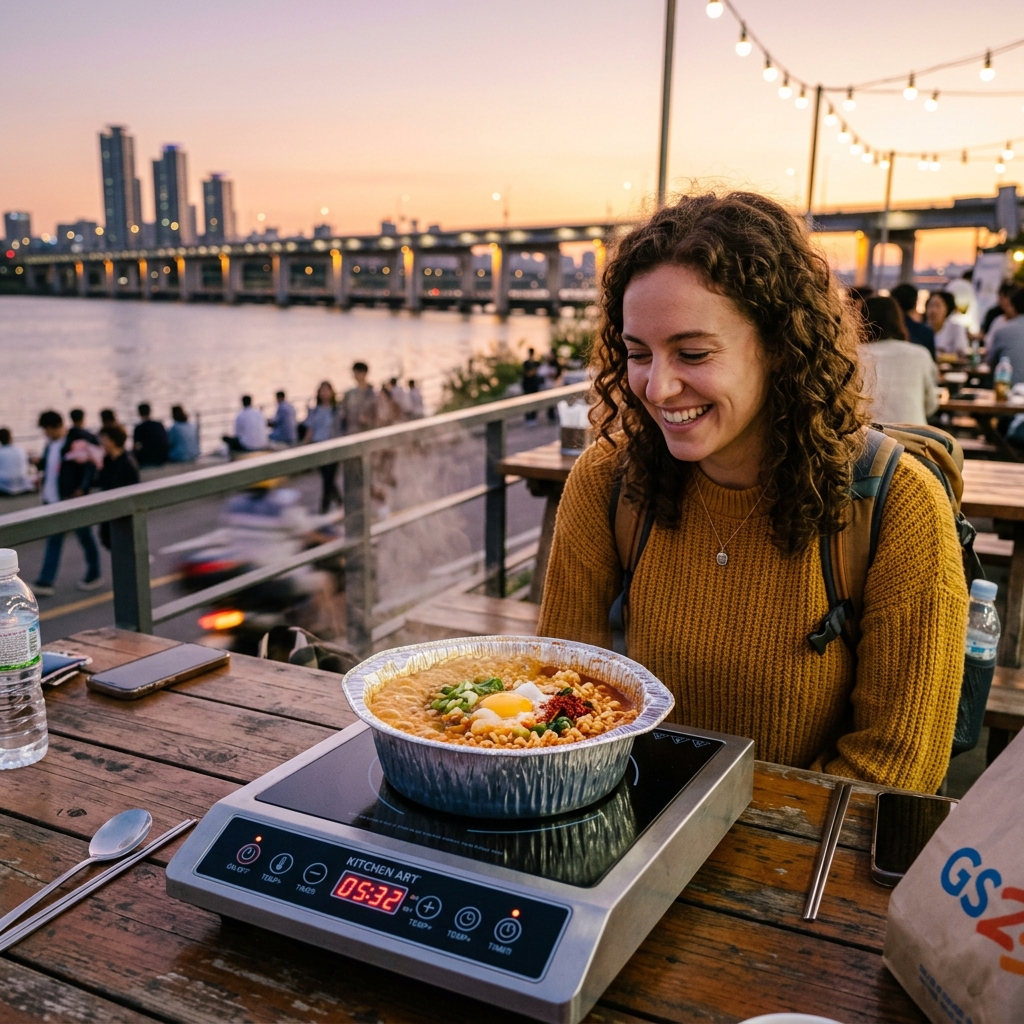
A traveler cooking instant ramen at a riverside convenience store terrace along the Han River in Seoul.
1. How the Ramen Machine Works
Seoul’s media hub describes the process at a Ttukseom Hangang Park convenience store simply: choose a ramen, place it on the machine, and wait. The writer notes that the machine adjusts the amount of water precisely, so you wait a short time for firm noodles.
| Step | What to do | Tips |
|---|---|---|
| 1. Buy your ramen | Pick a packet or cup ramen at the shelf and pay at the counter. | Some stores sell a special cooking container. If you are not sure what to buy for the machine, ask the staff. |
| 2. Follow the machine’s instructions | Place the ramen or container on the machine as the on-screen or printed instructions show. | Machines and buttons differ by store; do not guess, ask. |
| 3. Wait | The machine controls the water and timing. | Keep your fingers away from hot steam and surfaces. |
| 4. Eat and clean up | Take your bowl to the seating area. | Throw away trash in the designated bins and ask staff where to pour out leftover soup. |
2. Adding an Egg or Cheese
Many people add toppings such as an egg or a slice of cheese. Because machines differ, ask the staff when to add them.
3. 10 Popular Korean Instant Noodles to Try
This is a personal list of widely available noodles, not an official or sales ranking. Availability varies by store.
| Noodle | Style |
|---|---|
| Shin Ramyun (신라면) | Classic spicy beef-style soup noodles |
| Buldak Carbonara (불닭 까르보나라) | Spicy fire chicken flavor with a creamy sauce |
| Neoguri (너구리) | Thick, chewy noodles in a spicy seafood-style broth |
| Jin Ramen (진라면) | Everyday soup noodles, available in mild and spicy versions |
| Chapagetti (짜파게티) | Black bean sauce (Chajang) noodles; some people mix it with Neoguri to make “Chapaguri” |
| Yukgaejang Bowl Noodle (육개장 사발면) | Cup noodles in a spicy beef-soup style |
| Chamkkae Ramyun (참깨라면) | Sesame-flavored soup noodles |
| Ansungtangmyun (안성탕면) | Savory, mildly spicy soup noodles |
| Paldo Bibimmyun (팔도 비빔면) | Cold, sweet-and-spicy mixed noodles; rinse with cold water |
| Buldak Quattro Cheese (불닭 콰트로치즈) | Spicy noodles with a cheese flavor |
4. Where to Find Ramen Machines in Seoul
1. Han River convenience stores
Seoul’s media hub says there is a CU on the ground floor of each Hangang Bus pier, and ramen bought there (“한강라면”) can be cooked in a cooker installed outside the pier, with seating in front. That article is about a year old, so check whether the pier you plan to visit is currently operating. Its article on Ttukseom Hangang Park also describes choosing a ramen at the convenience store near Jayang Station and placing it on a machine.
2. CU Hongdae Sangsangjeom (CU 홍대상상점)
- Location: Jandari-ro 25, Mapo-gu, Seoul (near Hongik University).
- What it is: A ramen-themed CU. Seoul’s media hub describes a display of many types of ramen, including familiar brands and Seoul-themed ramen, and a ramen cooker for eating on the spot.
- Hours: Open year-round according to Seoul’s media hub; it gives no daily hours, so check before you go.
For evening views of the river, see the Banpo Moonlight Rainbow Fountain page on Visit Seoul. The timetable on that page is labeled 2024, so check the current seasonal schedule before you plan around a show.
5. Emergency Korean Showcards: Save to Your Phone
Show these bilingual phrases to convenience store staff:
📱 Showcard 1: Asking How to Use the Ramen Machine
“봉지 라면을 즉석 조리기계로 끓여 먹으려고 하는데, 어떻게 하면 되나요?” (Bongji ramyeon-eul jeukseok jorigigye-ro kkeullyeo meogeuryeogo haneunde, eotteoke hamyeon doenayo?)
💬 Translation: “I want to cook packet ramen on the machine. How do I do it?”
📱 Showcard 2: Asking for a Raw Egg & Cheese Slice for Ramen
“라면에 넣어 먹을 날계란(날달걀) 하나랑 슬라이스 치즈 있나요?” (Ramyeon-e neoheo meogeul nalgyeran [naldalgyal] hanarang seullaisu chijeu innayo?)
💬 Translation: “Do you have a raw egg and a slice of cheese to put inside the ramen?”
Before cafe-hopping through Seongsu, familiarize yourself with one-drink-per-person rules and ordering customs in our Korean cafe culture etiquette guide.
6. Frequently Asked Questions (FAQ)
Q1: What should I do if the machine does not work or shows an error?
Do not keep pressing buttons. Ask the staff at the counter; they know how that store’s machine works.
Q2: How do I dispose of leftover soup?
Do not pour red soup into bushes or public sinks. Ask the staff where to pour it out and where to throw the container. Seoul’s Han River park ordinance lists a fine for litter left outside designated places.
Q3: Can I drink alcohol with my ramen at Han River parks?
See our convenience store and Han River alcohol guide for what Seoul’s park ordinance says about noise, litter and cooking.
Official sources to check
- Seoul Media Hub, Hangang Bus piers: a CU on each pier’s ground floor, with ramen cookers outside and seating.
- Seoul Media Hub, Ttukseom Hangang Park guide: picnic rentals, tent rules, and a convenience store ramen machine near Jayang Station.
- Seoul Media Hub, CU Hongdae Sangsangjeom: the ramen-themed CU at Jandari-ro 25, Mapo-gu.
- Visit Seoul, Banpodaegyo Bridge Moonlight Rainbow Fountain: fountain information; its timetable is labeled 2024, so check the current schedule.
- Han River Parks, Prohibited acts and fines: the ordinance’s litter and noise fines.
Machine models, container rules, prices and store hours vary and change; follow the instructions in the store.
Sources
- https://mediahub.seoul.go.kr/archives/2015475
- https://mediahub.seoul.go.kr/archives/2011031
- https://mediahub.seoul.go.kr/archives/2010510
- https://english.visitseoul.net/attractions/Banpodaegyo-Bridge-Moonlight-Rainbow-Fountain_/2222
- https://hangang.seoul.go.kr/www/contents/646.do?mid=427
This is independent guidance, not an official operator or government publication. Evidence and check dates vary by article. See our editorial and corrections policy for the distinction between source checks, personal visits and planning advice.
Korean Convenience Store Drinking & Han River: Alcohol Rules, Outdoor Tables & Hangover Cures
Korean Restaurant Dining Etiquette: Chopsticks, Free Banchan Refills, Drinking Rules & How to Pay