Travel
Seoul Weather in Winter (December–February): What to Wear and Pack
Research context: Seasonal search demand for Seoul winter weather and what to wear
Winter in Seoul surprises many visitors — not because sightseeing slows down, but because the cold is dry, crisp, and paired with heavily heated indoor spaces. From December through February, average overnight lows remain below freezing, and January’s average afternoon high reaches only 2.1°C (35.8°F).
Packing well for Seoul in winter means preparing for two climates in the same hour: freezing streets outside and warm subways, cafes, and floor-heated rooms inside.
Seoul Winter Temperature & Precipitation Normals (November–March)
The table below compiles Seoul’s official 1991–2020 climate normals from the World Meteorological Organization (WMO) World Weather Information Service, including November and March as shoulder months.
| Month | Mean Daily Min | Mean Daily Max | Mean Precipitation Days | Mean Total Precipitation |
|---|---|---|---|---|
| November | 3.5°C (38.3°F) | 11.9°C (53.4°F) | 8.8 days | 51.1 mm |
| December | −3.4°C (25.9°F) | 4.2°C (39.6°F) | 7.8 days | 22.6 mm |
| January | −5.5°C (22.1°F) | 2.1°C (35.8°F) | 6.1 days | 16.8 mm |
| February | −3.2°C (26.2°F) | 5.1°C (41.2°F) | 5.8 days | 28.2 mm |
| March | 1.9°C (35.4°F) | 11.0°C (51.8°F) | 7.0 days | 36.9 mm |
Source: WMO World Weather Information Service — Seoul (1991–2020 normals). Precipitation days and millimeter totals combine rain and snow together; separate snowfall-day counts are not reported in this dataset.
- January is the coldest stretch: Mean lows fall to −5.5°C (22.1°F) and daytime highs average 2.1°C (35.8°F), so morning and evening walks stay below freezing.
- December vs. February: Early December still transitions out of autumn (November averages 11.9°C highs), while late February gradually warms toward March.
- Normals are 30-year averages, not daily limits: Actual winter days can run noticeably milder or much colder. The Korea Meteorological Administration (KMA) issues a Cold Wave Advisory when morning lows are forecast at −12°C or lower for two or more consecutive days (or drop 10°C+ overnight to 3°C or below and 3°C below normal), and a Cold Wave Warning at −15°C or lower for two consecutive days (KMA Advisories & Warnings).
Comparing seasons? See our Seoul weather in September and October guide.
Why the Cold Feels Sharper: 삼한사온 and Wind Chill (체감온도)
Two Korean weather terms explain why winter temperatures can feel unpredictable day to day.
삼한사온 (三寒四溫, samhan-saon): The National Institute of Korean Language’s Standard Korean Dictionary (표준국어대사전) defines 삼한사온 as a winter temperature fluctuation in Korea and eastern/northern Asia marked by a seven-day cycle of three cold days followed by four warmer days (7일을 주기로 사흘 동안 춥고 나흘 동안 따뜻하다). How consistently that pattern appears in modern winters varies and is not asserted here, but it illustrates why one week in Seoul can mix mild sunshine with sharp cold snaps.
체감온도 (體感溫度, feels-like temperature): The Standard Korean Dictionary defines 체감온도 as a quantitative measure of how hot or cold the human body feels, calculated from air temperature, humidity, wind speed, solar radiation, and thermal radiation. In winter, wind makes the biggest difference. Generally, exposed stretches along the Han River, wide avenues, bridges, and elevated areas feel colder than sheltered alleys at the exact same air temperature.
Dressing for Two Climates: Freezing Streets and Heated Indoors
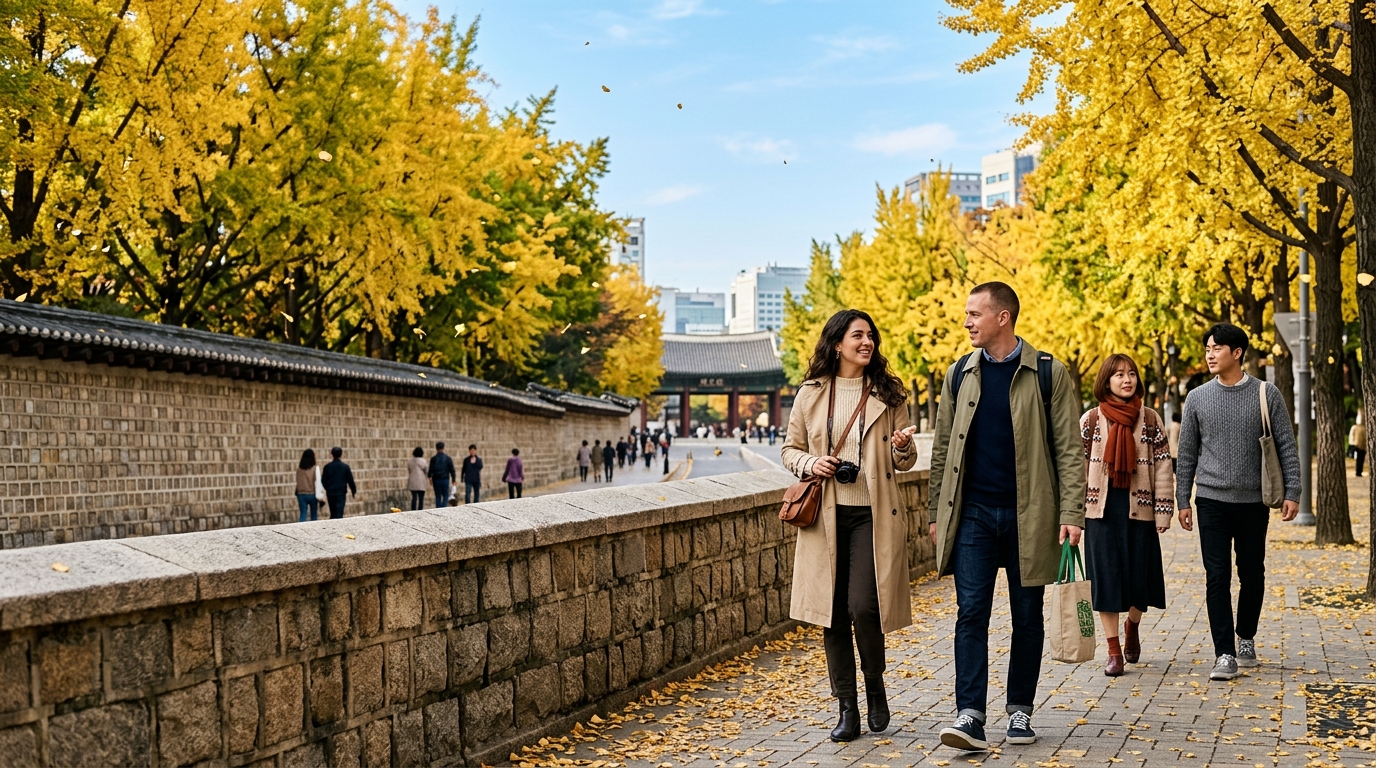
Winter days in Seoul swing constantly between sub-zero streets and heated subway cars, restaurants, and shops. Dressing in removable layers prevents overheating indoors.
Practical winter layering structure (adjust to the live forecast):
- Base layer: A breathable thermal undershirt and, on colder days, thermal leggings or tights under trousers.
- Mid-layer: A zip-up fleece, knit sweater, or cardigan that adds insulation outdoors and comes off easily inside cafes or subways.
- Outer layer: A wind-blocking insulated coat or parka — ideally long enough to cover the hips — with a hood or high collar.
- Extremities: Warm socks, gloves, a scarf or neck gaiter, and a knit hat or earmuffs.
- Footwear: Closed-toe, water-resistant shoes or winter boots with grippy, slip-resistant soles. Overnight refreezing and light snow can make shaded sidewalks, stone palace courtyards, and subway steps icy.
Dry heated indoor air also makes lip balm and hand cream worth packing, along with a compact umbrella in case winter precipitation arrives as sleet or cold rain.
Indoor Heating, Transit, and Winter Trip Planning
- Korean floor heating (ondol): Many apartments and Airbnbs use under-floor heating controlled by a Korean wall boiler panel. Check our Korean Floor Heating & Airbnb Boiler Guide before your first night so you can set heat and hot water easily.
- Warming up indoors: Traditional Korean bathhouses offer hot pools and heated rooms on bitter afternoons — see etiquette rules in our Korean Jjimjilbang Guide for Foreigners.
- Transit vs. walking: Cold wind pushes many winter visitors onto subways and buses more often. Compare unlimited short-term passes against per-ride fares in our Seoul Climate Card for Tourists guide.
- Heavy winter suitcases: Bulky coats and boots add luggage weight quickly; for hands-free arrival days, check our Incheon Airport Luggage Delivery to Seoul Hotel guide.
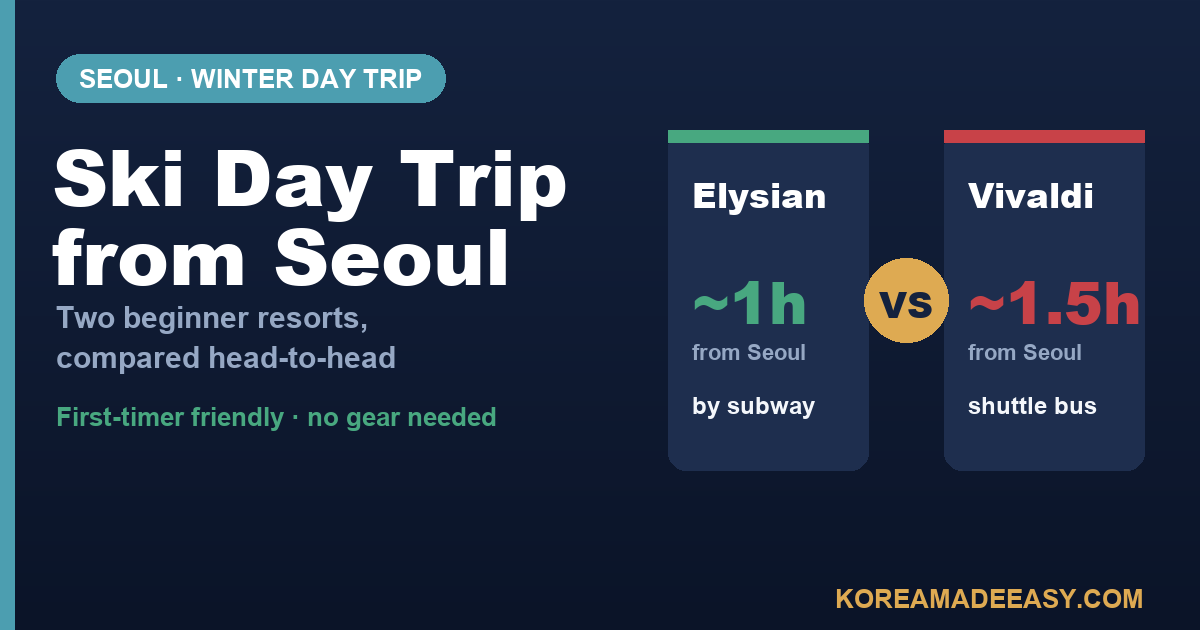
- Ski day trips: Adding slopes outside Seoul? Compare beginner-friendly resorts in our Ski Day Trip from Seoul: Elysian vs Vivaldi Park guide.
- Late-December into 2027 trips: If your trip extends past December 31, 2026, check entry updates in our K-ETA in 2027 guide.
FAQ
Does it snow in Seoul in winter? Yes, winter precipitation can fall as snow, sleet, or cold rain, though winter is Seoul’s driest season by total volume. WMO 1991–2020 normals average 5.8 to 7.8 precipitation days and 16.8 to 28.2 mm per month from December to February (combining rain and snow; separate snowfall-day counts are not listed). KMA issues a Heavy Snowfall Advisory when 24-hour snowfall is expected to reach 5 cm or more. Pack slip-resistant shoes for snow or black ice rather than assuming constant snow cover.
How cold does Seoul get in December, January, and February? WMO 1991–2020 normals show daily lows to highs of −3.4°C to 4.2°C in December, −5.5°C to 2.1°C in January, and −3.2°C to 5.1°C in February. Cold snaps can drop well below those averages (KMA Cold Wave Advisories start at −12°C morning lows for two consecutive days), and wind chill (체감온도) makes exposed streets feel colder.
Where should I check the Seoul weather forecast before flying? Check official forecasts a few days before departure rather than relying solely on monthly normals. KMA publishes English-language Short-Range Forecasts, Nationwide Medium-Range Forecasts, and live Severe Weather Status / Advisories covering cold waves and heavy snow.
Sources checked
- WMO World Weather Information Service — Seoul JSON (cityId 231) & Seoul City Page — 1991–2020 monthly mean lows/highs, precipitation days, and precipitation totals for Nov–Mar (checked 2026-11-25).
- Standard Korean Dictionary (표준국어대사전) — 삼한사온 — definition of the 7-day 3-cold / 4-warm winter cycle (checked 2026-11-25).
- Standard Korean Dictionary (표준국어대사전) — 체감온도 — definition factoring temperature, humidity, wind speed, solar radiation, and thermal radiation (checked 2026-11-25).
- Korea Meteorological Administration (KMA) — Short-Range Forecasts, Medium-Range Forecasts, and Severe Weather Status / Criteria — official English forecasts and Cold Wave / Heavy Snowfall criteria (checked 2026-11-25).
- Note: WMO 1991–2020 figures combine rain and snow without separate snowfall-day counts, and 30-year averages do not predict weather on specific dates. Recent climate frequency of 삼한사온 was not verified and is not claimed. No 2026–27 winter event schedules, clothing brands, or prices are included; verify live forecasts on KMA shortly before departure.
Sources
- https://worldweather.wmo.int/en/json/231_en.json
- https://worldweather.wmo.int/en/city.html?cityId=231
- https://stdict.korean.go.kr/search/searchResult.do?searchKeyword=%EC%82%BC%ED%95%9C%EC%82%AC%EC%98%A8
- https://stdict.korean.go.kr/search/searchResult.do?searchKeyword=%EC%B2%B4%EA%B0%90%EC%98%A8%EB%8F%84
- https://www.kma.go.kr/neng/forecast/short-term.do
- https://www.kma.go.kr/neng/forecast/mid-term-forecast.do
- https://www.kma.go.kr/neng/forecast/warning.do
This is independent guidance, not an official operator or government publication. Evidence and check dates vary by article. See our editorial and corrections policy for the distinction between source checks, personal visits and planning advice.