Money & Shopping
Where Credit Cards Fail in Korea (2026): The Cashless Myth & Exact Cash You Need
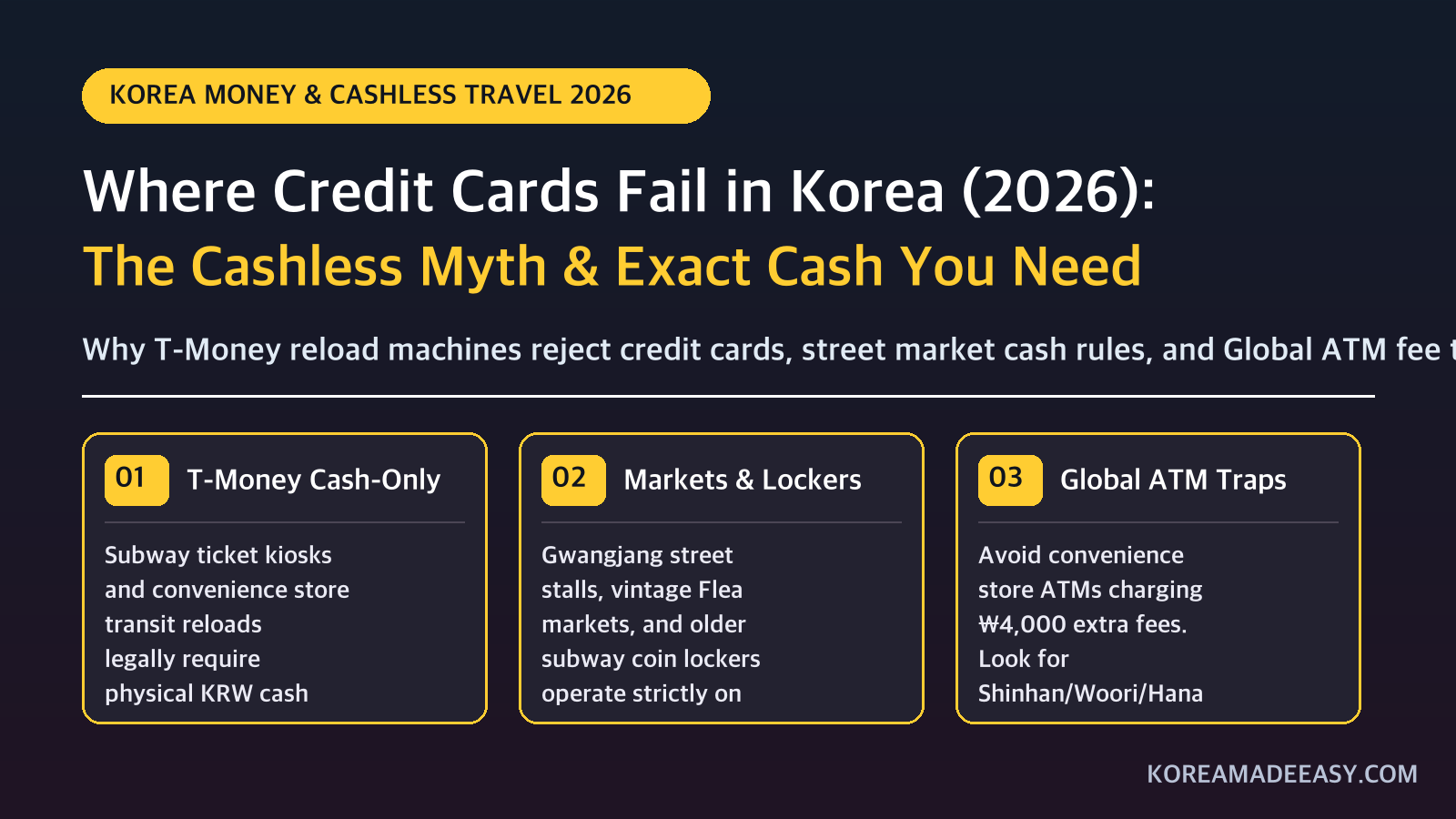
The payoff Anxious about getting stranded at subway turnstiles with a rejected card → Effortlessly navigating Seoul with the perfect blend of credit cards and strategic Won cash.
📈 Trend signal: Foreign Card Terminal Acceptance & Transit Cash Laws (Financial Services Commission Korea)
If you have researched traveling to South Korea on YouTube, Reddit, or travel blogs, you have almost certainly encountered this popular claim:
“South Korea is virtually 100% cashless! You can pay for everything with your foreign Visa or Mastercard—don’t bother bringing paper money.”
While it is true that Seoul is one of the most technologically advanced digital economies on earth, relying entirely on credit cards will leave you stranded at some of the most critical moments of your trip.
Every single week, international visitors get stuck at subway turnstiles unable to reload their transit cards, get rejected at viral food stalls in Gwangjang Market, or get hit with massive service fees at corner store ATMs.
Here is the local breakdown of where credit cards fail in Korea in 2026, why transit machines refuse foreign cards, how to avoid ATM fee traps, and exactly how much cash you actually need.
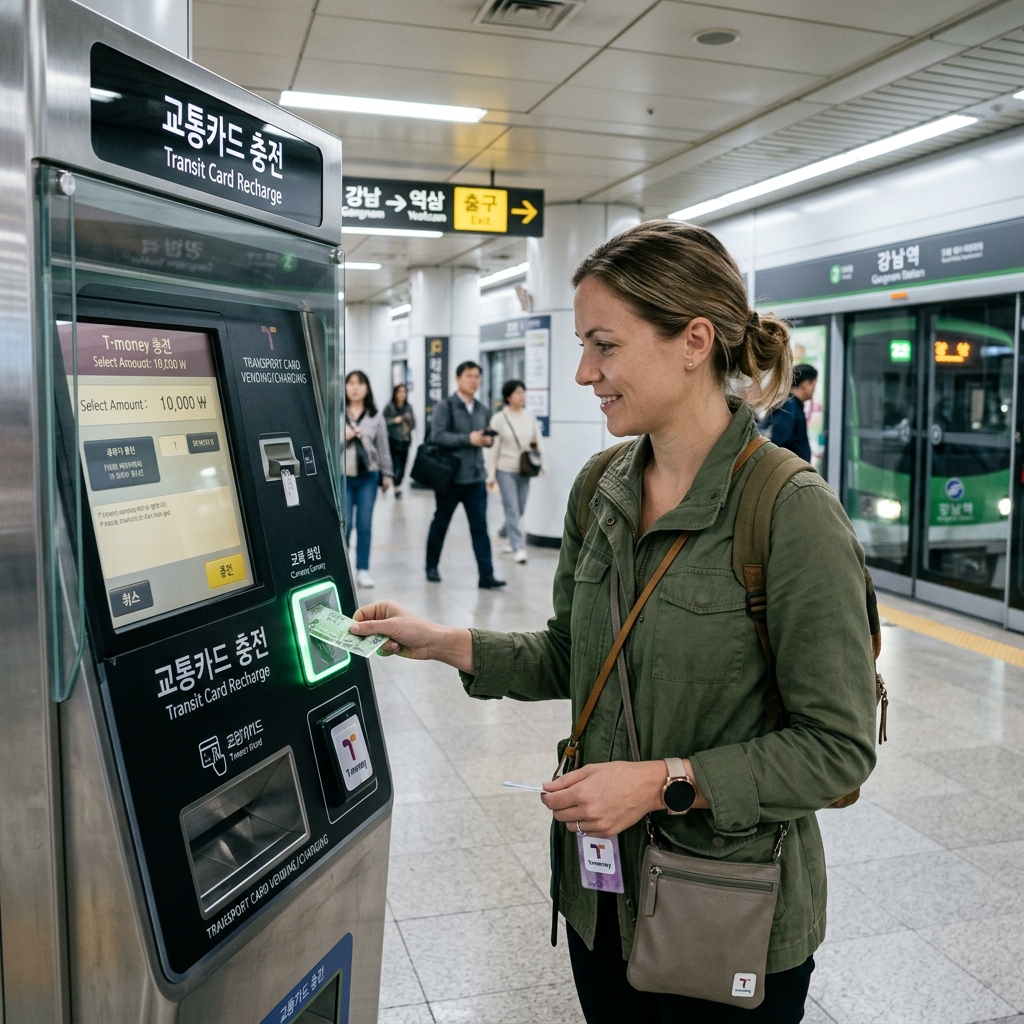
A traveler recharging a T-money card at a Seoul Metro kiosk. Keep cash ready for T-money reloads; only designated new kiosks take foreign cards, and only for Climate Card passes and single-journey tickets.
1. The Top 5 Places Where Credit Cards Fail in Seoul
Understanding where card terminals do not work allows you to plan your daily wallet without carrying bulky stacks of bills:
| Location / Service | Card Acceptance Status | Why Cards Fail | What You Must Use |
|---|---|---|---|
| Subway T-Money Card Reload Kiosks | ⚠️ Cash Default | Designated Seoul Metro kiosks accept foreign cards for Climate Cards and single tickets (~3.7% fee), but standard physical T-money reloads rely on paper cash. | Physical KRW Paper Cash (₩1,000, ₩5,000, ₩10,000 notes). |
| Convenience Store Transit Reloads (CU, GS25) | ❌ Cash Only | Convenience store cash registers require cash for regular physical T-money top-ups. | Physical KRW Paper Cash. |
| Traditional Markets & Food Carts | ⚠️ 90% Cash / Bank Transfer | Street vendors (Gwangjang Bindaetteok, Namdaemun Hotteok, Myeongdong carts) operate without card POS terminals. | Physical KRW Cash or Korean Domestic Bank Transfer (Gyejwa-iche). |
| Neighborhood 24/7 Coin Laundromats | ⚠️ Coins or Domestic Kiosk Only | Central kiosks reject foreign credit cards due to domestic VAN gateway locks, and change machines reject ₩50,000 notes. | ₩500 coins or cash via bill changer (See our Coin Laundromat Guide). |
| Older Subway Station Coin Lockers | ❌ Coin / Cash Only | Mechanical luggage lockers at older stations (Line 1 to 4) require physical ₩500 coins. | ₩500 coins or newer T-Locker Digital App Lockers. |
| Vintage Flea Markets & Temple Donations | ❌ Cash Only | Dongmyo Vintage Flea Market stalls and Buddhist temple gift shops do not have wireless card readers. | Physical KRW Cash. |
💡 Where Cards Work Flawlessly: 99% of modern convenience stores, cafes, Olive Young stores, sit-down restaurants, KTX ticket counters, and taxis accept foreign Visa, Mastercard, AMEX, and WOWPASS cards.
2. Transit Top-Up Rules: Cash Default vs. Supported Kiosks
A common surprise for arriving visitors is discovering that regular physical T-money balance reloads at convenience store counters and standard station machines require paper cash (Korean Won notes).
Key points to know:
- Designated Foreign-Card Kiosks: On Seoul Metro Lines 1–8, around 440 designated kiosks across 273 stations accept international credit cards specifically for single-journey tickets and Climate Card short-term tourist passes (subject to an average ~3.7% service fee).
- Standard Physical T-Money: For standard physical T-money card balance reloads, station machines and convenience stores generally do not accept foreign credit cards. Check official station guidance by machine type and keep paper cash on hand as the reliable default.
- Cashless Alternatives: If you prefer avoiding cash, use WOWPASS (foreign currency cash deposits) or the Seoul Climate Card Tourist Pass on supported kiosks.
🛠️ The Cashless Transit Solution: If you hate carrying cash for transit, you have two modern alternatives:
- Seoul Climate Card Tourist Pass: Purchase an unlimited 1-day to 7-day tourist pass (available with international credit cards at supported station kiosks, or cash at older machines) for unlimited subway/bus rides without tracking balances.
- WOWPASS Card: Insert foreign currency (USD, EUR, SGD, JPY) directly into orange WOWPASS airport kiosks to top up your shopping card and built-in T-money wallet.
3. ATM Traps: Bank Global ATMs vs. Convenience Store ATMs
If you run out of cash in Seoul, do not insert your overseas debit card into the first machine you see.
The Convenience Store ATM Trap (Avoid If Possible)
Inside CU, GS25, and 7-Eleven stores, you will find standalone ATM machines operated by third-party financial networks (such as Nice, HanNet, or Cyber).
- The Problem: They charge high local operator fees (often ₩3,500 to ₩4,500 per withdrawal) on top of your home bank’s international fees.
- Aggressive DCC: They often force Dynamic Currency Conversion (DCC), converting your withdrawal into your home currency at unfavorable exchange rates.
The Solution: Official Bank “Global ATMs”
Look for official street-level branches of major South Korean commercial banks:
- Shinhan Bank (신한은행)
- Woori Bank (우리은행)
- Hana Bank (하나은행)
- KB Kookmin Bank (KB국민은행)
Walk inside the automated glass lobby and find the machine clearly marked with the blue “Global ATM” (글로벌 ATM / 외국카드) logo.
📌 Global ATM Best Practices:
- Select “Foreign Card / International Card” on the touchscreen.
- Always choose “Withdraw in KRW (South Korean Won)” without DCC conversion, letting your home bank handle the foreign exchange rate.
- Standard bank ATM fees for international cards are typically ₩3,000–₩3,600, with much higher withdrawal limits (up to ₩1,000,000 per transaction).
4. How Much Cash Should You Actually Carry?
Use this simple formula to calculate your cash budget for a Seoul trip in 2026:
💵 The Recommended Daily Cash Buffer:
Solo Traveler: Carry ₩20,000 to ₩30,000 ($15–$22 USD) in cash per day.
Couples / Families: Carry ₩50,000 ($37 USD) in cash per day.
Typical Breakdown of Daily Cash Spending:
- Subway / Bus T-Money top-up: ₩4,000 – ₩6,000
- Street food stall snacks (Hotteok, Tteokbokki, Skewers): ₩5,000 – ₩10,000
- Emergency taxi / locker coin reserve: ₩10,000
5. Emergency Korean Showcards: Save to Your Phone
Show these bilingual phrases on your screen if you need help finding cash or making payments:
📱 Showcard 1: Finding the Nearest Bank Global ATM
“해외 카드 출금 가능한 글로벌 ATM(외국 카드 기기)이 어디에 있나요?” (Haeoe kadeu chulgeum ganeunghan geullobeol ATM [oeguk kadeu gigi] ga eodie innayo?)
💬 Translation: “Where is the nearest Global ATM that accepts international credit/debit cards?”
📱 Showcard 2: Asking if a Street Stall Accepts Card or Cash Only
“여기 카드 결제 되나요, 아니면 현금만 가능한가요?” (Yeogi kadeu gyeolje doenayo, animyeon hyeon-geum-man ganeunghangayo?)
💬 Translation: “Do you accept credit cards here, or is it cash only?”
International cardholders attempting online verification often hit security errors; troubleshoot with our foreign credit card OTP and 3D Secure fix guide.
6. Frequently Asked Questions (FAQ)
Q1: Does Apple Pay work in South Korea?
Apple Pay is accepted at major franchise convenience stores (GS25, CU, 7-Eleven, Emart24), Hyundai Department Store, Olive Young, Starbucks, and McDonald’s. However, Apple Pay does NOT work on Seoul subways, city buses, or at standard independent neighborhood restaurants and markets, because local terminals use proprietary MST/IC standards rather than open NFC transit protocols.
Q2: Should I exchange money at Incheon Airport or in the city?
Airport bank exchange booths have the highest markups (often 4% to 8% worse than market rates). Only exchange $20–$50 USD at the airport for immediate subway cash, and exchange the rest at authorized money changers in Myeongdong (such as Money Box or Ambassador Exchange) for near-spot exchange rates.
Q3: What happens if my card gets declined at a restaurant kiosk?
Many Korean self-order touch kiosks fail with foreign credit cards due to 3D-Secure foreign authentication timeouts. If your card fails, step up to the kitchen counter and ask the staff: “Card payment at counter please” (See our Korean Kiosk Declined Guide).
Planning Your Korea Trip? Compare Your Options
Compare transport, mobile data, and attraction options. Prices and eligibility depend on your selected date and package.
AREX Incheon ↔ Seoul Express
Express train between Incheon Airport and Seoul Station. Follow the selected voucher’s seat reservation and redemption instructions.
Check AREX Express Tickets →Korea eSIM Options
Compare Korea eSIM search results. Check data allowance, supported network, device compatibility, activation, and speed limits.
Compare Korea eSIM Options →WOWPASS Card (Pay + T-Money)
Compare WOWPASS and T-money. Payment and transit balances are separate; check issuance, top-up, exchange, and withdrawal fees.
Read WOWPASS vs T-money →Top Seoul Passes & Day Tours
Browse general Seoul activity search results. This is not a guaranteed-entry pass or a fixed-discount offer; check each product’s inclusions.
Browse Seoul Activity Options →Sources
- Bank of Korea Payment & Settlement Systems Report
- Seoul Metro Transit Payment Regulations
- Korea Financial Telecommunications & Clearings Institute
Search-trend data from Google Trends (KR) and Naver DataLab. This article is independent commentary and is not affiliated with any broadcaster, agency, or the individuals mentioned.
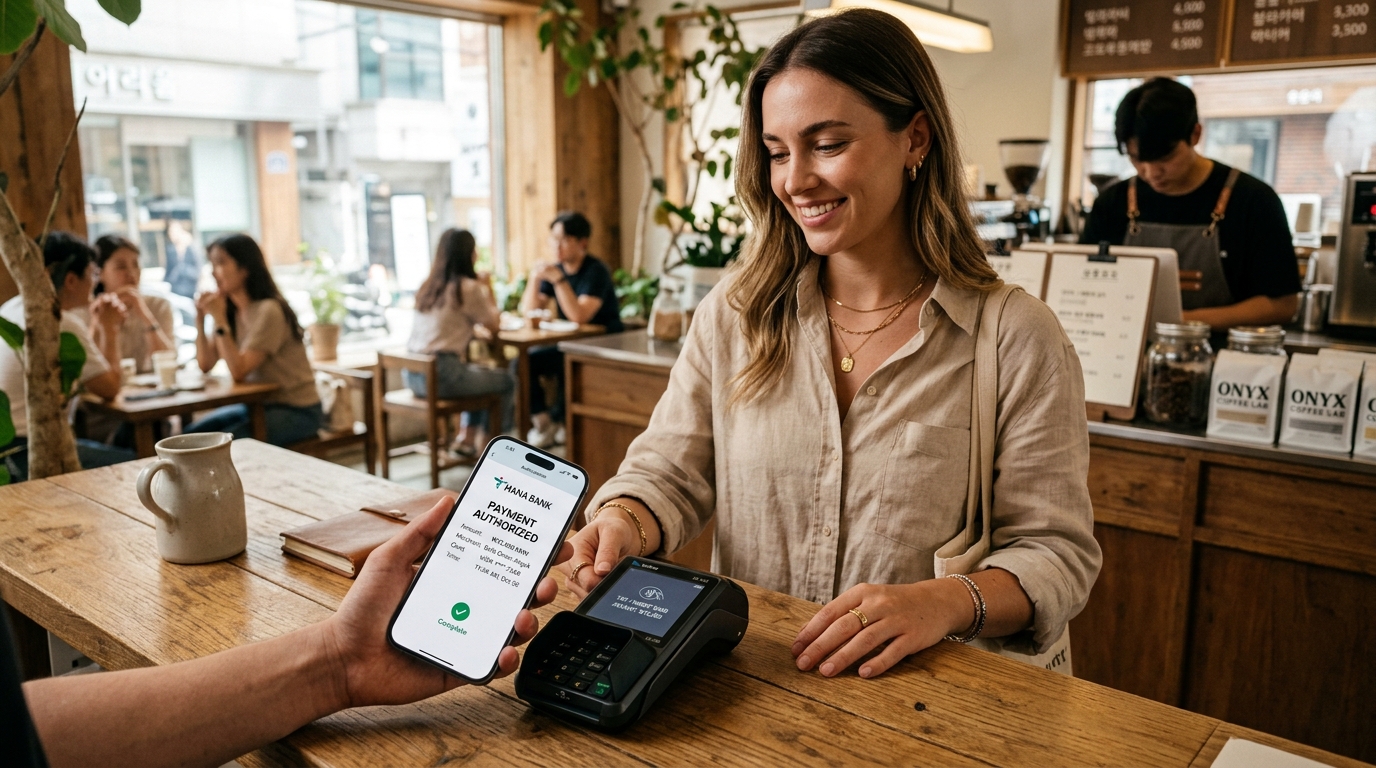
Foreign Credit Card 3D Secure & SMS OTP Payment Failures in Korea: 5 Working Fixes for 2026
Korea Duty-Free Shopping Guide 2026: Airport vs Downtown Duty-Free vs Instant Tax Refund