Korean Language & Culture
What Does 헐 (Heol) Actually Mean? The One Korean Word Every Subtitle Gets Wrong
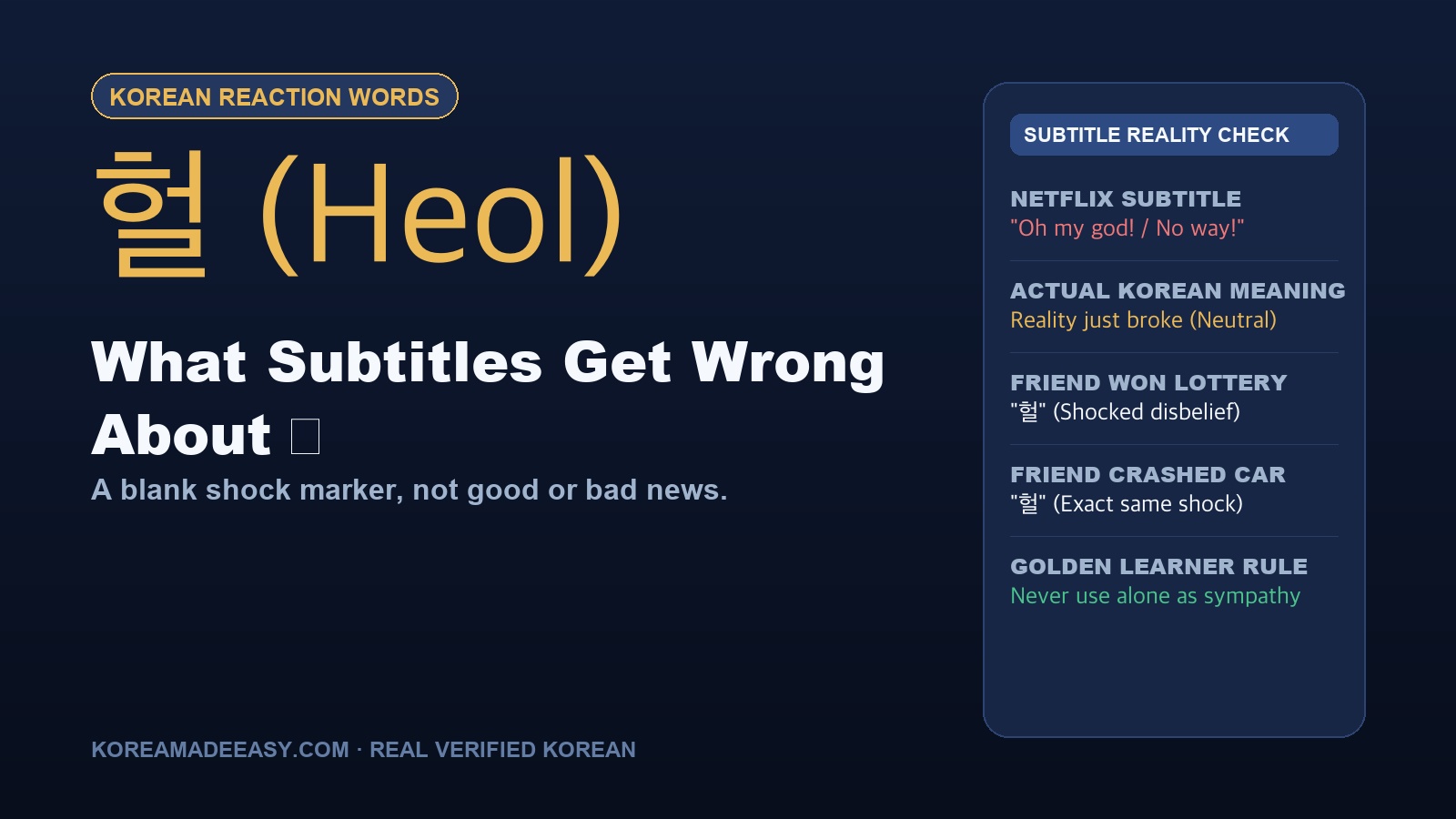
The payoff Hearing 헐 in every other scene and trusting whatever the subtitle picked → hearing it as the blank shock marker it is, and knowing from context whether the character is thrilled, horrified, or done.
📈 Trend signal: Korean reaction words in K-drama subtitles — 'what does heol mean' searches from subtitle-only viewers
What Does 헐 (Heol) Actually Mean?
If you watch Korean dramas with subtitles, you have heard 헐 several hundred times. You have probably also read three different English words for it in the same episode — “oh my god,” “no way,” “what?” — and assumed the translator was just varying the phrasing.
They weren’t. They were guessing.
헐 is one of a small set of Korean reaction words that carry no emotional valence at all. It does not mean good news or bad news. It means the thing you just said does not fit in my head yet. English has no single word that does this job, so subtitlers have to pick a side every single time — and roughly half the time they pick wrong.
The test that shows the problem
Here are four situations. In Korean, the natural reaction to all four is the same syllable.
| What just happened | Natural Korean reaction | What a subtitle would say |
|---|---|---|
| Your friend won the lottery | 헐 | ”Oh my god!” |
| Your friend crashed their car | 헐 | ”Oh no!” |
| Your bias cut his hair | 헐 | ”What?!” |
| Your roommate ate your leftovers | 헐 | ”Are you serious?” |
Four different English phrases. One Korean word. That gap is the whole story.
An English speaker reading those subtitles walks away believing 헐 means four different things. It doesn’t. It means one thing — processing failure — and the situation supplies the rest.
Where 헐 comes from
헐 is internet-era slang. It spread through early-2000s Korean online communities and messaging, then moved into speech, and it is now completely normal in casual conversation among people under about 50. It is not in the same register as older interjections like 어머 (more feminine, more traditional) or 아이고 (weariness, sympathy, physical effort).
The National Institute of Korean Language’s dictionaries list it as an exclamation used when one is dumbfounded or at a loss for words — note that the definition describes a state of the speaker, not a judgment about the event. That is exactly the distinction subtitles erase.
The 12 situations, sorted by what’s actually happening
Grouping them this way is more useful than a list of translations, because the word never changes — only your reason for saying it.
Good shock (4)
- Someone tells you they got the concert tickets → 헐 진짜?
- A friend announces an engagement → 헐 축하해!
- Your favorite group announces a comeback → 헐 대박
- You get an unexpectedly good exam result → 헐 나 붙었어
Bad shock (4) 5. Hearing about an accident → 헐 괜찮아? 6. A friend says they got fired → 헐… 7. Finding out a price is absurd → 헐 이게 이 가격이라고? 8. Realizing you missed a deadline → 헐 어떡해
Mild disbelief / secondhand embarrassment (2) 9. Someone tells a story about a rude stranger → 헐 진짜 별로다 10. A friend admits to something cringeworthy → 헐 너 진짜…
Flat, sarcastic, or done (2) 11. Someone cancels plans for the third time → 헐 또? 12. Reading an obviously fake excuse → 헐 그렇구나 (delivered flat, means the opposite of acceptance)
Numbers 11 and 12 are the ones learners get burned by. Written in a text with no tone, a bare 헐 can read as I have run out of interest in this conversation. Koreans soften it with a follow-up — 헐 진짜?, 헐 괜찮아?, 헐 대박 — precisely because the naked syllable is ambiguous.
Why subtitles structurally cannot fix this
This is not laziness. Three constraints stack up:
Reading speed. Subtitle guidelines cap characters per second. A translator cannot write “an untranslatable shock particle that could mean delight or horror depending on what happens next.” They get about twelve characters.
English forces a choice. “Oh my god” leans positive-surprised. “Oh no” is negative. “What?” is confused. There is no neutral English shock word that fits a subtitle line. The closest is a bare ”…” which reads as a dropped line.
Scene-by-scene commitment. Because the translator picks per line, a viewer never sees the same word twice, so the pattern — one sound, any emotion — is invisible to them. The information isn’t just lost; the existence of the pattern is hidden.
What the reaction from foreign viewers looks like
Here is the part you won’t find in other explainers, because it comes from our own data rather than a dictionary.
We run a small Instagram account, @seoulreactions, that explains one Korean word per video to subtitle-only K-drama viewers. Most of our videos reach 100–230 people — normal for a new account. When we posted one about how subtitles mistranslate Korean reaction words, it reached 1,043 people and was saved 17 times within 72 hours, roughly five times our previous best and eight times our usual save rate.
The comparison matters more than the raw number. Videos that simply taught Korean words performed at baseline. The one that pointed out viewers had been misreading something they’d already seen hundreds of times did not. The gap suggests the demand isn’t for vocabulary — it’s for correcting a misunderstanding people didn’t know they had.
That’s a small sample from one account, and we’re stating it as an observation rather than a rule. But it lines up with what the search data looks like: “what does heol mean” is searched by people who already watch, not by people starting Korean lessons.
How to actually use it
If you want to use 헐 yourself without sounding off:
- Do use it for genuine surprise, good or bad. This is the core use and it’s hard to get wrong.
- Do add a follow-up clause. 헐 진짜? / 헐 대박 / 헐 괜찮아? Almost no one uses it completely bare in speech.
- Don’t use it as your only response to serious bad news. Alone, it can land as huh, anyway. Korean sympathy needs 어떡해 or 괜찮아? attached.
- Don’t use it in formal settings or with someone much older. It’s casual internet-origin slang — fine with friends, wrong in a work email.
- Don’t confuse it with 대박. 대박 leans toward impressive scale (jackpot, huge, incredible) even when used about something bad. 헐 is pure shock with no size claim.
FAQ
Is 헐 rude? No, but it is casual. It’s slang that came from the internet, so it belongs in conversation with friends and peers, not with a boss, a professor, or a much older relative. There’s nothing offensive in the word itself — the issue is register, the same way “yikes” is fine with friends and odd in a job interview.
Is 헐 the same as 대박? They overlap but aren’t interchangeable. 대박 originally means a jackpot or huge success and still carries a sense of scale — it works for “that’s incredible” even about a disaster (“차 사고 났어” → “헐 대박”). 헐 makes no claim about size; it only reports that you’re stunned. You’ll often hear them stacked, 헐 대박, which is roughly “wait — that’s huge.”
Do Koreans actually say 헐 out loud, or is it typing-only? Both. It started in text but moved into speech years ago, and you’ll hear it constantly in variety shows and everyday conversation. Spoken, the vowel often stretches — 허얼 — which adds emphasis, the same way “whaaat” does in English.
Why do subtitles vary it so much if it’s one word? Because English has no neutral shock word that fits in a subtitle line. Translators pick the reading that matches the scene, which is the correct choice for that line but hides the pattern across the episode. It’s a limitation of the format, not a translation error in the usual sense.
Written by Yongwoo Chung, who has lived in Seoul for five years and spends an unreasonable amount of time explaining why subtitles flatten Korean. Next in this series: 대박, which isn’t a compliment, and 아니, which isn’t “no”.
Planning Your Korea Trip? Don't Pay Full Price! ✨
Save $20–$50 per person with our verified reader perks & skip the long ticket booth queues:
AREX Incheon ↔ Seoul Express
Non-stop 43-min direct train with guaranteed reserved seats & free Wi-Fi. Scan your mobile QR straight at the gate!
Get 20% Off AREX Ticket →Korea Unlimited 5G eSIM
Skip the 30-min airport counter line. Scan the QR code to connect instantly for smooth Naver Maps navigation.
Compare Korea eSIM Options →WOWPASS Card (Pay + T-Money)
Pay anywhere in Korea with zero FX fees + subway card. Use code KOREAEASY for 0.5% cash top-up bonus!
Top Seoul Passes & Day Tours
Guaranteed entry for Lotte World, Nami Island tours, CIMER Spa, and Hanbok palace rentals with instant mobile vouchers.
Browse Top Seoul Deals →Sources
- https://krdict.korean.go.kr/eng/dicSearch/SearchView?ParaWordNo=71545
- https://opendict.korean.go.kr/dictionary/view?sense_no=1049568
Search-trend data from Google Trends (KR) and Naver DataLab. This article is independent commentary and is not affiliated with any broadcaster, agency, or the individuals mentioned.

Korea Duty-Free Shopping Guide 2026: Airport vs Downtown Duty-Free vs Instant Tax Refund

Korean Cafe Etiquette 2026: The 1-Drink-Per-Person Rule, 2-Hour Laptop Limits & Rooftop Secrets in Seoul