Korean Language & Culture
아니 Doesn't Mean "No": The Korean Word Subtitles Turn Into an Argument
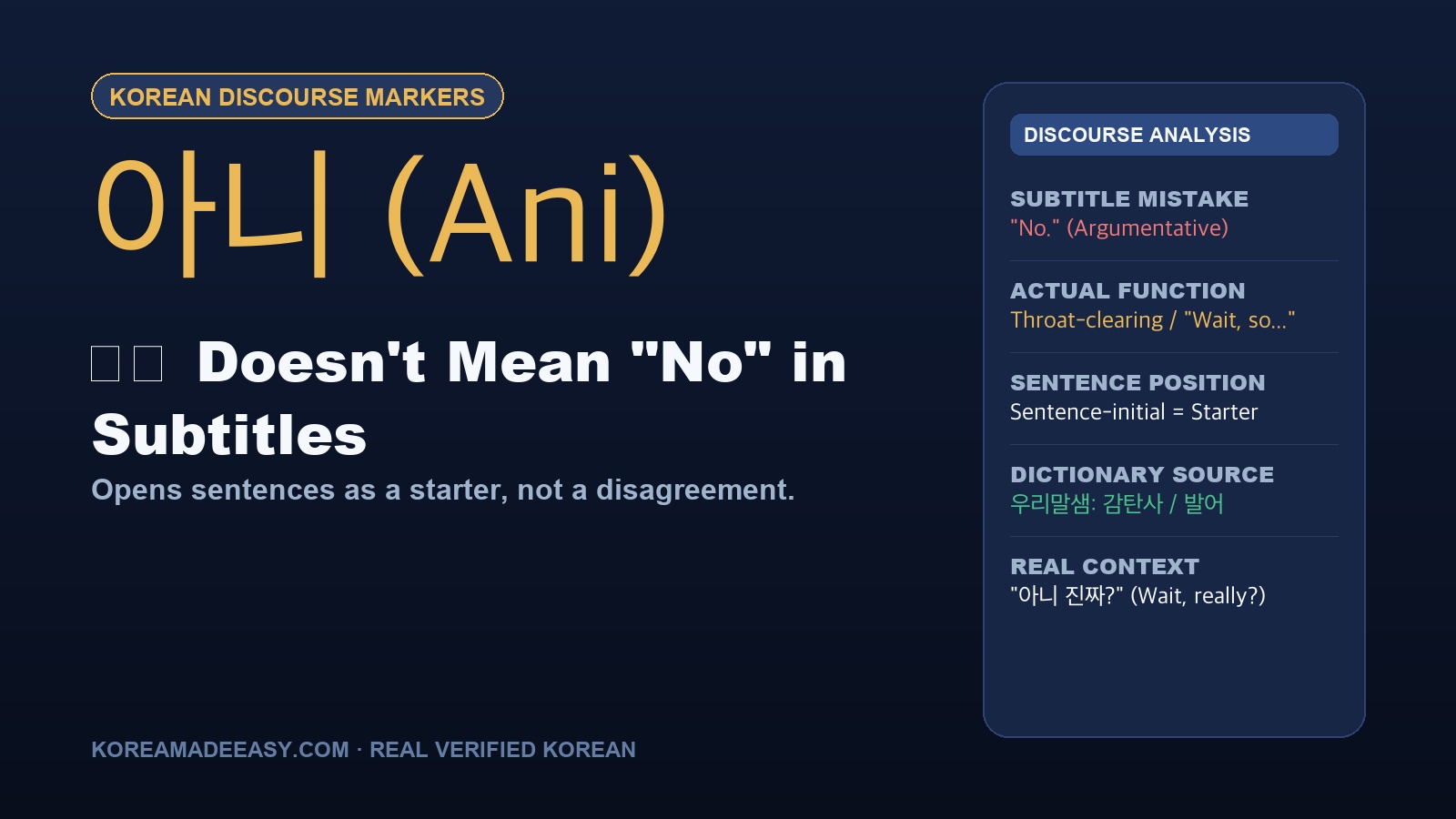
The payoff Reading Korean characters as unusually argumentative → hearing 아니 as the throat-clearing sound it usually is, and knowing from its position whether an actual 'no' was said.
📈 Trend signal: Subtitle-only viewers searching why Korean characters seem to disagree constantly
아니 Doesn’t Mean “No”
There’s a moment that happens constantly in subtitled Korean drama and never gets explained.
A friend asks the lead whether she likes him. She says 아니. The subtitle says “No.” Then, in the very next breath, she says she’s completely in love with him — and the subtitle dutifully renders that too. Two lines, flat contradiction, no reaction from anyone on screen.
She didn’t contradict herself. The subtitle did. What she actually said was closer to:
“No— I mean, I’m completely in love with him.”
That dash is the whole word. 아니 was never the answer to the question; it was the sound of her starting to speak.
Start with what the dictionary already admits
This isn’t a fringe reading. It’s in the reference works.
The Standard Korean Dictionary lists two 아니 entries, and both are negative — 아니1 as an adverb “expressing negation or opposition,” 아니2 as an interjection used to answer no to someone of equal or lower status. If those were the only entries, subtitles would be right.
But 우리말샘, the National Institute of Korean Language’s open dictionary, carries an additional interjection sense:
아니 「004」 「감탄사」 놀라거나 감탄스럽거나, 또는 의아스러울 때 하는 말. Said when one is surprised, impressed, or puzzled.
Surprised. Impressed. Puzzled. Not one of those is a refusal. The word has a documented life outside negation, and it’s the one you hear most in casual speech — but it’s the sense a translator with twelve characters and one shot at the line will never reach for, because “no” is right there and technically defensible.
To understand how fans describe discovering their favorite group member, check our breakdown of choeae and ipdeok fandom slang.
Four lines, taken apart
Same syllables every time. Watch what changes.
1. Agreeing, not disagreeing
— 너 걔 좋아하지? You like him, right? — 아니 완전 좋아해. No— I’m crazy about him.
The subtitle writes “No.” The speaker is agreeing more strongly than the question asked. 아니 here rejects the mildness of “like,” not the content.
2. Buying a beat
— 왜 화났어? Why are you mad? — 아니, 들어봐. No, wait— listen.
Nobody is denying anything yet. This is “hold on, let me explain.” English does this with “no, but—” or just “look,” and both are closer than a bare “No.”
3. Pure excitement
아니 그거 봤어?! Wait, did you SEE that?
This is the 우리말샘 004 sense exactly: surprise. There is no proposition on the table to negate. Rendering it “No” makes an excited person sound like they’re objecting to a question nobody asked.
4. Exasperation
아니 진짜… Ugh, seriously…
Here it’s barely a word at all — a sigh with a shape. It marks that the speaker has run out of patience.
Korean isn’t doing anything exotic here
The trap is that English has this too, and we don’t notice.
Linguists call these discourse markers: words that manage the flow of talk rather than contribute meaning to the sentence. English speakers open sentences with well, so, look, I mean, okay dozens of times a day. “Well, I don’t know about that” isn’t a statement about a well.
아니 is Korean’s version. The reason it gets mangled and well doesn’t is an accident of the dictionary: 아니’s discourse-marker use happens to be homophonous with a genuine negation word. A translator seeing well never reaches for the noun. A translator seeing 아니 has a perfectly good negative sitting in the first dictionary entry, and the line is eight frames long.
So it isn’t a translation error in the usual sense. It’s a structural one, and it repeats every episode.
How to tell which one you’re hearing
Position does most of the work.
| What you hear | What it is |
|---|---|
| 아니 alone, then silence | An actual “no” |
| 아니 followed by 아니야 / 아니에요 | An actual “no” (the full negative form) |
| 아니 + more sentence | Discourse marker — “wait,” “I mean,” “okay so” |
| 아니 + a question | Surprise — “wait, did you…?” |
| 아니 said flat, trailing off | Exasperation |
The single most useful rule: if speech continues after 아니, it probably wasn’t a refusal. A real “no” tends to stand alone or attach to the full form 아니야.
What we got wrong testing this
The original layer here is a mistake we made, since it’s more useful than another dictionary paraphrase.
We run @seoulreactions, a small Instagram account explaining one Korean word per video to subtitle-only viewers. Reviewing the format, we concluded that showing Hangul on screen was pointless — most of our viewers can’t read it — and rebuilt a video so the romanization was the headline and the Hangul shrank to a caption underneath.
Saves on that video went from 17 on the previous edition to 0.
One video is not proof, and plenty else differed between the two. But it was enough to stop us generalizing, and the direction was the opposite of what we predicted. Our working guess now is that the Hangul was doing a job we’d misread: for someone who has watched hundreds of hours of subtitled drama, the shape 아니 is something they have seen on screen, in fan captions, in comments — recognizable even when unreadable. Romanization is easier to pronounce but connects to nothing they’ve already encountered.
Which is why this article keeps the Hangul in front of you and puts the romanization second. If you’ve watched enough drama, 아니 is a shape you know. That recognition is the thing worth building on.
Using it yourself
- Do use it to open a sentence when you’re surprised or about to correct a framing. 아니 진짜? is extremely common and means “wait, really?”
- Do let it carry exasperation — 아니 with a sigh is fully idiomatic.
- Don’t use it as a flat “no” to someone senior. That’s 아니요 / 아니에요. Bare 아니 to a boss or a much older person is too blunt.
- Don’t panic when you hear it aimed at you mid-conversation. Nine times out of ten the person is clearing their throat, not objecting.
Reading social situations and subtle hospitality cues is part of Korean situational awareness, known as nunchi (눈치).
FAQ
Is 아니 rude? Bare 아니 is casual, not rude — but it’s the plain form, so it belongs with friends and peers. With someone senior, use 아니요 or 아니에요. As a discourse marker at the start of a sentence it’s much less loaded, since you aren’t actually refusing anything.
What’s the difference between 아니 and 아니야? 아니야 is the full negative form — “it’s not,” “no it isn’t” — and is unambiguously a denial. 아니 on its own is the short form and does double duty as the discourse marker. If you hear the full 아니야, someone genuinely disagreed.
Why do Korean characters in dramas seem to argue so much? Partly this. When every 아니 becomes “No,” a normal conversation reads on screen as two people contradicting each other constantly. Some of the abrasiveness English-speaking viewers perceive in Korean dialogue is manufactured by the subtitle track.
Is 아니 related to 안? Yes — 안 is the short negative adverb used before verbs (안 가 = “not going”), and both trace to the same negative root. But 안 never developed the discourse-marker use; it stays strictly grammatical.
Written by Yongwoo, in Seoul, working through the Korean words subtitles quietly rewrite — 헐 and 대박 came first.
Planning Your Korea Trip? Compare Your Options
Compare transport, mobile data, and attraction options. Prices and eligibility depend on your selected date and package.
AREX Incheon ↔ Seoul Express
Express train between Incheon Airport and Seoul Station. Follow the selected voucher’s seat reservation and redemption instructions.
Check AREX Express Tickets →Korea eSIM Options
Compare Korea eSIM search results. Check data allowance, supported network, device compatibility, activation, and speed limits.
Compare Korea eSIM Options →WOWPASS Card (Pay + T-Money)
Compare WOWPASS and T-money. Payment and transit balances are separate; check issuance, top-up, exchange, and withdrawal fees.
Read WOWPASS vs T-money →Top Seoul Passes & Day Tours
Browse general Seoul activity search results. This is not a guaranteed-entry pass or a fixed-discount offer; check each product’s inclusions.
Browse Seoul Activity Options →Sources
- https://stdict.korean.go.kr/search/searchResult.do?searchKeyword=%EC%95%84%EB%8B%88
- https://opendict.korean.go.kr/search/searchResult?query=%EC%95%84%EB%8B%88
Search-trend data from Google Trends (KR) and Naver DataLab. This article is independent commentary and is not affiliated with any broadcaster, agency, or the individuals mentioned.