Health
Full-Body Health Checkup in Korea: Brain MRI + Scans for Less Than One US MRI (2026)
The payoff Quietly putting off the brain MRI and cancer screening you can't afford back home → walking out of a Seoul center the same morning with bloodwork, endoscopy and imaging done and English results in hand — all self-pay from about $350–$2,200, less than one US MRI.
📈 Trend signal: Medical-checkup tourism to Korea — Seoul screening centers report MRI-checkup demand up ~40% since 2023; a wave of 2026 English booking guides
This is general information for travelers, not medical advice. A screening package is not a diagnosis, and no test catches everything — discuss your results and any follow-up with a qualified doctor. Prices below are self-pay estimates that change with the center, exchange rate, and add-ons; always confirm on the live booking page before you reserve. Some outbound links in this post are affiliate links to travel services; where they are, I may earn a small commission at no extra cost to you, and it never changes what I recommend.
Here’s a sentence that sounds made up but isn’t: you can fly to Seoul, get a head-to-toe health screening — bloodwork, ultrasound, a sedation gastroscopy, even a brain MRI — walk out the same morning with results in English, and still pay less than the cost of a single MRI back home. That’s why “K-checkup” has quietly become one of the fastest-growing reasons foreigners book a trip to Korea. One Seoul imaging network told reporters demand from international patients jumped roughly 40% since 2023.
I’ve helped enough visiting friends navigate this to know where the real questions are — not “is it good” (it is), but what does it actually cost, what’s in each package, and how do I book one without speaking Korean? Here’s the honest version.
The short answer
- You do not need Korean insurance or residency. Tourists pay out of pocket (“self-pay”), which is exactly why the pricing is clear and bookable in advance. Bring your passport.
- Three rough tiers: a Basic blood-and-ultrasound package (
$350–550), a Gold/Signature that adds sedation endoscopy and more imaging ($600–1,000), and a Premium/VIP with brain MRI, multi-organ CT, and cancer-gene panels (~$1,400–2,200). - It’s a half-day. Most packages run 2–4 hours, done in one center, often with a light meal after. Come fasting (usually 8+ hours).
- Book through an International Healthcare Center or an English booking agency 1–2 weeks ahead. Results come same-day to ~2 weeks depending on the center, in English.
That’s the whole decision. The rest is the why, the real numbers, and the booking steps.
Why the price gap is this large
This isn’t a small discount — it’s a different order of magnitude, because you’re comparing a US uninsured cash price against a Korean self-pay package price in a system built for high-volume preventive screening.
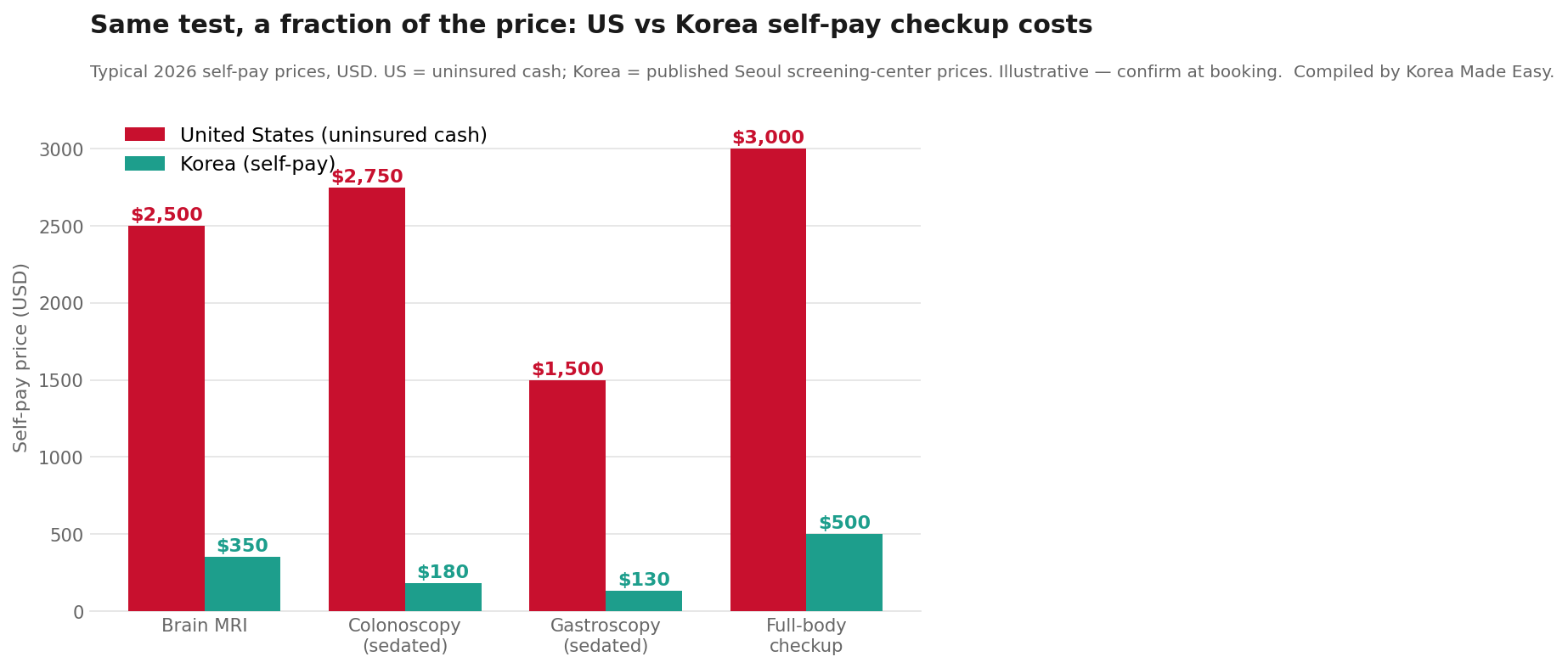
Typical 2026 self-pay prices. US figures are uninsured cash/“chargemaster” rates; Korea figures are published prices at Seoul screening centers. Illustrative single points for real-world ranges — confirm at booking. Compiled by Korea Made Easy from the sources listed below.
A brain MRI that can run $2,500+ uninsured in the US is a ₩400,000 (~$300) à-la-carte add-on at a major Korean screening center. A sedation colonoscopy that’s frequently $1,250–4,800 in the US is around ₩210,000 (~$155) here. As one US-focused guide bluntly put it, “the savings on the MRI alone pay for your round-trip ticket.” Two caveats so you’re not surprised: US prices vary wildly by insurance (yours may be far lower than the cash rate), and Korean sedation and contrast add small extra fees (often ₩115,000–120,000). Compare like with like.

A Korean screening package bundles bloodwork, imaging, and scopes into one organized half-day visit.
What’s actually inside each tier
Korean centers sell packages (종합검진, jonghap geomjin), not a menu of separate appointments. Here’s what tends to be in each level — confirm the exact item list on the package page, since centers differ.
| Tier | Typical price | What’s included |
|---|---|---|
| Basic | ~$350–550 (₩500,000–750,000) | Body measurements, full blood & urine panel (liver, kidney, thyroid, lipids, diabetes, tumor markers), blood pressure, chest X-ray, ECG, abdominal ultrasound, vision/hearing, often dental |
| Gold / Signature | ~$600–1,000 (₩850,000–1,400,000) | Everything in Basic + sedation gastroscopy (“stomach camera”), often colonoscopy, thyroid/carotid ultrasound, and two imaging choices (e.g. a CT) |
| Premium / VIP | ~$1,400–2,200 (₩2,000,000–3,000,000) | Everything above + brain MRI/MRA (stroke & aneurysm screen), multi-organ CT, cancer-gene panels, heart evaluation, sometimes a recovery IV drip |
One detail that surprises Western visitors: “conscious sedation” endoscopy (수면내시경, literally “sleep endoscopy”) is standard and cheap here. You drift off, and wake ~20 minutes later with no memory of the scope — which is why so many people finally get the stomach and colon screening they’d been putting off.
Three ways to book in English (and who each suits)
You don’t want to walk into a random neighborhood clinic. You want either a tertiary hospital’s International Healthcare Center (IHC) or a dedicated screening center used to foreign patients. Three solid, genuinely English-friendly routes:
-
KMI (Korea Medical Institute) — a large screening-center network with branches in Gwanghwamun, Gangnam, Yeouido, plus Busan and Jeju, so you can slot it into your itinerary. Standardized packages: Standard ₩500,000 / Signature ₩1,000,000 / Noble ₩2,000,000 (72 / 77 / 93+ tests). KMI’s global program advertises up to a 40% discount for foreign passport holders and emails English results in ~10–15 days. Best if you want scale, multiple locations, and a predictable process.
-
Kwangdong Hospital (Gangnam) — premium end, with a dedicated 1:1 English (and Russian) medical interpreter walking you through the whole visit and an English full report. Packages run about $400 up to ~$1,250 (Standard Ivory to a Brain-MRI or heart premium). Best if you’d feel calmer with hand-holding and interpretation the whole way.
-
A university-hospital IHC — Severance (Yonsei), Samsung Medical Center, or Asan — the “Big 5,” JCI-accredited, with dedicated international coordinators. You book by emailing the International Healthcare Center directly. Best if you want a big-name tertiary hospital and the option to convert straight into specialist care if something turns up.
A simple booking email works: “Hello, I’m visiting Seoul from [date] to [date] and would like to book a comprehensive health checkup (Gold-package equivalent). Do you have availability, and what does the package include?” Agencies like Creatrip also package KMI/Kwangdong bookings with English support and a small deposit (~₩20,000) if you’d rather not email hospitals yourself.
How the day actually goes
- Book 1–2 weeks ahead and fill out the health questionnaire they email you. Be honest about medications — if you’re on blood thinners (aspirin, warfarin), they’ll tell you when to pause them before any biopsy.
- Fast the night before (usually no food/drink 8+ hours; follow their exact instructions, especially for endoscopy).
- Arrive in the morning, ideally on day 2 of your trip so you’re rested and past the worst jet lag. A coordinator routes you room to room; the whole thing is 2–4 hours.
- Get results — some centers do a same-day physician review; others email an English report in 2 weeks. Ask which, so you can plan follow-up before you fly home.
Where to base yourself: most international-friendly centers cluster in Gangnam, so staying nearby keeps a fasting morning painless — see our guide to where to stay in Seoul. Coming straight from the airport the day before? Here’s the no-stress way to get from Incheon Airport to Seoul, and the eSIM to sort first so booking confirmations and maps just work when you land.
The money details nobody mentions
- US insurance usually won’t cover this (it’s elective care abroad). But ask the center for an itemized English receipt (a “superbill”) — many US travelers submit it to an HSA/FSA, and some plans reimburse part of it. Verify with your provider first.
- Pay with a 0% foreign-transaction-fee card if you can; a standard debit card can quietly cost you ~3% plus a poor exchange rate. If you’re moving money in for a longer stay, our Seoul cost-of-living guide covers the cheapest way to do that.
- Still buy travel insurance. Not for the checkup — for the rare complication (e.g. a perforation during a scope). The checkup is cash; hospitalization if something goes wrong is a separate risk worth covering.
 Read next →Most checkup centers are in Gangnam — here’s which Seoul neighborhood to actually book
Is it “weird” for a foreigner to do this?
Not even slightly. Medical tourism is a large, normal industry in Korea; the staff are used to international patients, signage in the big centers is often in English, Chinese, and Japanese, and you’ll likely share the waiting lounge with other travelers doing exactly the same thing. The same English-friendly infrastructure serves visitors who come for dermatology rather than screening — if a skin treatment is more your goal, see our guide to Seoul skin clinics for foreigners and its real 2026 prices. The bigger risk isn’t awkwardness — it’s over-buying. You do not need the $2,000 VVIP with a PET-CT if you’re a healthy 30-something with no family history. Match the package to your age and risk, skip the tests you’ve done recently at home, and you’ll get the real value without the upsell.
A checkup is the planned version. For the unplanned kind — you’re ill on a Tuesday and don’t know where to go — here’s how seeing a doctor in Korea actually works.
FAQ
Do I need a Korean visa or residency to get a health checkup? No. Private screening packages are self-pay and open to short-term visitors — you generally just need your passport. Korea’s national insurance (NHIS) screenings are for residents, but tourists don’t use those; they book private packages, which is why the pricing is transparent and reservable in advance.
Will I get my results in English? Yes, at the international-facing centers. Timing varies: some give a same-day physician review and English summary, while others email an English report within about two weeks. If you want to review results before flying home, ask for a same-day center and book early in your trip.
How long does it take, and how far ahead should I book? The checkup itself is usually 2–4 hours in a single visit. Book 1–2 weeks ahead, especially if you want MRI or colonoscopy slots, which fill up. Come fasting per their instructions.
Can I add a brain MRI or colonoscopy to a cheaper package? Often yes — many centers let you add imaging à la carte (a brain MRI is roughly ₩400,000 / ~$300, a sedated colonoscopy around ₩210,000 / ~$155), and bundling it into a package sometimes costs less than booking it standalone. Availability depends on the center and your medical eligibility.
Is the quality actually good? Korea runs one of the world’s most developed preventive-screening systems, with modern 3.0-Tesla MRI, sedation endoscopy as standard, and increasingly AI-assisted imaging at major centers — several of which are JCI-accredited. The value comes from scale and efficiency, not corner-cutting. That said, a screening is preventive, not a guarantee: take the report to a doctor and follow up on anything flagged.
Planning Your Korea Trip? Don't Pay Full Price! ✨
Save $20–$50 per person with our verified reader perks & skip the long ticket booth queues:
AREX Incheon ↔ Seoul Express
Non-stop 43-min direct train with guaranteed reserved seats & free Wi-Fi. Scan your mobile QR straight at the gate!
Get 20% Off AREX Ticket →Korea Unlimited 5G eSIM
Skip the 30-min airport counter line. Scan the QR code to connect instantly for smooth Naver Maps navigation.
Get Instant eSIM QR (From $2.80) →WOWPASS Card (Pay + T-Money)
Pay anywhere in Korea with zero FX fees + subway card. Use code KOREAEASY for 0.5% cash top-up bonus!
Top Seoul Passes & Day Tours
Guaranteed entry for Lotte World, Nami Island tours, CIMER Spa, and Hanbok palace rentals with instant mobile vouchers.
Browse Top Seoul Deals →Sources
- https://creatrip.com/en/blog/15083
- https://mydockorea.com/blog/korea-health-checkup-executive-screening-guide-2026
- https://global.kmi.or.kr/examination/personal_examination
- https://koreaplus-lifes.com/full-body-health-checkup-in-korea-healthcare/
- https://medicalcheckupseoul.com/mri-checkup-seoul-guide-international-patients/
- https://creatrip.com/en/spot/15390
Search-trend data from Google Trends (KR) and Naver DataLab. This article is independent commentary and is not affiliated with any broadcaster, agency, or the individuals mentioned.
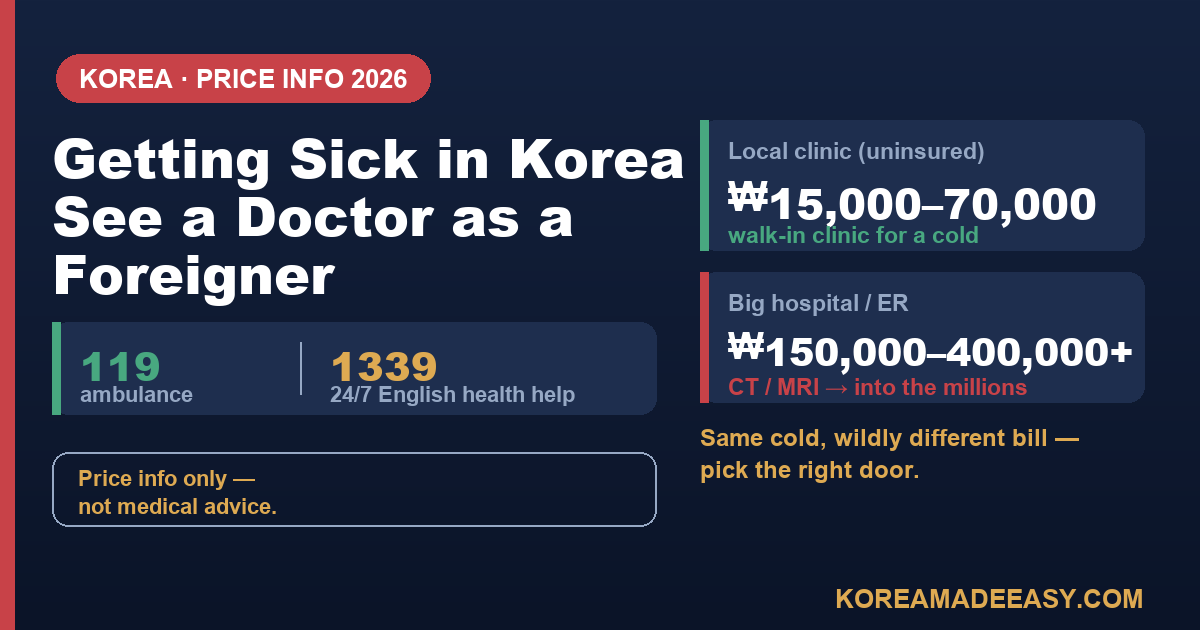
Getting Sick in Korea: How to See a Doctor as a Foreigner (Walk-in Clinics, Costs & English) 2026
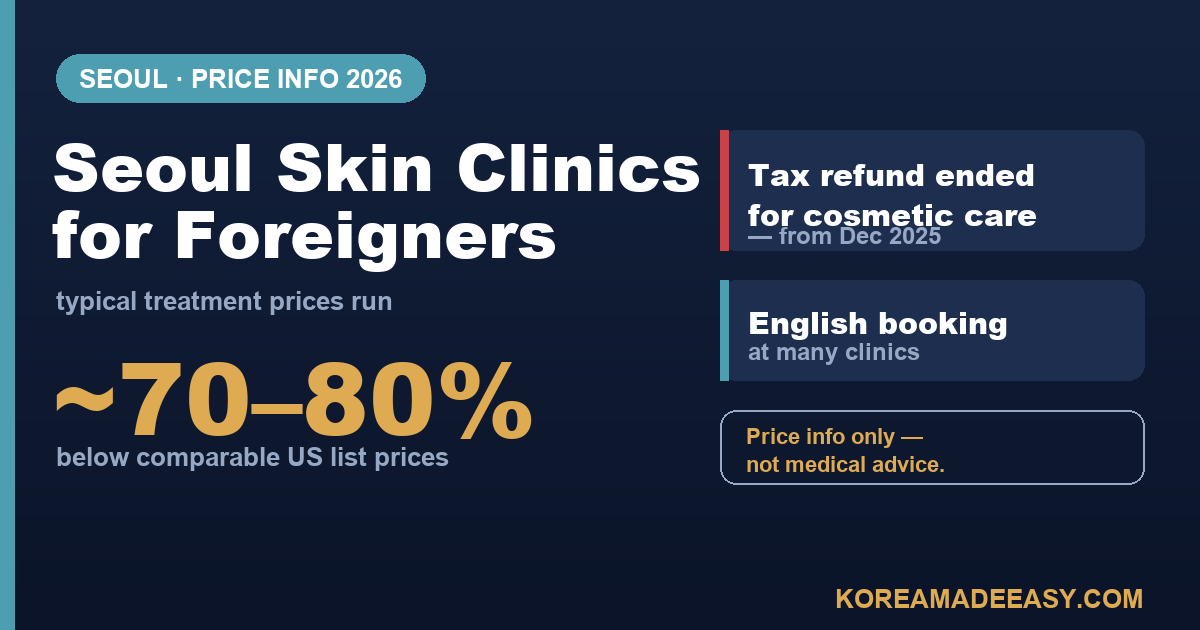
Seoul Skin Clinics for Foreigners: English-Speaking Derma & Real 2026 Prices (Tax Refund Is Gone)