Travel
Korail Pass vs KTX Tickets: Which Is Actually Cheaper for Your Korea Trip? (2026)
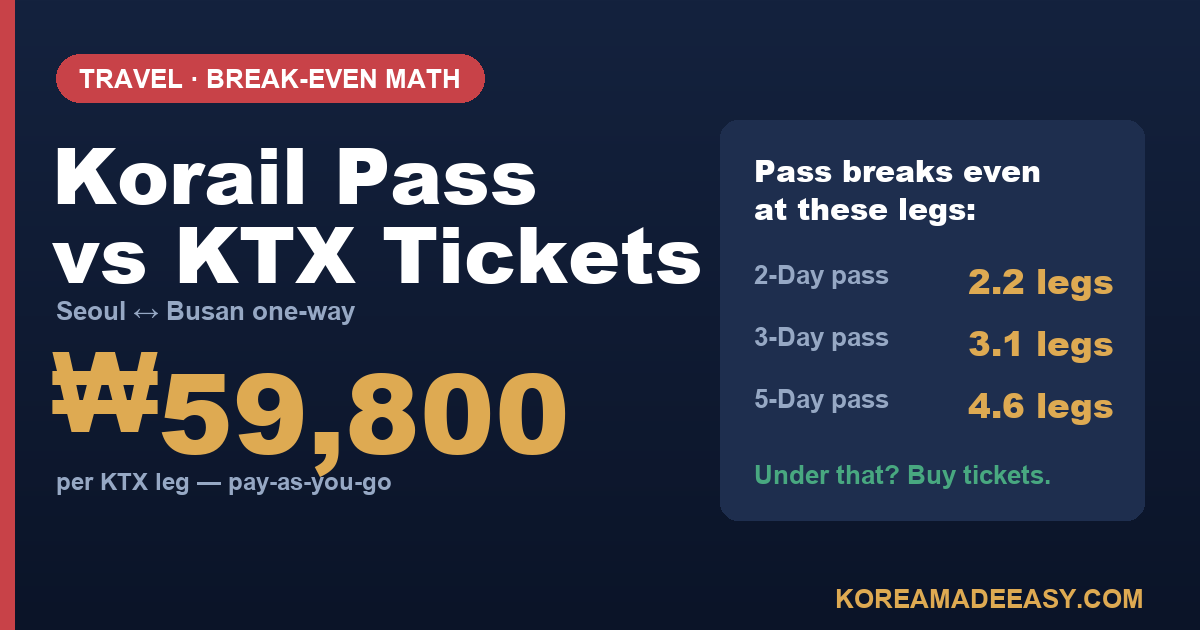
The payoff About to buy the pass every guide quietly pushes → running your own leg count and pocketing ₩11,000+ on the classic Seoul–Busan round trip with individual KTX tickets instead.
📈 Trend signal: Korail Pass vs point-to-point KTX (original break-even model: pass price ÷ ₩60,000 per long-haul leg → 2-Day pays off at 2.2 legs, 3-Day at 3.1, 5-Day at 4.6)
This guide contains affiliate links — if you book through them we may earn a small commission at no extra cost to you.
Nearly every English guide to the Korail Pass ends the same way: “buy the pass.” I understand why — most of those guides earn a commission when you do. So I did something they mostly don’t: I sat down with the actual 2026 fares and built a break-even table. The result surprised even me. For the single most common Korea itinerary — Seoul, down to Busan, back to Seoul — the pass loses you money. You’d be better off buying two individual KTX tickets.
That doesn’t mean the pass is a scam. It means it’s a tool that wins in one specific situation and loses in another, and almost nobody tells you which is which. This article is the calculator I wish I’d had. All prices are as of 2026 — always reconfirm on Korail’s official site before buying, because fares and exchange rates shift constantly.
First, what the Korail Pass actually is
The Korail Pass (sometimes written “KR Pass”) is a foreigner-only tourist rail pass. If you hold a Korean passport or live here on a resident visa, you generally can’t use it — they check your passport at boarding, so check eligibility on Korail if you’re unsure.
When it’s valid, it lets you ride Korail-operated trains — KTX, ITX, Mugunghwa and more — without buying individual tickets. It comes in two shapes:
- Consecutive — unlimited travel on 3 or 5 days in a row.
- Flexible / Select — you pick 2 or 4 travel days out of a 10-day window.
Here’s the thing that used to trip up every first-timer, and which is changing under your feet on 1 September 2026, so read this before anything else on the page.
Until now Korea had two separate high-speed rail companies: Korail ran the KTX out of Seoul and Yongsan stations, and a different company, SR, ran the SRT out of Suseo Station in southern Seoul. They look almost identical on the platform, they never shared an app, and the Korail Pass never covered the SRT.
From 1 September 2026 they run as one integrated service. The SRT trains are folded into KTX operation, both are booked through a single app, and fares drop. If you are travelling before 1 September, the old split still applies — SRT seats sit in their own inventory and won’t show up when you search Korail, which is why people conclude everything is sold out having checked half the trains. If you are travelling on or after 1 September, search once and you see everything.
⚠️ One thing I cannot yet confirm, and won’t guess at: whether the Korail Pass covers the former SRT trains after the merger. It logically should, but I have not found an official statement either way. If your plan depends on it, check with Korail directly before you buy the pass. I’d rather tell you I don’t know than have you arrive at Suseo with a pass that doesn’t work.
The pass also doesn’t cover the Seoul subway — that part hasn’t changed.
The fares that make the math — and the 1 September cut
To know whether a pass pays off, you first need to know what you’d otherwise pay per trip.
Fares fall on 1 September 2026. The merger comes with an average 10% cut, held for three years, plus about 116,000 extra seats a week. The headline route, Seoul–Busan standard class, goes from ₩59,800 to ₩54,400. Yongsan–Gwangju Songjeong drops similarly. That matters here because it makes individual tickets cheaper while pass prices stay put — so every break-even number below moves further in favour of buying tickets one at a time.
The table is the pre-September fare I built the math on. Subtract roughly 10% for travel from 1 September:
| Route | One-way KTX (standard) | Journey time |
|---|---|---|
| Seoul ↔ Busan | ₩59,800 – ₩78,700 → ₩54,400 from 1 Sept | ~2h 15m fastest |
| Seoul ↔ Gyeongju (Singyeongju) | from ₩39,600 | ~2h |
| Seoul ↔ Gwangju (Songjeong) | approx. ~₩47,000 (reconfirm) | ~1h 45m |
One quirk worth flagging: KTX pricing is close to flat-rate. Unlike a flight, booking two weeks early rarely makes it much cheaper — advance discounts are small. So the Western instinct to “book early to save” barely applies. What booking early does buy you is a guaranteed seat, which matters on peak weekends when trains sell out and you’re left standing.
Now the pass side (adult, standard):
| Pass | Type | Price (adult) |
|---|---|---|
| 2-Day | Flexible (2 days within 10) | ₩131,000 |
| 3-Day | Consecutive | ₩186,000 |
| 4-Day | Flexible (4 days within 10) | ₩234,000 |
| 5-Day | Consecutive | ₩275,000 |
Kids (roughly age 6–12) are about half price, and a “Saver” rate discounts each person when 2–5 travel together. One caution: prices vary noticeably by platform and exchange rate. The same pass shows up in won on Korail and in dollars on resale sites, and the numbers don’t always match. Reconfirm before you pay.
The break-even table — the heart of this whole thing
Here’s the calculation nobody publishes. A long-haul leg (Seoul–Busan class of distance) runs about ₩60,000. So I divided each pass price by ₩60,000 to find how many long-haul legs you’d need to ride just to break even:
| Pass | Price | Legs to break even | Verdict |
|---|---|---|---|
| 2-Day | ₩131,000 | 131,000 ÷ 60,000 = 2.2 legs | A Seoul–Busan round trip (2 legs = ₩119,600) loses money. You need a 3rd long leg to win. |
| 3-Day | ₩186,000 | 3.1 legs | Only clearly ahead at 4 long legs (~₩239k). |
| 4-Day | ₩234,000 | 3.9 legs | Worth it when you pack in 4–5 long legs. |
| 5-Day | ₩275,000 | 4.6 legs | Wins only at 5+ legs — a genuine multi-city marathon. |
Read that top row again, because it’s the punchline. The most common Korea trip is Seoul → Busan → back to Seoul. That’s two long legs, ₩119,600 in individual tickets. The cheapest pass that covers it, the 2-Day, costs ₩131,000. You’d pay ₩11,000+ extra for the privilege of holding a pass. For that itinerary, buy the individual tickets.
The pass only pulls ahead when you’re stringing together three or more long-haul legs in a tight window — think Seoul → Busan → Gyeongju → Gwangju, hopping cities every day. If that’s your trip, the pass is genuinely the cheaper and more flexible choice, and you should buy it.
So the real question isn’t “is the Korail Pass worth it?” It’s “how many long-haul legs does my actual itinerary have?” Count them. Then use the table.
If you’re the round-trip majority: buy individual KTX tickets
If your trip is Seoul-and-Busan (which, statistically, it probably is), skip the pass and book point-to-point. You’ll want to reserve a day or two ahead in peak season — July beaches and holiday weekends sell out.
👉 Compare and book individual Seoul–Busan KTX tickets on Trip.com Trains — clean English booking with seat selection, ideal if you’re only doing one or two long routes.
Once you land in Busan, that ₩11,000 you didn’t waste on a pass covers a very good bowl of something. My Busan food guide tells you exactly where to spend it, and if you’re planning the days themselves, start with the 3-day Busan itinerary. Still deciding where to sleep? Haeundae vs Gwangalli settles the beach-base question.
If you’re the multi-city minority: the pass finally wins
If your legs add up to three or more — you’re doing the grand loop — this is exactly the traveler the pass was designed for. Unlimited Korail trains across consecutive days, no per-ticket fuss, and real savings over buying each leg.
👉 Reserve the Korail Pass on Trazy or compare rail options on GetYourGuide — worth it once you’re crossing three-plus cities.
Two things even pass holders forget. First, unlimited doesn’t mean you skip seat reservations — a packed train still means standing unless you’ve reserved. Use the Korail+ (코레일+) app to lock seats on popular routes in advance. Second, that app (English-supported, QR boarding, no paper tickets) needs data to work from the moment you land, so sort mobile connectivity early.
Not every trip is a KTX trip, either. The pretty Nami Island day trip near Gapyeong runs on the slower ITX line, not high-speed KTX — the pass covers it, but it barely moves the break-even math.
Getting from the airport into the KTX network
One practical note for arrival day: your KTX journeys start at Seoul Station or Yongsan, not the airport. Getting from Incheon to a KTX hub is its own small decision — the Incheon Airport to Seoul guide walks through the AREX train and bus options so you connect smoothly onto your first KTX.
How to actually buy either one
- Individual KTX tickets: book on the Korail+ (코레일+) app or Korail’s global English site, or through resellers like Trip.com Trains. You board with a mobile QR — no paper.
- Korail Pass: buy the e-pass on Korail’s global site or a reseller (Trazy, GetYourGuide, and others), then use Korail+ (코레일+) to reserve your specific seats. Boarding is mobile QR plus your reserved seat.
Either way, reconfirm the current fare on Korail before you pay — 2026 prices move.
FAQ
Is the Korail Pass worth it in 2026? Only if your itinerary has three or more long-haul legs in a short window. For the common Seoul–Busan round trip (two legs), individual KTX tickets are cheaper by ₩11,000+ — the 2-Day pass actively loses money there. Count your long legs and check the break-even table above.
Does the Korail Pass cover the SRT? No. The SRT is run by a separate company (SR) out of Suseo Station and is not a Korail train, so the pass doesn’t work on it. The pass covers KTX (from Seoul or Yongsan Station), ITX and Mugunghwa — but not SRT and not the subway.
How much is a KTX ticket from Seoul to Busan? Standard class runs roughly ₩59,800–₩78,700 one way depending on the train and time of day (as of 2026 — reconfirm on Korail), with the fastest trip about 2 hours 15 minutes. First class is higher. Advance-booking discounts are small, so book early mainly to secure a seat in peak season.
Can I buy the Korail Pass if I live in Korea? Generally no — it’s a foreigner tourist pass and excludes residents on long-term visas. Your passport is checked at boarding. If you’re unsure, confirm eligibility on Korail’s official site before buying.
Planning Your Korea Trip? Don't Pay Full Price! ✨
Save $20–$50 per person with our verified reader perks & skip the long ticket booth queues:
AREX Incheon ↔ Seoul Express
Non-stop 43-min direct train with guaranteed reserved seats & free Wi-Fi. Scan your mobile QR straight at the gate!
Get 20% Off AREX Ticket →Korea Unlimited 5G eSIM
Skip the 30-min airport counter line. Scan the QR code to connect instantly for smooth Naver Maps navigation.
Get Instant eSIM QR (From $2.80) →WOWPASS Card (Pay + T-Money)
Pay anywhere in Korea with zero FX fees + subway card. Use code KOREAEASY for 0.5% cash top-up bonus!
Top Seoul Passes & Day Tours
Guaranteed entry for Lotte World, Nami Island tours, CIMER Spa, and Hanbok palace rentals with instant mobile vouchers.
Browse Top Seoul Deals →Sources
- https://www.korail.com/global/eng/korailpass/reservation
- https://lovekorea.me/posts/korea-ktx-korail-pass-prices-2026/
- https://hungrypursuit.com/how-to-get-from-seoul-to-busan/
- https://www.koreantrain.com/train-seoul-busan
- https://us.trip.com/trains/korail/route/seoul-to-gyeongju/
- https://www.trip.com/trains/korail/route/seoul-to-gwangju/
- https://www.trazy.com/experience/detail/korail-pass-korea-train-ktx-ticket-booking
- https://www.trip.com/guide/train/korail.html
Search-trend data from Google Trends (KR) and Naver DataLab. This article is independent commentary and is not affiliated with any broadcaster, agency, or the individuals mentioned.