Travel
Is the Discover Seoul Pass Worth It in 2026? Honest Break-Even Math (+ Which One to Buy)
The payoff Squinting at pass prices and wondering if it's a tourist rip-off → armed with the break-even math, buying the card version only when your itinerary clears two big-ticket attractions — and skipping it with a clear conscience when it doesn't.
📈 Trend signal: is the discover seoul pass worth it / which one to buy — evergreen commercial-intent travel search 2026
Almost every “Discover Seoul Pass review” you’ll find online lists the same attractions and then tells you it’s “great value” without ever doing the one thing that actually answers your question: adding up what those attractions cost individually and comparing it to the pass price. So that’s what I did. I live in Seoul, I’ve watched friends buy the wrong version, and I got tired of the hand-wavy verdicts — so below is a real break-even table, not vibes.
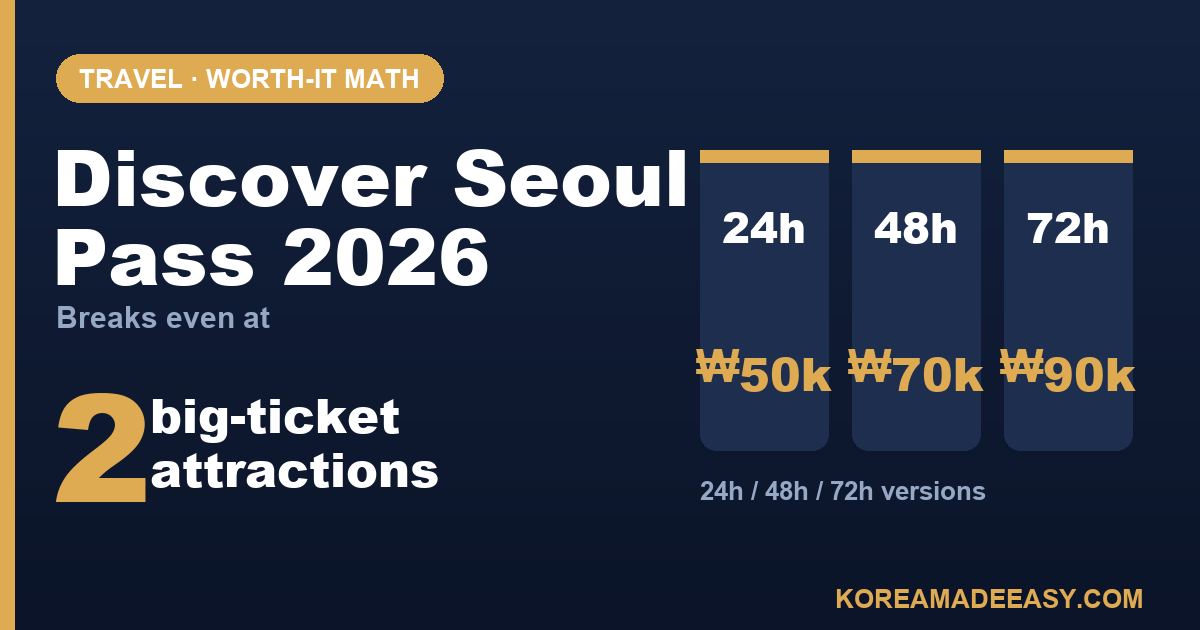
Short answer up front: the Discover Seoul Pass is worth it if you’re doing two or more paid, big-ticket attractions inside the pass’s active window. Hit Lotte World and N Seoul Tower and you’ve already cleared the price of a 48-hour pass. But if your Seoul trip is palaces, markets, and slow cafe mornings, the pass will quietly lose you money — Korea’s palaces cost about ₩3,000, and you can’t recoup ₩50,000 on ₩3,000 tickets. Let me show you the math.
This post contains affiliate links. If you book through them, I may earn a small commission at no extra cost to you. Prices are as of mid-2026 — always check the live pass page for current inclusions before you buy.
What the Discover Seoul Pass actually is
If you’ve never seen one: it’s a single tourist pass that gives free entry to 70+ Seoul attractions for a fixed number of hours, plus discount coupons at roughly 125 more (those are discounts, not free — an important distinction that trips up newcomers). You buy a duration, activate it at your first attraction, and then tap or scan your way in everywhere else at no extra cost until the clock runs out.
The marquee free-entry inclusions — the ones that make the math work — are N Seoul Tower observatory, Lotte World Adventure, the SEA LIFE COEX Aquarium, the Seoul City Tour Bus, hanbok rental, Seoul Bike, and a Han River cruise, plus the palaces. (As of 2026 — inclusions rotate, so confirm the current list before buying. Everland, notably, is often discount-only rather than free on this pass, and it’s out in Yongin anyway, an hour from central Seoul, so don’t build your break-even around it.)
The break-even table (the part nobody else shows you)
Here’s the whole argument in one place. I took the individual walk-up gate price of each big free-entry attraction — what you’d pay without the pass — and lined it up against the pass cost. These are 2026 adult gate prices verified through the attractions and OTAs; treat them as ballpark and reconfirm on the day, since Korean attraction prices drift mid-year.
| Attraction (free with pass) | Individual 2026 gate price | Notes |
|---|---|---|
| Lotte World Adventure (day pass) | ₩59,000–67,000 | The single biggest value driver |
| N Seoul Tower observatory | ₩21,000–29,000 | Gate vs OTA spread — verify |
| SEA LIFE COEX Aquarium | ~₩35,000 | ~₩28,000 if booked online separately |
| Seoul City Tour Bus | ₩24,000–27,000 | Hop-on-hop-off day ticket |
| AREX airport train (one-way perk) | ~₩9,500 | Included in some editions — reconfirm |
| Hanbok rental | ₩15,000–30,000 | Vendor-dependent |
| Gyeongbokgung Palace | ~₩3,000 | Cheap — not a value driver |
Now the worked math against the 48-hour pass (₩70,000 official, or ~₩49,500 on Trazy):
- Lotte World (₩62,000) + N Seoul Tower (₩29,000) = ₩91,000. Two stops and you’ve already beaten the ₩70,000 pass — and demolished the ₩49,500 Trazy price.
- Even using the most conservative gate prices (Lotte ₩59,000 + Tower ₩21,000 = ₩80,000), you still clear the pass on just two attractions.
- Add SEA LIFE COEX (₩35,000) and the City Tour Bus (₩24,000) across your two days, and a 48-hour pass returns roughly ₩150,000 of entry for ₩70,000 — better than half off.
One real traveler I found documented hitting five attractions in a single 24-hour window and pulling ₩134,900 of entry out of a pass that then cost ₩39,900. That’s the ceiling. Most people won’t sprint that hard — but you don’t need to. Two big-ticket stops is the whole game.
So who actually wins — and who loses
The pass wins for you if: you’re doing a theme park (Lotte World is right in the city, unlike Everland) plus the tower and/or the aquarium, and you can cluster those paid attractions into consecutive days. First-timers on a classic “see the big stuff” Seoul trip almost always come out ahead.
The pass loses money for you if: you’re a slow traveler, your itinerary is palaces + markets + cafes + neighborhoods, or you simply can’t fit two-plus paid attractions into the active window. Palaces at ₩3,000 will never recoup a ₩50,000 pass. If that’s your trip, skip the pass entirely — I’ve rounded up genuinely great free things to do in Seoul that make a no-pass itinerary shine, and you can buy the one or two paid tickets you do want à la carte. More on that below, because the honest answer for some readers is “don’t buy the pass.”
Which one to buy: 24h vs 48h vs 72h
The version matters as much as the yes/no, and here’s where the activation clock becomes critical. The timer does not start when you buy — it starts when you scan into your first attraction, and then runs continuously. A “48-hour” pass is 48 straight hours from that first tap, so you plan back-to-back days, not a leisurely spread.
- 24h (₩50,000 / ~₩35,900 Trazy) — the power-day. Only worth it if you back-load three to four paid attractions into one hard-charging day: morning theme park, afternoon aquarium, evening tower. Highest value-per-won, but exhausting and easy to fumble.
- 48h (₩70,000 / ~₩49,500 Trazy) — the sweet spot, and my default recommendation. Two comfortable days clears break-even without a death march: Lotte World and the aquarium on day one, tower and City Tour Bus on day two. This is what I’d tell most first-timers to buy.
- 72h (₩90,000) — the maximizer. Only for people genuinely doing a theme park plus multiple museums and experiences across three days. Many travelers can’t sustain the pace, and a 48h pass plus a couple of à-la-carte tickets often works out cheaper.
👉 Check current Discover Seoul Pass prices and pick your duration on GetYourGuide — free cancellation on most listings, so you can lock a date without committing.
👉 Compare the card vs mobile version on KKday — the product page confirms exactly which attractions are free-entry this edition.
If price is your only concern, Trazy regularly undercuts the official rate — around ₩35,900 for 24h and ₩49,500 for 48h when I last checked, though these are promo prices that expire, so confirm the live number. Trip.com is another solid backup seller if a date is sold out elsewhere.
The T-money trap that catches newcomers
Here’s the gotcha that costs people real convenience: only the physical CARD version doubles as a T-money transit card. You can load won onto the card and tap into the subway, buses and taxis with it. The mobile / QR version does not do this — it’s attractions only. So travelers who buy the mobile pass “for convenience” then discover they still need a separate transit card.
If you’re getting the card version, it can be your one-and-done transit card too — but understand how T-money actually works first, including reloads and refunds, so you don’t leave money stranded on it. I walk through all of that in how to buy and use a T-money card in Korea. And if your edition includes the one-way AREX airport-train perk, use it on arrival — my Incheon Airport to Seoul guide shows where that fits versus the other routes into the city.
If the pass isn’t worth it for you — buy the tickets you want
Ran the math and concluded the pass loses you money? Good — that’s the honest outcome for a lot of trips, and you should still see the one or two big things you actually care about. Buy those individually instead of a pass you won’t fill:
👉 Book Lotte World Adventure tickets à la carte on GetYourGuide — often discounted below the ₩59,000+ gate price.
👉 Book N Seoul Tower observatory tickets on KKday — the view’s worth it even without a pass; skip the gate queue.
Pair either with a smartly chosen base — where to stay in Seoul breaks the neighborhoods down by budget and vibe — and you’ve got a pass-free trip that costs you exactly what you use and not a won more.
FAQ
Is the Discover Seoul Pass worth it in 2026? Yes, if you do at least two big-ticket paid attractions inside the pass’s active window. Lotte World plus N Seoul Tower alone (₩80,000–91,000 at the gate) already beats the ₩70,000 48-hour pass. It’s not worth it for slow, palace-and-cafe itineraries, because Korea’s palaces cost about ₩3,000 and you can’t recoup the pass price on tickets that cheap.
Which Discover Seoul Pass should I buy — 24, 48 or 72 hours? For most first-time visitors, the 48-hour pass is the sweet spot: two comfortable days easily clears break-even. Choose 24h only if you’ll cram three-plus paid attractions into one power day, and 72h only if you’re a genuine attraction-maximizer doing a theme park plus several museums across three days.
Does the Discover Seoul Pass work as a T-money card? Only the physical card version doubles as a T-money card for subway, bus and taxi. The mobile QR version does not — it covers attractions only, so you’d still need a separate transit card. This is the single most common newcomer mistake with this pass.
Where’s the cheapest place to buy it? Official prices are ₩50,000 / ₩70,000 / ₩90,000, but resellers like Trazy often undercut that (recently around ₩35,900 for 24h and ₩49,500 for 48h). Those are promo prices that expire, so compare the live rate on Trazy, GetYourGuide, KKday and Trip.com before you buy.
Written by Yongwoo Chung, who lives in Seoul and has run the gate-price math more than once. All prices and inclusions are dated mid-2026 and worth a quick reconfirm on the official Discover Seoul Pass page before you travel — durations, the AREX perk, and which attractions are free-entry (versus discount-only) all change between editions.
Planning Your Korea Trip? Don't Pay Full Price! ✨
Save $20–$50 per person with our verified reader perks & skip the long ticket booth queues:
AREX Incheon ↔ Seoul Express
Non-stop 43-min direct train with guaranteed reserved seats & free Wi-Fi. Scan your mobile QR straight at the gate!
Get 20% Off AREX Ticket →Korea Unlimited 5G eSIM
Skip the 30-min airport counter line. Scan the QR code to connect instantly for smooth Naver Maps navigation.
Get Instant eSIM QR (From $2.80) →WOWPASS Card (Pay + T-Money)
Pay anywhere in Korea with zero FX fees + subway card. Use code KOREAEASY for 0.5% cash top-up bonus!
Top Seoul Passes & Day Tours
Guaranteed entry for Lotte World, Nami Island tours, CIMER Spa, and Hanbok palace rentals with instant mobile vouchers.
Browse Top Seoul Deals →Sources
- https://www.discoverseoulpass.com/
- https://www.discoverseoulpass.com/attraction/list
- https://southkoreahallyu.com/discover-seoul-pass-review/
- https://www.trazy.com/
- https://www.kkday.com/en/product/12827-korea-discover-seoul-pass-card-version
- https://thesoulofseoul.net/discover-seoul-pass-save-money-on-travel/
Search-trend data from Google Trends (KR) and Naver DataLab. This article is independent commentary and is not affiliated with any broadcaster, agency, or the individuals mentioned.