Travel
Where Did All the Trash Cans Go? The Seoul Street Waste & Recycling Guide for Tourists
📈 Trend signal: Persistent tourist friction regarding lack of street garbage cans and fears of illegal dumping fines across Seoul
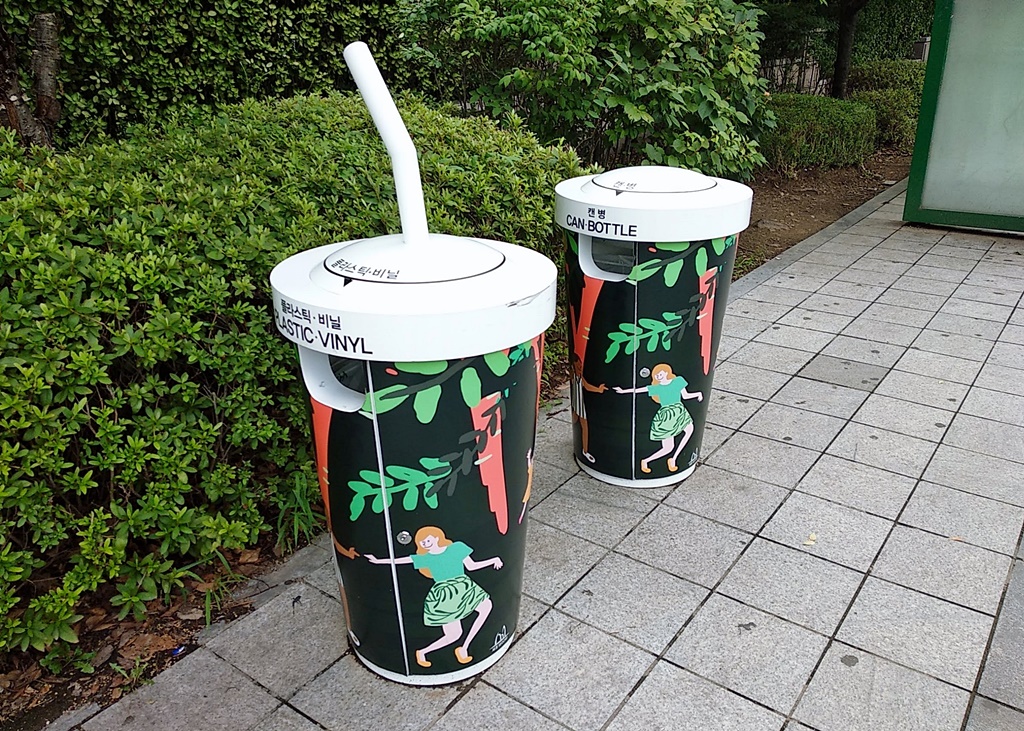
Sorted street recycling bins (plastic/vinyl and can/bottle) in Seocho-gu, Seoul. Photo by Exj via Wikimedia Commons, CC BY-SA 4.0.
You buy a hot cup of tteokbokki at a street stall in Myeongdong or an iced Americano in Seongsu. Twenty minutes later, you finish your snack, look around for a trash can to toss the wooden skewer and paper cup, and realize something startling: there is not a single trash bin anywhere on the street.
You walk two blocks. Nothing. You check an alleyway. Still nothing.
Desperate, you walk into a nearby convenience store or cafe, sheepishly aiming for their indoor bin, only to have the clerk wave their hands and say, “No, outside trash not allowed.”
Every single week on travel forums, incoming visitors voice genuine panic about this. Some describe carrying empty plastic cups inside their backpacks for eight hours; others post in sheer anxiety that making an honest mistake will trigger a massive ₩100,000 fine and legal trouble with immigration.
As someone who has lived in Seoul for five years, let me demystify why Korea’s streets look like this, the real laws governing waste disposal, and the practical shortcuts locals use to legally get rid of trash without ruining their day.
1. Why Did Seoul Remove Its Street Trash Cans?
When foreigners notice that Seoul’s streets are remarkably clean despite having virtually no public bins, they often assume it is a cultural mystery. In reality, it is the direct result of a calculated government policy introduced decades ago.
The 1995 Pay-As-You-Go Revolution (Jongryangje)
Before 1995, South Korea handled waste like most countries: local municipal taxes covered unlimited household garbage disposal. But rapid industrialization caused a landfill crisis.
On January 1, 1995, the Korean government introduced the Volume-Based Waste Fee System (쓰레기 종량제, Jongryangje). Under this law, every household and commercial business must buy designated, government-regulated plastic trash bags to dispose of non-recyclable general waste. The price of the bag pays for the waste processing.
Immediately after the law took effect, an unintended consequence exploded: residents and shopkeepers seeking to avoid buying official trash bags started hauling their household kitchen garbage and commercial waste onto the sidewalks, stuffing it into public street bins. Street trash cans quickly overflowed with smelly domestic refuse.
To curb this widespread illegal dumping, Seoul’s municipal districts took a drastic measure: they systematically removed street trash cans. In 1995, Seoul had over 7,600 public street bins; by the late 2000s, that number had plummeted by nearly half.
Why Did Subway Platforms Remove Their Bins?
Many travelers think, “Fine, if there are no bins on the street, I’ll just toss this on the subway platform.” But when you get down to the train boarding area, the platform bins are often missing too.
Following the tragic 2003 Daegu subway fire and international incidents like the 2005 London transit bombings, transit authorities overhauled station safety protocols. Enclosed platform trash cans were identified as potential fire hazards and concealment points for hazardous devices. While Seoul Metro later reintroduced transparent vinyl bins at select turnstile gates and concourses, platform-level bins remain intentionally scarce.
2. Why Convenience Stores and Cafes Reject Your Trash
A frequent source of cultural friction occurs when a tourist walks into a CU, GS25, or local bakery trying to dispose of street trash.
Why do shopkeepers get visibly defensive?
- They Pay for Every Liter of Trash: Because of Jongryangje, businesses do not have free commercial dumpster service. Every single 50-liter or 100-liter bag they fill costs the store owner money out of their own pocket.
- Strict Sorting Penalties: If a foreign tourist tosses food-soaked paper or unrinsed plastic into a business’s recycling bin, the municipal sanitation department can fine the shopkeeper for improper sorting.
- The Unwritten Rule: If you purchased food or drinks inside that specific store, you are 100% entitled to use their customer bins. But bringing outside trash from street vendors into an unrelated shop is considered an imposition on their private waste quota.
3. The 4 Places You CAN Legally Throw Away Trash
You do not need to haul empty coffee cups around Seoul all day. Here is where you can legally and safely dispose of items while exploring the city:
1. Subway Station Turnstiles & Restroom Entrances
While platform-level bins are rare, nearly every Seoul subway station has a set of designated recycling and general waste bins located on the upper concourse level (outside the ticket gates), usually positioned right next to the public restrooms or passenger fare gates.
Tip: Look for the split receptacles: 일반쓰레기 (Ilban Sseuregi = General Waste) and 재활용 (Jaehwalyong = Recyclables: Plastic, Cans, Paper).
2. Giving Back to the Original Street Food Vendor
If you bought skewers, hotteok, tteokbokki, or egg bread from an outdoor market stall (such as in Gwangjang, Myeongdong, or Namdaemun), the vendor almost always has a private trash bucket tucked beside their cart.
When you finish eating, simply hand the empty skewer or paper cup back to the vendor with a polite smile. It is completely customary, and vendors expect it.
3. Bus Stops & Major Intersection “Seoul-Type” Bins
After years of public complaints from both locals and foreign tourists, the Seoul Metropolitan Government reversed its removal policy starting in 2013 and accelerated it again in 2023. The count has fluctuated year to year (it was actually still falling as recently as 2022–2023, down to under 5,000), but the city has stated a target of roughly 7,500 bins by 2025 — so the trend is genuinely upward, even if the exact current count is worth a quick local check rather than treating any single number as fixed.
These newer “Seoul-Style” bins feature smaller openings (to prevent people from dumping entire household trash bags) and are concentrated near:
- High-traffic bus transit shelters.
- Major subway station street exits (e.g., Gangnam Exit 10, Hongdae Exit 9).
- Public parks and tourist hotspots like Cheonggyecheon Stream.
4. Inside Public Restrooms
Seoul has thousands of immaculately clean, free public restrooms in parks, government community centers, and transit hubs. While individual toilet stalls no longer have paper bins (following the 2018 Clean Restroom reform requiring toilet paper to be flushed directly into the bowl), there is almost always a general paper towel trash bin next to the public handwashing sinks. You can toss dry personal tissues and small wrappers there.
4. Fines and Legal Reality: Debunking the Myth
Online forums often share horror stories about tourists receiving immediate ₩100,000 or ₩300,000 fines for accidentally dropping a tissue or mishandling a takeout cup.
Here is the legal reality under the Waste Management Act (폐기물관리법):
| Violation Type | Actual Statutory Fine | Who Gets Targeted? |
|---|---|---|
| Discarding handheld litter (cigarette butts, tissues, small wrappers) | ₩50,000 | People caught by active district enforcement officers or CCTV littering on sidewalks. |
| Dumping household waste in unapproved plastic bags | ₩200,000 | Residents who dump untagged residential trash bags on street corners. |
| Dumping garbage using vehicles or handcarts | ₩500,000+ | Commercial dumpers and illegal haulers. |
The Good News for Travelers: Foreign tourists carrying a single beverage cup are not being hunted down by undercover agents. Enforcement officers are targeting chronic, illegal neighborhood dumpers who leave bags of kitchen garbage on street corners.
However, deliberately leaving your empty coffee cup on top of an electrical utility box, a bus stop bench, or a fire hydrant is considered illegal littering. Aside from being considered exceptionally bad etiquette by locals, doing so can subject you to an on-the-spot ₩50,000 fine if spotted by local district patrol officers (Guchong Dan-sok-ban).
5. Practical Rules for Walking Around Seoul
To navigate Seoul like a seasoned local, follow these four simple habits:
- Finish Drinks Before You Leave: In Korea, walking while drinking or eating street food is far less common than sitting or standing near the shop to finish it. Drink your coffee or eat your skewer at the shop, toss the cup in their bin, and then walk away hands-free.
- Never Board a City Bus with an Open Cup: Since a January 2018 city ordinance, Seoul bus drivers are authorized to refuse boarding to a passenger holding an open takeout coffee cup, smoothie, or unsealed drink with a straw. Enforcement varies by driver, but expect to be turned away if you try.
- Carry a Small Plastic Bag: Locals frequently carry a small fold-up pouch or plastic bag in their tote bag or daypack. If you generate snack wrappers or wet wipes, pop them into your bag until you reach a subway station restroom or return to your hotel room.
- Hotels Handle Your Daily Trash: You never need to purchase Jongryangje pay-as-you-go bags for personal trash generated inside your hotel room. Hotel housekeeping services sort and manage waste disposal as part of your room rate. (If staying in an Airbnb, however, check your host’s house manual—residential apartments require you to separate food waste, recyclables, and general trash into official district bags).
Frequently Asked Questions (FAQ)
Q1: Can I throw away my trash in a convenience store bin if I didn’t buy anything?
Generally, no. Convenience stores pay per bag for commercial waste disposal and face fines if outside trash contaminates their recycling. If you buy a bottle of water or a snack at that store, using their bin is fine; otherwise, hold onto your trash until you reach a subway station concourse.
Q2: What should I do with empty coffee cups on the street?
Take the cup to the nearest subway station concourse (near the ticket gates or public restrooms), look for a new street-side bin near a major bus stop shelter, or return it to the cafe where you purchased it. Never abandon cups on utility boxes or subway stairs.
Q3: Do I have to separate my trash in my hotel room?
No. Standard hotels, business hotels, and guesthouses sort waste internally. You can leave standard personal travel trash in your hotel room wastebasket without worrying about local municipal sorting rules.
Sources & Regulatory Reference
- Ministry of Environment (환경부): Volume-Based Waste Fee System (쓰레기 수수료 종량제) Guidelines and Enforcement Decree of the Waste Management Act (폐기물관리법 제8조 및 제68조).
- Seoul Metropolitan Government (서울특별시청): Climate & Environment Headquarters Street Garbage Bin Expansion Project Data (2023–2026).
- Seoul Metro (서울교통공사): Safety & Disaster Prevention Operations regarding station concourse and platform cleanliness protocols.
Planning Your Korea Trip? Don't Pay Full Price! ✨
Save $20–$50 per person with our verified reader perks & skip the long ticket booth queues:
AREX Incheon ↔ Seoul Express
Non-stop 43-min direct train with guaranteed reserved seats & free Wi-Fi. Scan your mobile QR straight at the gate!
Get 20% Off AREX Ticket →Korea Unlimited 5G eSIM
Skip the 30-min airport counter line. Scan the QR code to connect instantly for smooth Naver Maps navigation.
Get Instant eSIM QR (From $2.80) →WOWPASS Card (Pay + T-Money)
Pay anywhere in Korea with zero FX fees + subway card. Use code KOREAEASY for 0.5% cash top-up bonus!
Top Seoul Passes & Day Tours
Guaranteed entry for Lotte World, Nami Island tours, CIMER Spa, and Hanbok palace rentals with instant mobile vouchers.
Browse Top Seoul Deals →