Travel
Korea Travel Cards Compared (2026): T-Money vs Climate Card vs WOWPASS vs NAMANE
The payoff Carrying envelopes of Korean Won cash and buying single subway tickets → tapping through transit gates and local shops with the Korean travel card that fits your itinerary.
Research context: Smart Tourism Prepaid Transit & Fintech Integration (Korea Smart Card Corporation & Seoul Metro)
Arriving in South Korea and deciding which transit or prepaid card to buy can feel confusing at first.
Unlike cities where you can tap a contactless foreign Visa or Mastercard directly at subway turnstiles, Korean subways and city buses generally require a local transit card (or a single-journey ticket).
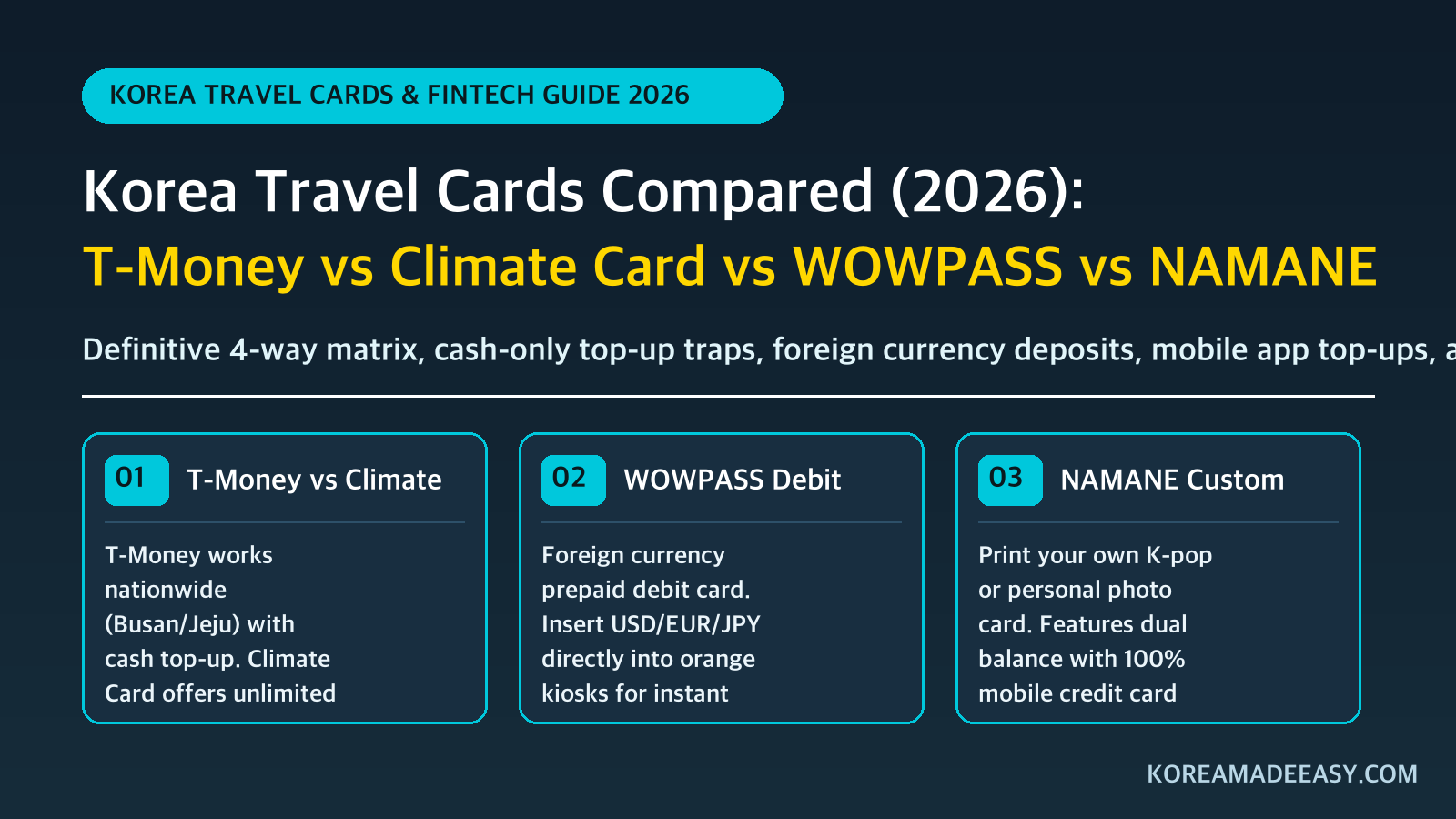
Today, foreign visitors mainly choose among four cards:
- T-Money Card (티머니) — The classic nationwide transit card.
- Seoul Climate Card (기후동행카드) — Seoul’s unlimited short-term transit pass.
- WOWPASS (와우패스) — Foreigner-exclusive prepaid payment-and-exchange card with built-in Tmoney.
- NAMANE Card (나마네카드) — Custom photo-printed prepaid payment and Railplus transit card.
Here is a 2026 four-way comparison based on each operator’s current official guides, including card prices, transit coverage, top-up methods, and refund rules.
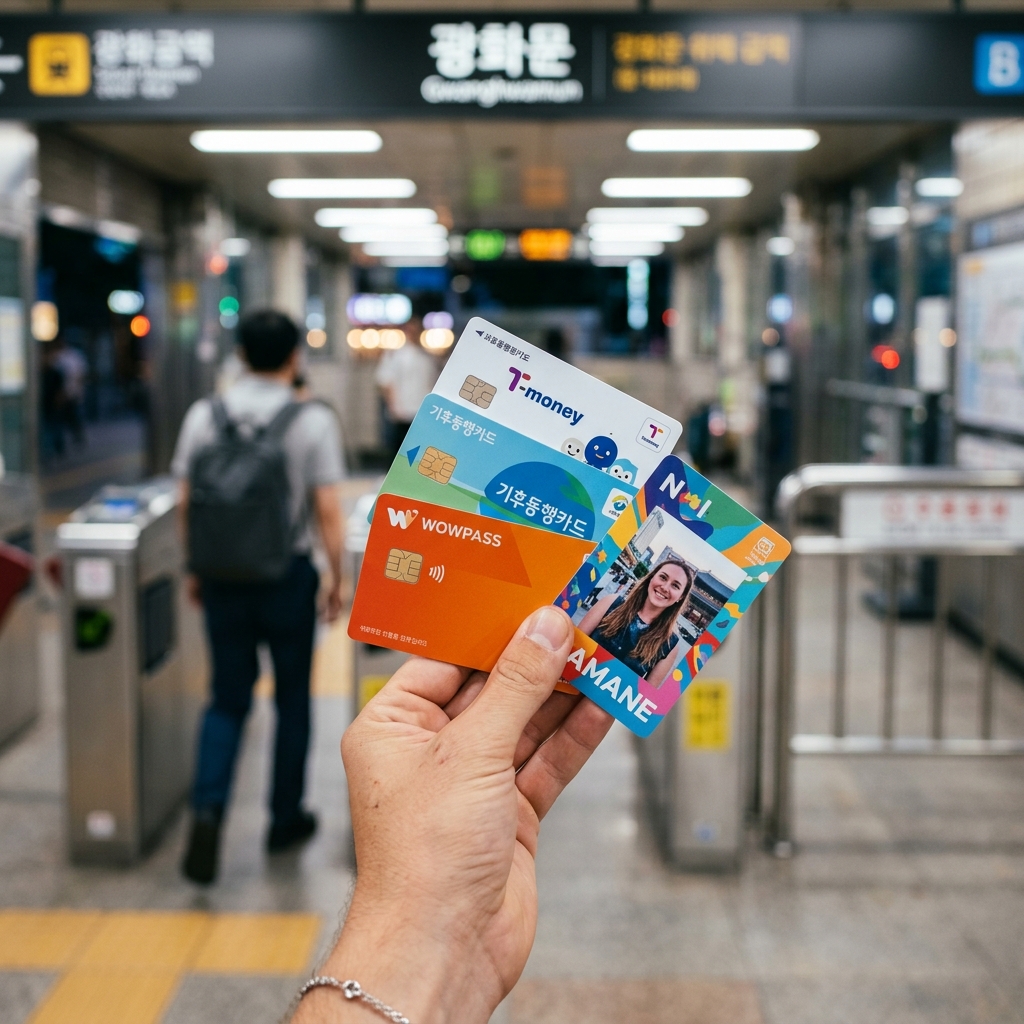
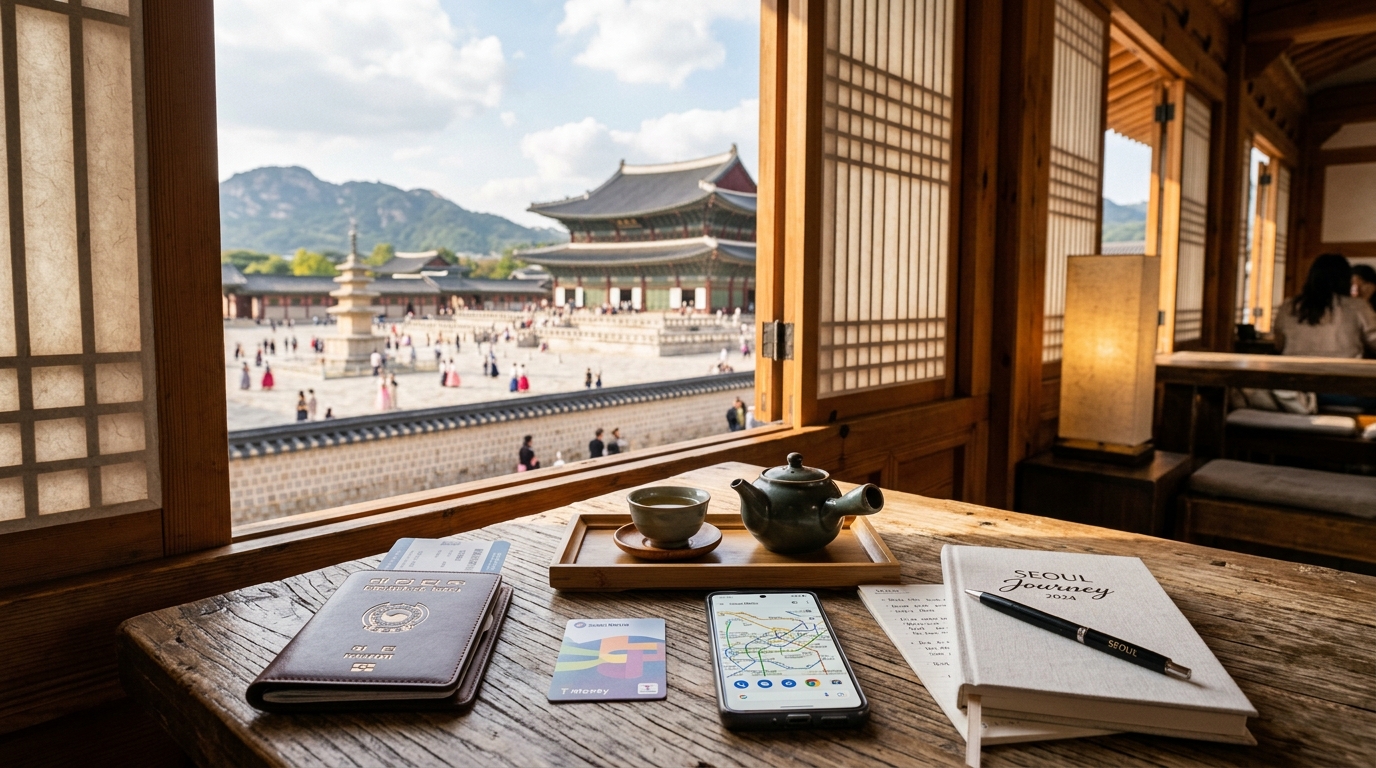
The four main Korean travel cards: T-Money, Seoul Climate Card, WOWPASS, and a custom photo NAMANE Card outside a subway turnstile gate in Seoul.
🧭 4-Way Comparison Table (2026)
| Card Name | Card Purchase Cost | Transit Coverage | Shopping & Dining Function | Top-Up Payment Method | Best Suited For |
|---|---|---|---|---|---|
| T-Money | ₩3,000 – ₩5,000 (general, VISITKOREA; non-refundable) | Nationwide participating subways, buses, and taxis. | Limited to convenience stores and affiliated merchants displaying the Tmoney logo. | Korean won cash at convenience stores and station machines (₩1,000–₩90,000 per top-up; ₩500,000 cap). | Multi-city travelers who already have reliable bank cards for shopping. |
| Climate Card | ₩3,000 (physical card) + ₩5,000–₩20,000 short-term pass | Subways within Seoul (+ drop-off only at Incheon Airport T1/T2) and Seoul-licensed city/town buses. Exclusions apply. | None (transit pass only). | Cash or domestic cards at kiosks; since March 17, 2026, overseas Visa/Mastercard work at 440 designated machines in 273 stations (Lines 1–8) with an average 3.7% service fee. | Heavy transit riders staying inside Seoul’s covered area. |
| WOWPASS | Listed at ₩5,000 (VISITKOREA; check live kiosk/app fee) | Nationwide via its built-in Tmoney function (separate balance). | Offline merchants nationwide accepting local credit/debit cards (e.g., Olive Young). | WOWPASS balance: 16 foreign currencies, KRW, or credit card at WOWPASS machines; overseas cards/mobile wallets in app. Tmoney balance: KRW cash or in-app NFC transfer. | Foreign visitors bringing cash to exchange or wanting a local prepaid card plus Tmoney on one card. |
| NAMANE Card | ₩7,000 custom design; ₩6,000–₩10,000 character card (NAMANE manual) | Nationwide public transit via its Railplus transit balance (separate from Pay balance). | Pay balance works at convenience stores, cafes, restaurants, and local merchants. | Kiosks (cash with exact amount, overseas Visa/Mastercard/JCB, QR/Alipay+) and NAMANE app (overseas credit/debit cards, Alipay+, CU cash top-up; Korean cards not supported in the app card-top-up flow). | Visitors who want a custom photo card with both Pay and Transit balances managed in one app. |
1. T-Money: The Classic Nationwide Transit Card
- How It Works: A stored-value transit card tapped when entering and exiting subways and buses. Tmoney’s foreigner guide notes a ₩100-plus per-ride discount compared with single-journey tickets and up to four transfer discounts per day within 30 minutes (up to 1 hour from 9:00 PM to 7:00 AM).
- Coverage: Widely accepted across participating Korean subways, buses, taxis, and convenience stores displaying the Tmoney logo.
- Top-Up Limits: Per Tmoney’s official foreigner guide, physical cards are topped up with Korean won cash in ₩1,000 units from ₩1,000 to ₩90,000 per reload, up to a ₩500,000 maximum balance, at convenience stores (GS25, CU, 7-Eleven, Emart24, etc.) and subway station machines.
2. Seoul Climate Card (기후동행카드): The Unlimited Pass
- How It Works: Seoul’s official short-term unlimited transit pass (See Full Climate Card Guide).
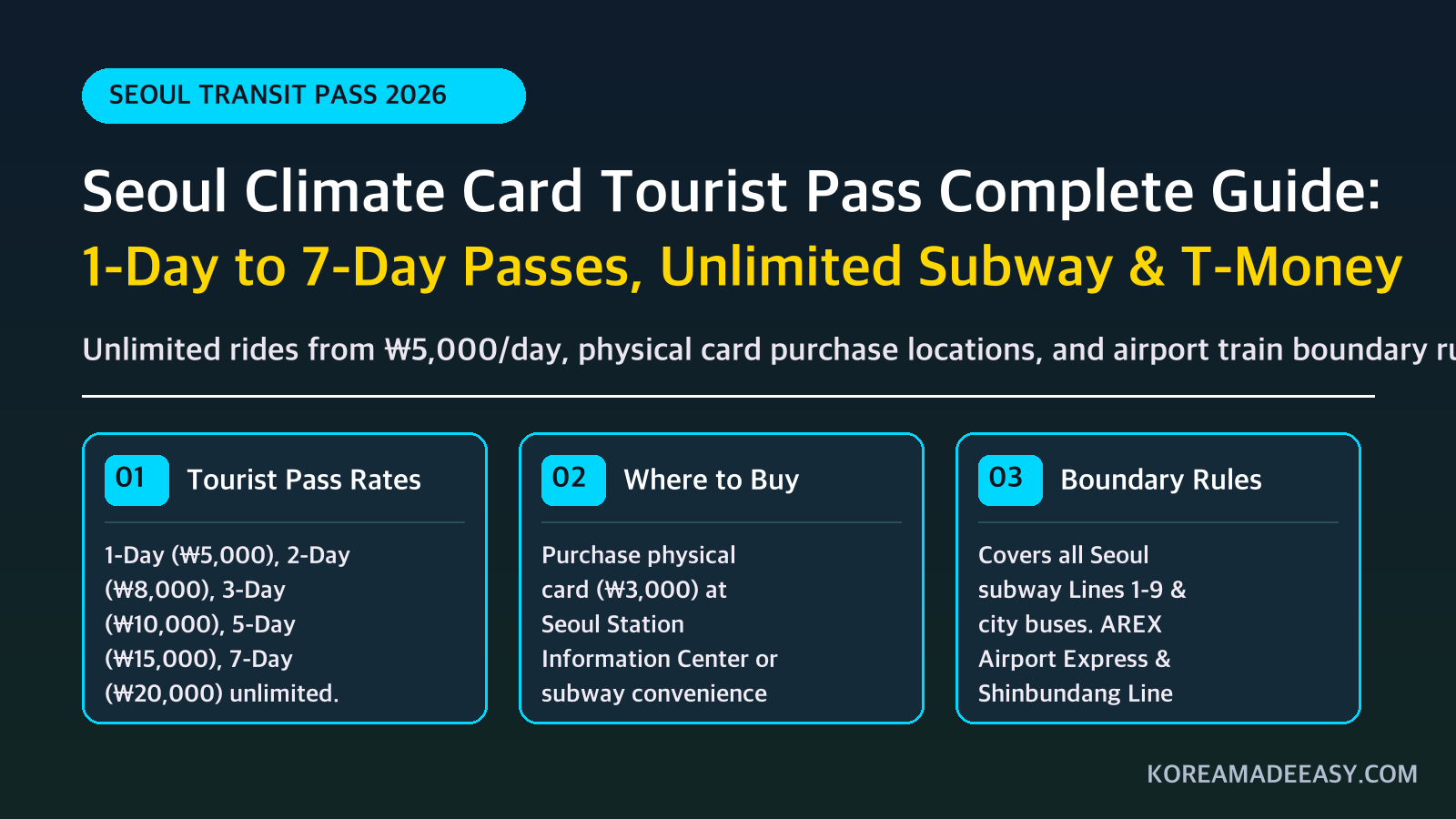
- Pricing (Seoul Metropolitan Government): ₩5,000 (1-Day) / ₩8,000 (2-Day) / ₩10,000 (3-Day) / ₩15,000 (5-Day) / ₩20,000 (7-Day), plus ₩3,000 for the physical card (bought separately). A 7-day youth pass (₩13,000) is also listed with age verification. Use begins on the day you charge the card; advance charging is not available.
- The Savings Rule: Seoul’s adult subway base fare is ₩1,550 by transit card (₩1,650 for a single-journey ticket). At ₩1,550 per ride, a ₩5,000 1-day pass breaks even at 4 rides if you already own the card, or 6 rides if you also buy the ₩3,000 card (for example, hopping between Line 2 hotspots — Estimate Your Break-Even on Our Calculator).
- Paying with a foreign card (2026): Since March 17, 2026, Seoul accepts overseas-issued Visa and Mastercard credit and debit cards (plus mobile payments) at 440 new transit card vending machines across 273 stations on Seoul Metro Lines 1–8 for buying Climate Cards, recharging 1-, 2-, 3-, 5-, and 7-day passes, and buying single-journey tickets. An average 3.7% service fee applies to overseas cards (Seoul city notice).
- ⚠️ Coverage Boundaries (Current Rules): Per Seoul’s official Climate Card English page, the short-term pass covers subways within Seoul (including Gimpo Airport Station, which is inside Seoul), alighting (exit) only at Incheon Airport Terminal 1 or Terminal 2 on the Airport Railroad, and Seoul-licensed city and town buses (including late-night and circular buses). It does not cover the Sinbundang Line, GTX, subway stations outside Seoul, boarding at Incheon Airport, express or airport buses, buses licensed in other regions, Seoul Bike (Ttareungi), or the Hangang Bus.
3. WOWPASS: The Foreigner Prepaid Payment & Transit Card
- How It Works: A foreigner-exclusive all-in-one prepaid card issued and topped up at WOWPASS machines (check the official WOWPASS site or app for live kiosk locations) and managed via the WOWPASS app.
- Funding & Limits: Per the WOWPASS User Guide, machines support cash top-ups in 16 foreign currencies, Korean won, or credit cards, and the app supports overseas credit cards and mobile payments. WOWPASS Service Terms specify balance ceilings of ₩2,000,000 (registered) / ₩500,000 (unregistered), a ₩1,000,000 charging ceiling for foreigners under the innovative financial service rules, and a ₩500,000 cap on the integrated Tmoney balance. Compare the live exchange rate and any applicable fees shown on the kiosk or app before loading.
- Dual Balances:
- WOWPASS Payment Balance: Insert the IC chip at offline Korean merchants that accept local credit or debit cards. Protected if you lose the card and suspend it in the app.
- Integrated Tmoney Balance: Tap on subways and buses nationwide. Must be topped up separately (with KRW cash at stations/convenience stores, or converted from your WOWPASS balance via NFC in the app). Cannot be recovered if the card is lost.
💡 Check which balance you are loading: Funds added to your WOWPASS shopping balance will not open subway gates until you load the separate Tmoney balance. For full limits, fees, and withdrawal rules, see our WOWPASS vs T-Money 2026 Guide.
4. NAMANE Card: Custom Photo Printing & Dual-Balance App
- How It Works: Per NAMANE’s official kiosk purchase guide, you design a custom card front with your own photo and text via QR code and print it at a NAMANE kiosk for ₩7,000 (or choose a pre-designed character card for ₩6,000–₩10,000, depending on design). Kiosks accept cash (exact amount only — no change is returned), credit cards (including overseas Visa, Mastercard, and JCB), and QR/mobile wallets such as Alipay, Alipay+, WeChat Pay, and UnionPay QR.
- Dual Balances (Pay + Railplus Transit): Like WOWPASS, a NAMANE Card holds two separate balances — a Pay balance for retail merchants and a Transit balance (powered by Railplus) for Korean public transportation.
- Top-Up in the App: NAMANE’s official app top-up manual lists debit/credit card top-ups for the Pay balance (noting Korean-issued cards are not supported in that flow), alongside kiosk top-ups, Alipay+, and CU cash top-ups. Check the app for live fees, holding limits, and card-issuer compatibility before relying on it.
- Balance Transfers: NAMANE’s manual confirms you can move a Pay balance between registered NAMANE cards in the app, and refund a Transit balance back into your Pay balance via NFC (up to ₩30,000 per request, up to 5 times per calendar month, ₩500 fee).
🎯 30-Second Card Selector: Which One Fits You?
- Staying inside Seoul for 3–5 days with frequent daily subway/bus rides? ➔ Seoul Climate Card (e.g., 5-day pass ₩15,000 + ₩3,000 card = ₩18,000, breaking even at 12 base-fare ₩1,550 rides).
- Want 1 card to exchange foreign cash (16 currencies), shop at local card terminals, and ride transit? ➔ WOWPASS (remember to load the separate Tmoney balance; check displayed exchange rates and fees).
- Want a custom photo souvenir card with app-managed Pay + Railplus transit balances? ➔ NAMANE Card (₩7,000 custom card at kiosks; verify refund rules before loading a large Pay balance).
- Traveling across Seoul, Busan, and other regions with minimal setup? ➔ Standard T-Money Card (₩3,000–₩5,000 at convenience stores, cash reloads).
📱 Emergency Korean Showcards: Save to Your Phone
Show these bilingual phrases to convenience store staff or station attendants:
📱 Showcard 1: Recharging a Transit Card with Cash
“교통카드에 현금 [10,000원 / 20,000원] 충전해 주세요.” (Gyotong-kadeu-e hyeongeum [man-won / i-man-won] chungjeon-hae juseyo.)
💬 Translation: “Please top up this transit card with [₩10,000 / ₩20,000] in cash.”
📱 Showcard 2: Asking for a WOWPASS Kiosk Location
“근처에 외화 환전 및 와우패스(WOWPASS) 발급 기계가 어디에 있나요?” (Geuncheo-e oehwa hwanjeon mit Waupaeseu [WOWPASS] balgeup gigyega eodie innayo?)
💬 Translation: “Where is the nearest WOWPASS foreign currency exchange and card issuance kiosk located?”
For arrivals before rooms are ready, coordinate airport delivery with our Seoul hotel early check-in luggage plan.
❓ Frequently Asked Questions (FAQ)
Q1: Can I get a refund on leftover money when leaving Korea?
- T-Money: Per Tmoney’s official refund guide, balances are refunded in cash minus a ₩500 fee (card purchase price is non-refundable). Convenience store limits vary by chain: under ₩20,000 at GS25, up to ₩20,000 at 7-Eleven, and up to ₩30,000 at CU and emart24. Larger balances can be partially refunded (₩10,000–₩50,000) at Seoul-area subway customer service centers or refunded up to ₩500,000/day (no fee up to ₩500,000/month) at Tmoney Town near Seoul Station Exit 10.
- Seoul Climate Card: Per Seoul’s official Climate Card page, unused short-term pass value is refunded as (total charged − amount used − ₩500 fee) if requested before the pass expires. Physical cards must be registered online to qualify; foreign visitors without a Korean bank account can visit Tmoney headquarters.
- WOWPASS: Per the WOWPASS User Guide, remaining WOWPASS balance can be withdrawn as KRW cash at WOWPASS machines up to ₩100,000 per transaction with a ₩1,000 fee per withdrawal (coins and amounts under ₩1,000 cannot be withdrawn). The WOWPASS balance remains valid for 6 years from the last top-up or reissuance. Any leftover balance on the separate Tmoney side follows standard T-money refund locations and the ₩500 fee.
- NAMANE: Per NAMANE’s official manual, leftover Transit balance can be refunded into your Pay balance in the app via NFC (up to ₩30,000 per request, max 5 times/month, ₩500 fee), or requested via Railplus. In-app Pay balance refunds require at least 60% of the final top-up amount used and a domestic Korean bank account — so foreign travelers without a Korean bank account should check current partner refund options in the app or avoid over-loading the Pay balance.
Q2: Can two people share one transit card?
Subway turnstiles register one rider per tap, and the Climate Card is an individual pass — each traveler should carry their own card.
Q3: Where can I buy these cards immediately at Incheon Airport?
- T-Money: Tmoney lists convenience stores (GS25, CU, 7-Eleven, Emart24, etc.) and notes Incheon International Airport among its sales channels.
- WOWPASS, NAMANE, and Climate Card: Exact airport kiosk and store positions change over time and were not individually verified here. Use each provider’s official kiosk finder in its app or website — or the official Incheon Airport directory — to locate the nearest machine after landing. (Remember that the Climate Card cannot be used to board the Airport Railroad at Incheon Airport.)
Sources checked
- Tmoney Official Foreigner Guide — cash reload limits (₩1,000–₩90,000 in ₩1,000 units), ₩500,000 cap, transfer discounts, sales locations, and ₩500 refund fee (checked 2026-11-23).
- Tmoney Official Refund Guide (English) — convenience-store chain refund limits (GS25, 7-Eleven, CU, emart24), subway customer service center partial refunds, and Tmoney Town limits (checked 2026-11-23).
- VISITKOREA — Transportation Cards — card reference prices (Tmoney ₩3,000–₩5,000, WOWPASS ₩5,000, Climate Card ₩3,000) and overview (checked 2026-11-23).
- Seoul Metropolitan Government — Climate Card (English) — short-term pass prices (₩5,000–₩20,000 + ₩3,000 card), current Seoul coverage and Incheon Airport alighting-only rule, exclusions, start rules, and refund formula (checked 2026-11-23).
- Seoul Metropolitan Government Traffic Notice (16 March 2026) — foreign-issued Visa/Mastercard acceptance at 440 machines in 273 stations on Lines 1–8 from March 17, 2026, and the average 3.7% service fee (checked 2026-11-23).
- Seoul Metropolitan Government English Notice (March 2026) — English announcement for Climate Card short-term pass and single-journey ticket overseas card payments (checked 2026-11-23).
- Seoul Metropolitan Government — Subway Fares — adult base fares of ₩1,550 (transit card) and ₩1,650 (single ride) (checked 2026-11-23).
- WOWPASS User Guide (English) — separate WOWPASS and Tmoney balances, 16-currency machine top-up, NFC Tmoney transfer, KRW withdrawal limit (₩100,000) and ₩1,000 fee, 6-year balance validity, and loss protection (checked 2026-11-23).
- Orange Square — Terms and Conditions on WOWPASS Card Service — balance ceilings (₩2,000,000 registered / ₩500,000 unregistered / ₩1,000,000 foreigner ceiling / ₩500,000 Tmoney cap) (checked 2026-11-23).
- NAMANE Service Manual — Purchase Card at Kiosk — ₩7,000 custom card and ₩6,000–₩10,000 character card pricing, accepted kiosk payment methods (including overseas Visa, Mastercard, JCB, cash with no change) (checked 2026-11-23).
- NAMANE Service Manual — Top Up via Debit/Credit Card (App) — in-app Pay balance card top-up flow (checked 2026-11-23).
- NAMANE Service Manual — Pay Balance Refund & Card Cancellation — 60% usage requirement, domestic bank account refund flow, and Railplus transit refund distinction (checked 2026-11-23).
- NAMANE Service Manual — Transit Balance Refund — NFC transit-to-Pay balance refund limits (up to ₩30,000/request, max 5 times/month, ₩500 fee) (checked 2026-11-23).
- Note: Live WOWPASS exchange rates, WOWPASS/NAMANE in-app card top-up fee percentages, foreign-visitor cash refund options for NAMANE Pay balance without a Korean bank account, and exact Incheon Airport kiosk locations were not confirmed on the official pages cited above; check each provider’s app before purchasing.
Sources
- https://www.t-money.co.kr/ncs/pct/ugd/ReadFrgnGd.dev
- https://blog.tmoney.co.kr/en/tmoney-guide/tmoney-refund/
- https://english.visitkorea.or.kr/svc/contents/contentsView.do?vcontsId=140663
- https://english.seoul.go.kr/policy/transportation/climate-card/
- https://news.seoul.go.kr/traffic/archives/516544
- https://english.seoul.go.kr/climate-cards-and-single-journey-transit-tickets-now-accepting-international-credit-cards-no-cash-needed/
- https://english.seoul.go.kr/policy/transportation/modes-of-transport/subway/
- https://www.wowpass.io/en/guide
- https://www.orangesquare.kr/en/wowpass-service-agreement
- https://namanecard.com/en/service-manual/service-manual-101
- https://namanecard.com/en/service-manual/service-manual-203
- https://namanecard.com/en/service-manual/service-manual-602
- https://namanecard.com/en/service-manual/266
This is independent guidance, not an official operator or government publication. Evidence and check dates vary by article. See our editorial and corrections policy for the distinction between source checks, personal visits and planning advice.