Beauty
Snail Mucin Before or After Retinol? The Exact Korean Layering Order (2026)
The payoff Guessing the layering order and finding your snail essence and retinol pilling into little crumbs on your face → the exact order for your own skin type, retinol at night only, and three ~$16–27 bottles layered so they finally stop pilling.
📈 Trend signal: 달팽이크림·레티놀 (Naver DataLab: 레티놀이 달팽이 검색량 ~2배, 둘 다 겨울 피크)
This is skincare education, not medical advice — retinoids affect everyone differently, so patch-test and see a dermatologist for persistent irritation. Some links below are to products I mention; where they’re affiliate links I may earn a small commission at no extra cost to you, and it never changes what I recommend.
Search “snail mucin before or after retinol” and every single top result gives you the same confident answer: snail mucin always goes first. Clean, simple, and — if you actually read what long-time Korean-skincare users say — only half true. Because when you look at the real threads where people ask this exact question, they split: one camp puts snail mucin first, another deliberately puts it over the retinol as a buffer. Both are right. They’re just right for different skin.
I’ve lived in Seoul for five years and watched this debate play out in Korean beauty forums long before it hit the English internet. So here’s the honest version — not a dogma, a decision you make based on your own skin.

Texture comparison: viscous hydrating snail mucin essence (left) versus active golden retinol serum (right) on a minimalist stone vanity.
The short answer (pick your skin type)
- Normal, oily, or already used to retinol → snail mucin FIRST, then retinol on top. Better glide, better penetration, nothing wasted.
- Sensitive, dry, or new to retinol → the “sandwich”: snail mucin → wait → retinol → a second calming layer. You trade a little retinol strength for a lot less stinging.
- Everyone: layer, never mix the two in your palm. Retinol at night only. SPF every morning.
Get this backwards — pile a rich cream under the watery essence, or blend the retinol and snail mucin together in your palm — and you don’t just waste the ~$16–27 each bottle costs; you can hand yourself a week of stinging and flaking from a retinoid you’ve just diluted and destabilized.
That’s the whole guide in four lines. The rest is why, and how to stop it from pilling into little crumbs on your face.
Why “snail mucin first” is the default
The mainstream advice isn’t wrong for most people. A medically-reviewed source from Skin Pharm (reviewed by Chelsie Rogers, PA-C, a board-certified physician assistant in cosmetic dermatology) puts it plainly: “it’s best to use snail mucin before retinol,” because snail mucin “can help combat some of those uncomfortable side effects by hydrating the skin more thoroughly and strengthening the moisture barrier.” (Skin Pharm).
There’s also a physics reason. The universal layering rule is thinnest to thickest — lightest, most watery formula first. COSRX’s Advanced Snail 96 essence is exactly that: a thin, water-rich essence. Put a heavy cream on before a light essence and you build a wall the essence can’t get through. Koreans phrase it as 묽은 것 → 된 것, “runny before thick.” Snail essence belongs early.
The part the other guides skip: the retinol “sandwich”
Here’s what those one-answer articles bury. For sensitive skin or retinol beginners, applying snail mucin (or a soothing layer) over the retinol — or on both sides of it — is a well-known way to dial down irritation. Apply snail mucin, wait until it’s tacky but not wet, apply your retinol, then seal with a second layer of snail mucin or a cica cream. The buffer softens the sting and the early “purge” without stopping the retinol from working.
This isn’t fringe advice — it’s what real people report doing. On the r/SkincareAddiction thread that asks our exact question, the answers genuinely split. u/Interesting_Foot_105: “Definitely after! If you are not too sensitive to the retinol, apply [retinol] to dry skin… and then apply the snail mucin.” u/ReaLitTea, on the other side: “Personally snail mucin essence works better applied before my retinoid for easy layering… it’s more dependent on your preference.” (thread). Both have upvotes. Both are correct — for their skin.
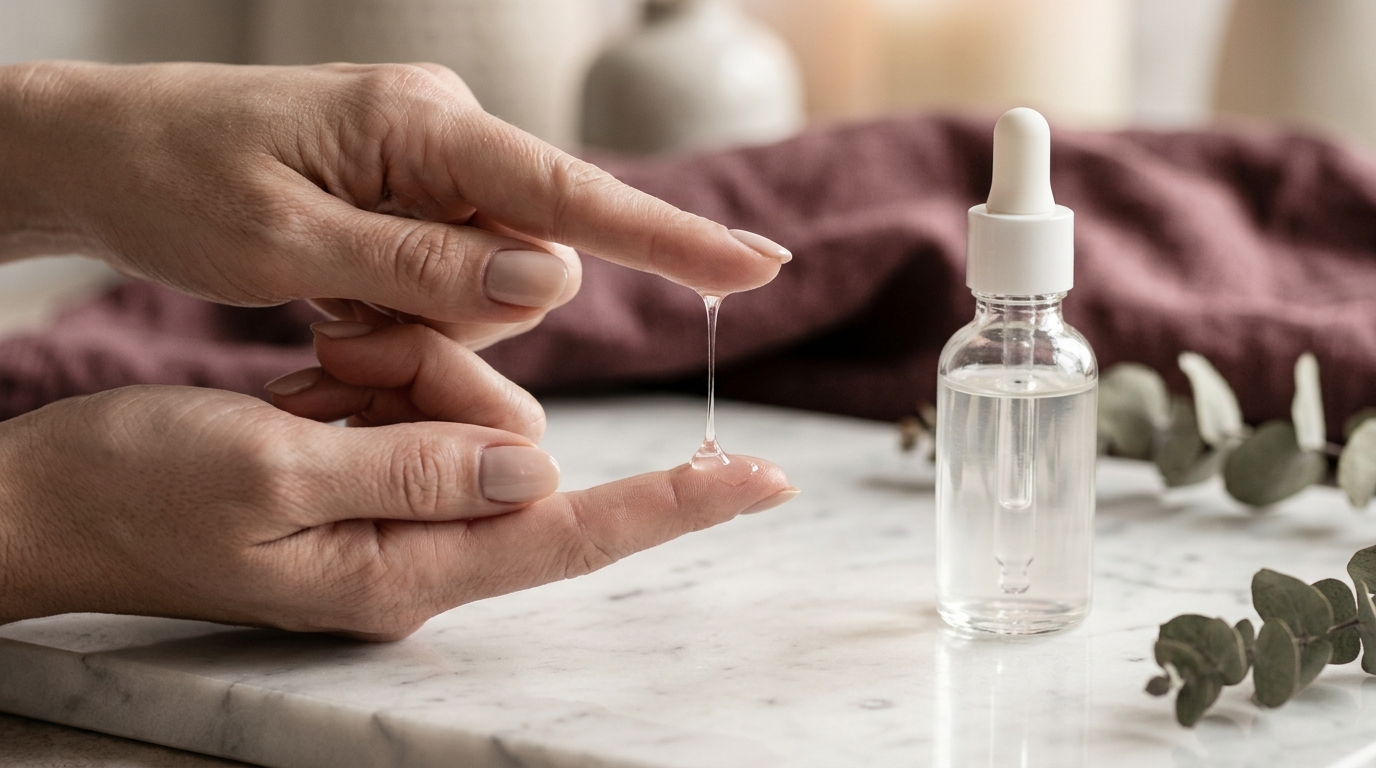
Snail-mucin essence has that signature stretchy, watery slip — which is exactly why the layering order below matters.
The exact order, AM and PM
Retinol is a night-only active because it makes skin more sun-sensitive (American Academy of Dermatology). Snail mucin is fine any time. Most single-answer posts blur this — here’s the two-column version.
| Step | PM (retinol lives here) | AM (no retinol) |
|---|---|---|
| 1 | Cleanse | Cleanse |
| 2 | Optional hydrating toner | Optional toner / vitamin C |
| 3 | Snail mucin essence — thin coat, wait ~1 min to tacky | Snail mucin essence (repairs after last night’s retinol) |
| 4 | Retinol — pea-size, on dry-to-touch skin | Moisturizer |
| 5 | Sensitive/beginner: 2nd snail-mucin or cica layer = the sandwich | Sunscreen SPF 30+ — non-negotiable |
| 6 | Moisturizer to seal | — |
On wait-times, sources honestly disagree: some say 20–60 seconds between layers is enough, others say 2–5 minutes (up to 10 for very reactive skin) before the retinol. Start on the generous side and shorten it once you know your skin doesn’t sting.
Why it pills — and how to stop it
Pilling is those little eraser-crumb rolls. Four causes, four fixes:
| Why it pills | The fix |
|---|---|
| Layers don’t absorb before the next goes on | Wait (20s–5min); apply to slightly damp, not soaking, skin |
| Too much product, or heavy-over-light order | Thin coats, a few drops, pat don’t rub; lightest → heaviest |
| Mixing snail mucin + retinol in your palm | Layer, never mix — mixing can dilute and destabilize the retinoid |
| Silicone/polymer formulas over water gels | Press with flat fingers, give the essence a full minute |
What Korea itself actually searches for
Here’s the data no English guide has, because it’s from Korea’s own search engine. I pulled a year of Naver DataLab numbers for 달팽이크림 (snail cream) versus 레티놀 (retinol):
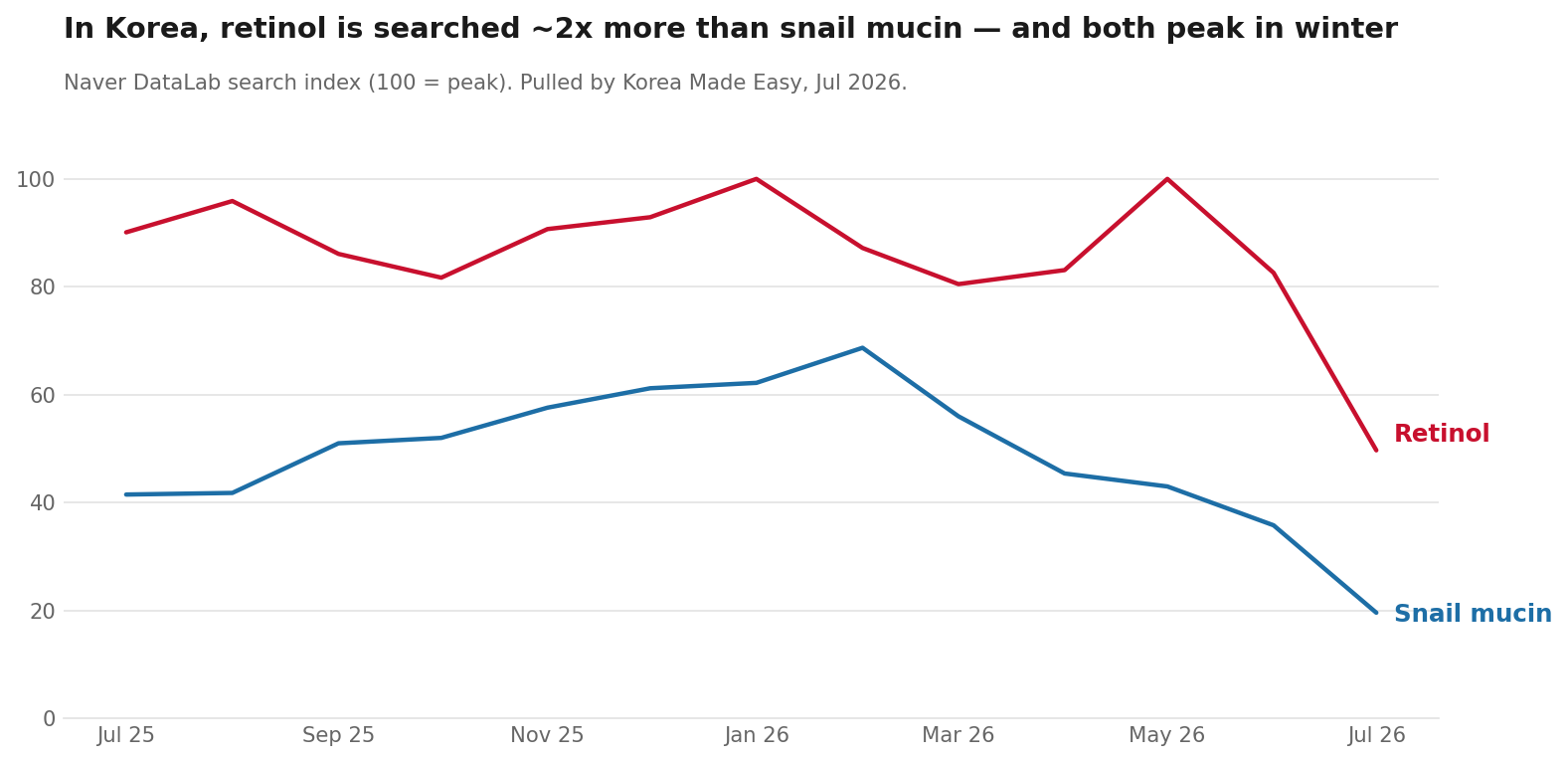
Two things jump out. First, in Korea retinol is searched roughly twice as much as snail mucin all year — the anti-aging active, not the soothing essence, is the bigger category at home. Second, both peak in winter (November–February) and bottom out in summer, tracking dry, cold, indoor-heating season. So the “snail-first vs retinol-first” debate the English internet treats as the whole story is, in Korea, a footnote to a much bigger retinol conversation — and a seasonal one. If you’re building a routine, ramp your retinol into the drier months and lean on snail mucin’s barrier support exactly when the heating comes on.
The three products that do this well (and don’t pill)
You only need two or three things. Buy from the brand’s official storefront on Amazon or from YesStyle to avoid fakes; if you’re visiting Korea, grab them at Olive Young (see what to actually buy there).
- COSRX Advanced Snail 96 Mucin Power Essence — the snail essence itself, 96% snail secretion filtrate. This is “step 3.” ~$16–26 depending on retailer.
- COSRX The Retinol 0.1 Cream — a beginner-friendly full-face K-beauty retinol with panthenol and vitamin E that help buffer it. ~$27–28. (Note: Beauty of Joseon’s popular retinal is an eye serum, not a full-face retinol — a common mix-up.)
- SKIN1004 Madagascar Centella Asiatica 100 Ampoule (or a COSRX Cica serum) — the calming “sandwich” and morning-after layer, fragrance-free. From ~$16.50.
Prices checked July 2026 and move around — verify at checkout. And if you’re in the US and just discovered Olive Young Global stopped shipping to you, here’s where to buy the real Korean lineup now.
A word on doing this safely
Retinol rewards patience and punishes eagerness. Per the AAD: start with the least-intense formula, a pea-sized amount on clean, dry skin, every other night, and build up slowly — back off a step the moment you’re irritated. Wear SPF 30+ every morning you use it (a mineral zinc-oxide sunscreen if you’re sensitive — our Korean sunscreen picks skew that way). Snail mucin is gentle, but if you get little bumps or a reaction, stop, simplify, and see a dermatologist. This is a routine, not a race.
 Read next →Building the whole routine? The Olive Young haul that’s actually worth it — under $50
FAQ
Does snail mucin cancel out my retinol or vitamin C? No. Layered correctly (not mixed in your palm), snail mucin doesn’t neutralize retinol or vitamin C — it mostly adds hydration and barrier support. The only real risk is mixing them together in your hand, which can dilute the active. Layer, let each set, and you’re fine.
Snail mucin gave me little bumps — is that normal? It can be a temporary purge or a reaction to introducing too much too fast. Patch-test first, introduce one new product at a time, and give it a couple of weeks. If bumps persist or worsen, stop using it and see a dermatologist — don’t push through a reaction.
Do I even need snail mucin if I already use toner, vitamin C and moisturizer? Not strictly — it’s a hydration-and-repair step, not a mandatory one. But it earns its place specifically when you’re using retinol, because that barrier support is exactly what reduces retinol’s sting and flaking. If your skin is dry or you’re new to actives, it’s one of the highest-value additions you can make.
Planning Your Korea Trip? Don't Pay Full Price! ✨
Save $20–$50 per person with our verified reader perks & skip the long ticket booth queues:
AREX Incheon ↔ Seoul Express
Non-stop 43-min direct train with guaranteed reserved seats & free Wi-Fi. Scan your mobile QR straight at the gate!
Get 20% Off AREX Ticket →Korea Unlimited 5G eSIM
Skip the 30-min airport counter line. Scan the QR code to connect instantly for smooth Naver Maps navigation.
Get Instant eSIM QR (From $2.80) →WOWPASS Card (Pay + T-Money)
Pay anywhere in Korea with zero FX fees + subway card. Use code KOREAEASY for 0.5% cash top-up bonus!
Top Seoul Passes & Day Tours
Guaranteed entry for Lotte World, Nami Island tours, CIMER Spa, and Hanbok palace rentals with instant mobile vouchers.
Browse Top Seoul Deals →Sources
- https://skinpharm.com/blogs/blog/snail-mucin-before-or-after-retinol
- https://www.aad.org/public/everyday-care/skin-care-secrets/anti-aging/retinoid-retinol
- https://www.cosrx.com/products/advanced-snail-96-mucin-power-essence
- https://www.cosrx.com/products/the-retinol-0-1-cream
- https://www.reddit.com/r/SkincareAddiction/comments/182gj2q/
Search-trend data from Google Trends (KR) and Naver DataLab. This article is independent commentary and is not affiliated with any broadcaster, agency, or the individuals mentioned.

Olive Young Myeongdong Sold Out? The 3-Minute Walk Hack for 0 Crowds & Instant Tax Refund (2026)
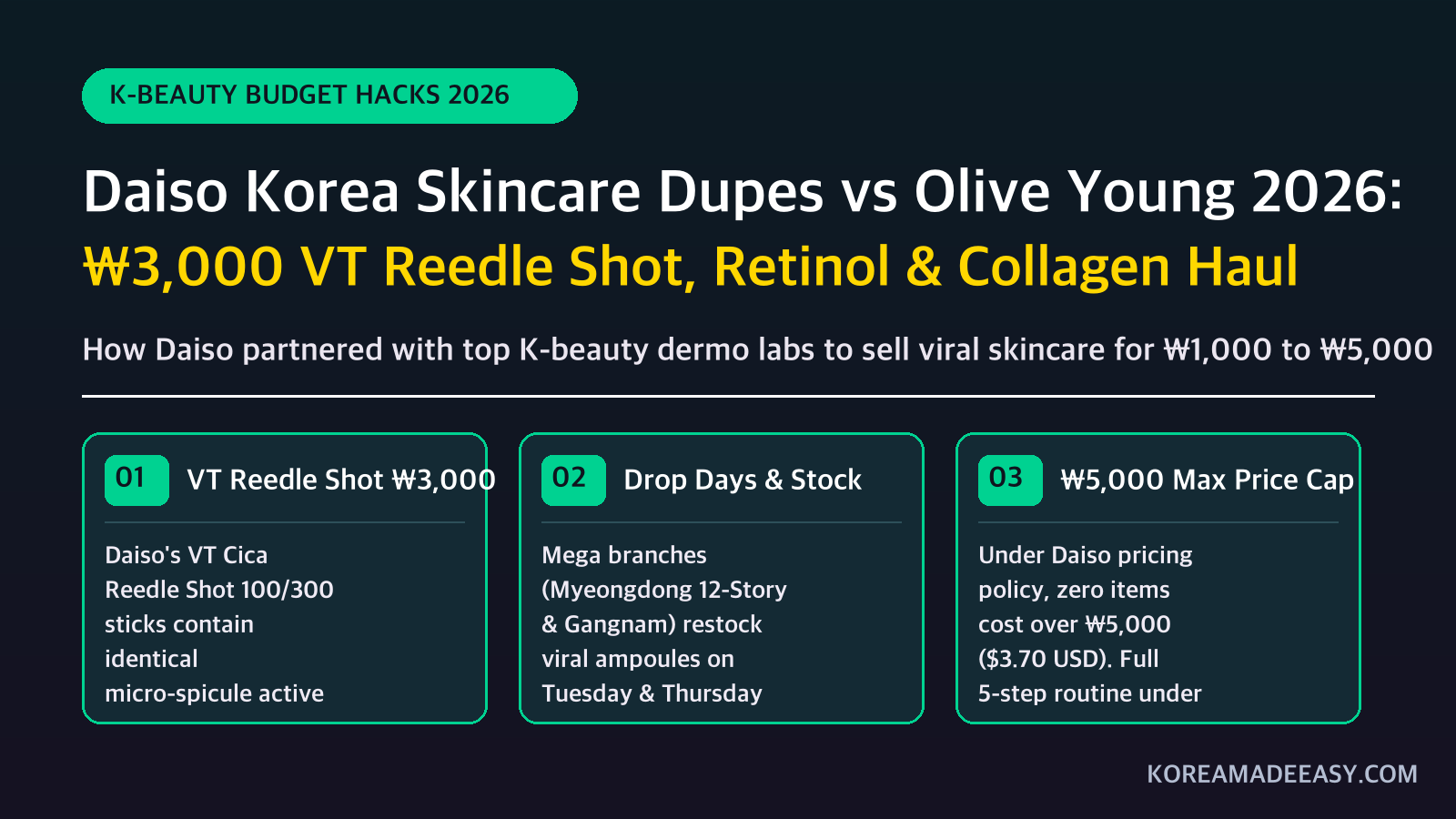
Daiso Korea Skincare: The ₩3,000 Dupes Beating Olive Young (2026 Foreigner Guide)