Health
Getting Sick in Korea: How to See a Doctor as a Foreigner (Walk-in Clinics, Costs & English) 2026
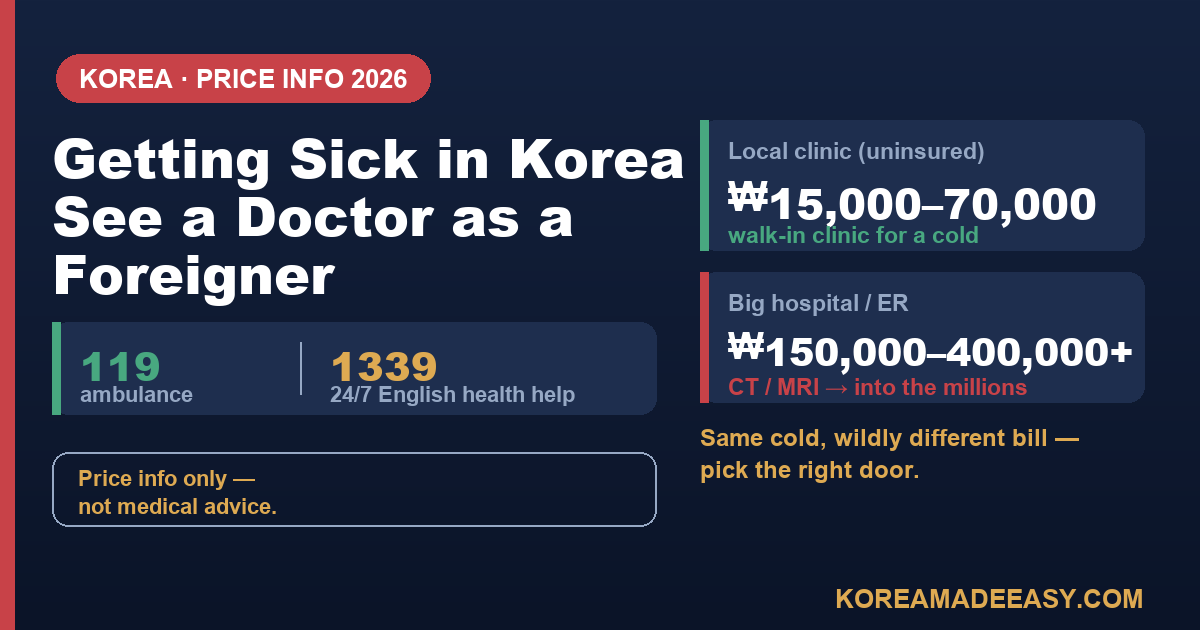
The payoff 2 a.m. in a Seoul hotel, sick, no Korean insurance, staring at pharmacy signs you can't read → walking into a neighborhood clinic on nothing but your passport, seen without an appointment for about ₩15,000–70,000, and picking up your medicine at the pharmacy next door.
📈 Trend signal: Two-tier out-of-pocket cost data for uninsured foreign patients (2026): a neighborhood 의원 walk-in stays cheap (~₩15,000–70,000) even with no NHIS, while a top-tier hospital bills at 'international rates' ~2.5–3× the local fee schedule and an ER visit starts at ₩150,000–400,000 before any scan — climbing into the millions with CT/MRI
This is general information for travelers, not medical advice, and it is not a recommendation of any specific hospital or medicine. If you are having a medical emergency in Korea, call 119 for an ambulance. For health questions in English at any hour, call 1339. Every price below is a 2026 range that shifts with the clinic, city, exchange rate, and your specific case — confirm on site. Some outbound links are affiliate links; where they are, I may earn a small commission at no extra cost to you, and it never changes what I write.
You are in a hotel in Seoul, it’s 2 a.m., and your stomach has decided to end you. You have no Korean insurance, you don’t read the language, and the pharmacy sign across the street is just glowing green letters you can’t parse. I’ve walked friends through this exact panic more times than I can count, so here is the calm version: what to do, in what order, and what it actually costs — including the one scenario that can turn a bad night into a four-figure bill.
The 30-second answer
- Minor stuff (mild cold, headache, upset stomach, small cut): a pharmacy (약국) or a 24/7 convenience store first. Cheapest, fastest, no appointment.
- Needs a diagnosis or prescription (fever that won’t break, gastroenteritis, ear infection, sprain, rash): a neighborhood clinic (의원) — walk in, no appointment needed at most.
- Serious or after-hours: an ER (응급실) at a hospital, or call 1339 (English) to find what’s open near you. 119 for an ambulance.
The single most useful thing most visitors have never heard of: 1339 is a free, 24/7 health helpline run by the government, with English interpretation, that will tell you which clinics or hospitals are open near you right now (source). Save it in your phone before you need it.
First, the thing nobody explains: clinic vs hospital
In Korea these are two different tiers, and picking the wrong one is how tourists overpay.
A 의원 (uiwon) is a small neighborhood clinic — one or a few doctors, walk-in, quick, cheap. This is where a Korean goes for a cold. A 병원 (byeongwon) is a full hospital; the big university hospitals are for serious cases, surgery, and specialists, and they usually want an appointment — walking in gets you a surcharge and a long wait (source).
Clinics also signpost by specialty, and you choose by symptom: 내과 internal medicine (general illness, stomach), 이비인후과 ENT (cold, throat, ear), 정형외과 orthopedics (sprain, injury), 피부과 dermatology (rash — though for acne and aesthetics see my Seoul skin-clinic guide instead). For a cold, you want the small 이비인후과 or 내과 down the street, not the giant hospital.
One more surprise for many visitors: the pharmacy is separate from the clinic. The doctor hands you a paper prescription (처방전), and you carry it to a 약국 — often literally next door — to buy the medicine. That’s two small payments, not one.
What it actually costs (the part nobody separates)
Here’s the data that this whole guide exists for. Almost every English post quotes “a doctor visit costs ₩15,000” — but that’s the insured Korean copay, not what an uninsured visitor pays. And confusingly, other posts throw around ₩300,000–500,000, which is a big-hospital / ER figure, not a neighborhood clinic. Both are true; they’re just different tiers. If you don’t separate them, you’ll either panic or get blindsided.
So here is the honest two-tier table for an uninsured foreigner (under the ~6-month stay that triggers NHIS), paying out of pocket. All figures are 2026 ranges at roughly ₩1,350 = $1 — confirm on site.
| Situation | Neighborhood clinic (의원), uninsured | Big hospital / “international rate” | ≈ USD |
|---|---|---|---|
| Doctor consult (general) | ₩15,000–70,000 | ~2.5–3× the local fee | ~$11–52+ |
| Cold / flu visit incl. meds | ~₩10,000–30,000 meds + consult | higher | ~$15–40 |
| Prescription (typical short course) | ₩5,000–20,000 at the pharmacy | — | ~$4–15 |
| Gastroenteritis / minor infection (may add IV or tests) | ₩20,000–70,000+ | more | ~$15–55+ |
| Minor injury (sprain, small cut, X-ray) | ₩30,000–100,000+ | more | ~$22–75+ |
| ER visit (major hospital), basic, no scan | — | ₩150,000–400,000 to start | ~$110–300 |
| ER + CT / MRI | — | ₩600,000 → into the millions | $440+++ |
Sources: krace.kr, koreahealthpages.com, korealivingguide.com. As of 2026; ranges vary by clinic, city, and case — verify locally.
Read the two left columns and relax: for a cold, a fever, or a sprained ankle, Korea is genuinely cheap even with no insurance. The bottom two rows are the whole story. An uninsured ER visit at a top hospital starts in the hundreds of thousands of won before anyone runs a single test, and the moment a CT or MRI enters the picture, the bill can pass ₩600,000 and keep climbing into the millions (source). Uninsured foreigners at major hospitals are also billed at “international rates” — often 2.5–3× the standard Korean fee schedule for the same treatment.
This is where travel insurance earns its keep. I don’t say that to sell you anything — I say it because a ~$40–70 policy for a one-to-two-week trip is a rational hedge against exactly that one ugly row. Note how Korea handles it: hospitals here do not bill your foreign insurer directly. You pay out of pocket, keep the itemized receipt (진료비 영수증), and claim reimbursement from your own policy afterward (source). So what you actually want is a policy with solid emergency-medical and evacuation coverage — and you want to understand that whatever you pay up front, you get back later according to your policy’s terms, not automatically.
👉 If you’re still pre-trip, it’s worth comparing travel medical insurance for a Korea trip (single-trip plans that cover ER, hospitalization, and evacuation). Coverage and payouts depend entirely on the plan you choose, so read the emergency-medical limit and the claims process before you buy — that’s the part that matters at 2 a.m., not the headline price.
The pharmacy: what you can grab without a doctor
For a lot of what sends travelers into a spiral, you don’t need a clinic at all.
At a pharmacy (약국) you can buy, without a prescription: pain and fever relievers, cold medicine, digestives and anti-diarrheals, topical creams, and muscle patches. A pharmacist consults you first and may ask for your passport (source). In major cities and tourist areas, pharmacists can usually manage basic English — and Papago (a translation app) closes the rest of the gap.
If it’s the middle of the night and pharmacies are shut, convenience stores (open 24/7) carry a short government-approved list of “safety essential medicines”: Tylenol, basic cold packets, digestives, and muscle-rub patches — no prescription, even at 3 a.m. (source). Rough price anchors: pharmacy cold meds or painkillers usually run ₩3,000–10,000; convenience-store single packs a bit more.
The one hard limit: antibiotics are prescription-only in Korea. You cannot walk into a pharmacy and buy amoxicillin or azithromycin over the counter — you need a doctor (source). If you think you need antibiotics, that’s your signal to go to a clinic, not the pharmacy counter.
How to find English (and get to the clinic)
Three reliable routes to English-language care:
- Call 1339. Free, 24/7, English interpretation. Best first move if you’re sick and lost — they’ll point you to what’s open nearby.
- A hospital International Healthcare Center. Major Seoul hospitals such as Severance, Samsung Medical Center, and Asan run international centers with English-speaking specialists and interpreters (example). I’m naming these only as neutral examples of hospitals that offer this service, not ranking them — appointments are recommended, and this route is pricier.
- Tourist-area clinics. Clinics in Itaewon, Gangnam, and Myeongdong are more likely to have some English on staff.
For any of this you need data on your phone from day one — to call 1339, run Papago at the reception desk, and pull up a map to the clinic (Google Maps doesn’t do walking/transit directions well in Korea, so lean on Naver Map or KakaoMap). If you haven’t sorted connectivity, my Korea eSIM guide covers which one to buy, and a loaded T-money card gets you to the clinic by subway or bus without fumbling for cash.
What actually happens at the clinic
So you’re going in. The flow is simple:
- Reception (접수): show your passport or ARC. Having your symptoms written out (in Korean via Papago) speeds this up.
- See the doctor. Consults are usually short and to the point.
- Pay at the clinic on your way out — card is fine.
- Take the prescription (처방전) to a pharmacy next door to fill it.
Bring your passport (or ARC), a payment card, and your translated symptoms. And whatever tier you end up in, keep every receipt and itemized bill — that’s what your travel insurer will want if you claim.
Please read this part
I’m a writer who has helped friends navigate getting sick here — I’m not a doctor, and this guide can’t diagnose you or tell you which medicine or dose to take. That’s the pharmacist’s or doctor’s job, and Korea’s rules rightly keep it that way. Two things I’ll repeat because they matter most: if it’s an emergency, call 119, and if you’re unsure and need English guidance, call 1339. Everything else here is about helping you route to the right, cheapest-correct option with less fear.
If you’re not actually sick but planning ahead — say you want a full screening while you’re in Korea — that’s a different track; see my health-checkup guide for foreigners. And if healthcare is one line in a bigger “can I afford to stay here” question, my cost of living in Seoul breakdown puts it in context.
FAQ
How much does it cost to see a doctor in Korea without insurance? For a normal illness at a neighborhood clinic (의원), an uninsured foreigner typically pays around ₩15,000–70,000 (~$11–52) for the consult, plus ₩5,000–20,000 for medicine at the pharmacy — as of 2026, varying by clinic. The scary numbers you may have read (₩300,000+) apply to big hospitals and ER visits, not a local clinic. An uninsured ER visit at a major hospital starts around ₩150,000–400,000 before tests, and a CT or MRI can push it into the millions. Confirm prices on site.
Do I need travel insurance for a trip to Korea? It’s not legally required, but it’s a sensible hedge. Routine clinic care is cheap even uninsured, so the point of insurance isn’t the cold visit — it’s the ER-plus-scan or hospitalization scenario that can run into the millions of won. Remember Korean hospitals don’t bill your insurer directly: you pay, keep the itemized receipt, and claim reimbursement afterward according to your policy’s terms. Compare plans for emergency-medical and evacuation limits before you buy.
Can I buy antibiotics over the counter in Korea? No. Antibiotics are prescription-only in Korea. Pharmacies sell OTC pain relievers, cold medicine, and digestives without a prescription, and convenience stores carry a small 24/7 essentials list — but for antibiotics you must see a doctor at a clinic first.
Is there an English-speaking doctor or helpline in Korea? Yes. Call 1339 for free 24/7 health guidance with English interpretation; for a life-threatening emergency, call 119 for an ambulance instead. For in-person English care, major Seoul hospitals (e.g., Severance, Samsung, Asan) run International Healthcare Centers with interpreters — appointments recommended, and pricier — and clinics in Itaewon, Gangnam, and Myeongdong often have some English on staff. This guide is general information, not medical advice — a pharmacist or doctor is the right person to diagnose you or advise on medicine.
Planning Your Korea Trip? Don't Pay Full Price! ✨
Save $20–$50 per person with our verified reader perks & skip the long ticket booth queues:
AREX Incheon ↔ Seoul Express
Non-stop 43-min direct train with guaranteed reserved seats & free Wi-Fi. Scan your mobile QR straight at the gate!
Get 20% Off AREX Ticket →Korea Unlimited 5G eSIM
Skip the 30-min airport counter line. Scan the QR code to connect instantly for smooth Naver Maps navigation.
Get Instant eSIM QR (From $2.80) →WOWPASS Card (Pay + T-Money)
Pay anywhere in Korea with zero FX fees + subway card. Use code KOREAEASY for 0.5% cash top-up bonus!
Top Seoul Passes & Day Tours
Guaranteed entry for Lotte World, Nami Island tours, CIMER Spa, and Hanbok palace rentals with instant mobile vouchers.
Browse Top Seoul Deals →Sources
- https://krace.kr/book-clinic-korea-foreigner/
- https://insight-bridge.co.kr/korean-national-health-insurance-for-foreigners/
- https://koreahealthpages.com/article/visiting-the-er-in-korea-without-insurance.html
- https://klifechoice.com/health-insurance-korea-foreigners/
- https://dowame.com/blog/what-to-do-sick-traveling-korea
- https://sev.severance.healthcare/sev-en/department/department/international-healthcare-center.do
- https://www.korealivingguide.com/2025/09/over-counter-medicine-in-korea-purchase.html
- https://www.awesomble.com/en/Aosdin/kr-convenience-store-medicine-guide/
- https://klifechoice.com/korean-pharmacy-foreigners/
Search-trend data from Google Trends (KR) and Naver DataLab. This article is independent commentary and is not affiliated with any broadcaster, agency, or the individuals mentioned.
Seoul Skin Clinics for Foreigners: English-Speaking Derma & Real 2026 Prices (Tax Refund Is Gone)
Full-Body Health Checkup in Korea: Brain MRI + Scans for Less Than One US MRI (2026)