Travel
Korea Digital Nomad Visa 2026 (F-1-D): The $37K–$66K Income Rule, and Which Tier You're Actually In
The payoff Trusting the 'the income rule dropped, come on over' headlines and half-guessing whether you'd even qualify → knowing your exact tier — $37K young-and-regional or $66K+ for 35-and-Seoul — before you spend a cent on apostilles or a non-refundable flight.
Research context: Korea digital nomad visa F-1-D permanent adoption 2026 (policy change)
Heads up: a couple of links below are affiliate links. If you book or sign up through them, I may earn a small commission at no extra cost to you. I only point to services I’ve actually used to set up life in Korea.
I’ve lived in Seoul for five years, most of them working for a company tied to the foreign auto-and-battery world, so I’ve watched a steady stream of colleagues wrestle Korean immigration paperwork into submission. When Korea made its digital nomad visa permanent on June 30, 2026, the English-language internet lit up with a comforting headline: the income requirement dropped, come on over. I read a dozen of those posts. Most of them are wrong — and I mean wrong in a way that could cost you a rejected application and a non-refundable flight.
Here’s the honest version. The F-1-D “Workation” visa didn’t just get easier. It got tiered. If you’re young and flexible about where you live, yes, the bar came down. If you’re 35 and set on Seoul, the bar actually went up compared to the old pilot. Let me show you which tier you land in, with the real July 2026 rules.
First, the myth that gets people deported: no, you can’t just work on a tourist stamp
Before anything else, the single most common misconception among nomads eyeing Korea: working remotely on a K-ETA, visa-free entry, or a short-term tourist stamp (B-2 / C-3) is not authorized — even if your employer and clients are entirely outside Korea. Multiple 2026 immigration and tax guides are blunt about this. The whole reason the F-1-D exists is to make remote work in Korea legal. So if you’re planning to “just come on a tourist visa and work quietly,” stop. That’s exactly the gap this visa closes. (Coming to teach English at a school or hagwon instead of working remotely? That’s a different visa entirely — the E-2 — and we’ve mapped its paperwork in the E-2 visa document checklist.)
What the F-1-D actually is
The F-1-D, officially labeled “Workation (Digital Nomad),” lets you live in Korea while working remotely for an employer or clients based outside the country. It ran as a pilot from January 2024, and on June 30, 2026 the Ministry of Justice converted it into a permanent, official visa category (confirmed by the Korea Herald and EY Tax News). Two things changed at the same time: the maximum stay stretched from 2 years to 3 years, and the income rule stopped being one flat number for everybody.
That second change is where all the confusion lives.
Pilot vs. permanent: what actually changed
Here’s the before-and-after, built from the Korea Herald, EY, Newspim, and cross-checked reporting. This comparison is the part most competitor posts skip.
| Feature | Pilot (2024 → mid-2026) | Permanent / official (from June 30, 2026) |
|---|---|---|
| Status | Trial program | Permanent visa category |
| Income rule | Flat 2× GNI for everyone | Tiered 1×–2× GNI by age + region |
| Standard applicant (35+, Greater Seoul) | 2× GNI (~₩85M in 2024 → ~₩104.8M by 2025) | 2× GNI ≈ ₩104.8M (~$66K+) |
| Young + regional (18–34, outside Greater Seoul) | Same flat 2× GNI — no discount | 1× GNI ≈ ₩52.4M (~$37K) |
| In-between cases | 2× GNI | ~1.5× GNI |
| Max stay | 2 years (1 + 1 renewal) | 3 years |
| Family | Spouse + minor children | Spouse + minor children (unchanged) |
| Health insurance | ≥₩100M coverage | ≥₩100M coverage |
See the trap? Under the pilot, everyone faced 2× Korea’s per-capita GNI. The “big reform” didn’t lower that ceiling — it carved out a cheaper lane for younger applicants who live outside the capital region. For a 35-year-old aiming at Seoul, the requirement in won is actually higher today than it was for a 2024 pilot applicant, simply because GNI (and therefore 2× GNI) rose in the meantime.
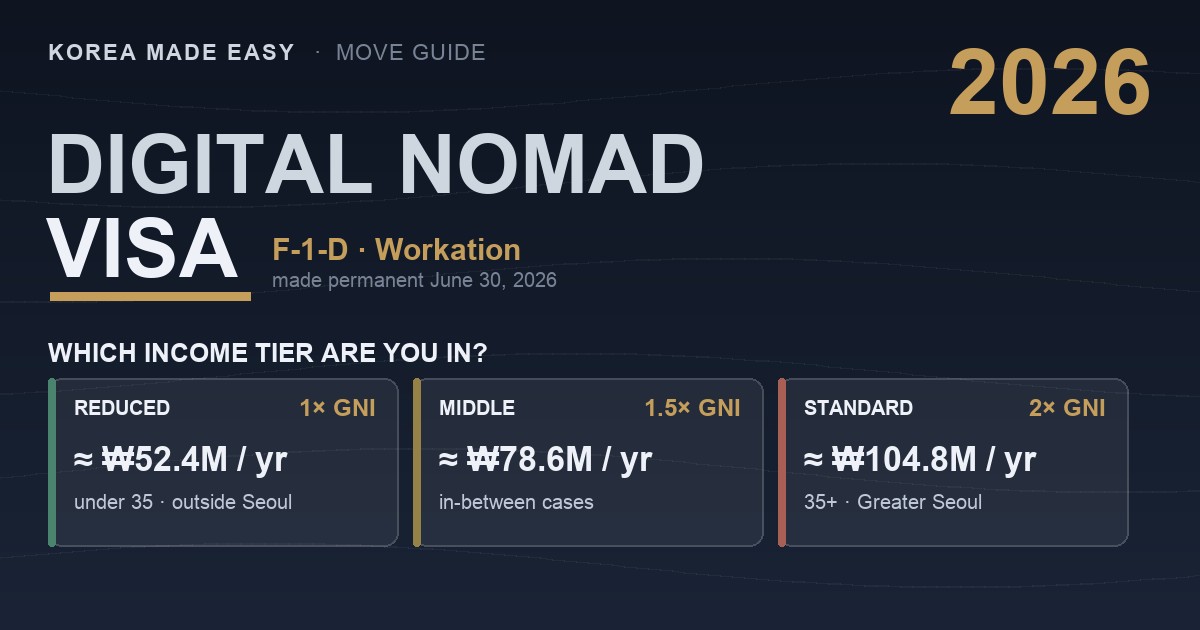
The income tiers — which one are you?
Quick plain-English footnote for newcomers: GNI per capita is Korea’s average national income per person. The visa pegs its income bar to a multiple of that number, and GNI creeps up every year — which is precisely why online articles quote different figures and argue with each other. As of 2025, GNI per capita sits at about ₩52.41 million (~US$36,963) per EY. So:
| Your tier | Who qualifies | Income needed |
|---|---|---|
| Reduced (1× GNI) | Age 18–34 living outside Greater Seoul or in a designated population-declining region | ≈ ₩52.4M / yr (~$37K) |
| Middle (~1.5× GNI) | The in-between cases | ≈ ₩78.6M / yr (~$55K) |
| Standard (2× GNI) | Age 35+ living in Seoul, Incheon, or Gyeonggi (Greater Seoul) | ≈ ₩104.8M / yr (~$66K+) |
“Greater Seoul” (수도권, sudogwon) means Seoul, Incheon, and Gyeonggi Province. Basing yourself in Busan, Jeju, Gwangju, Daegu, or a rural depopulating county is what unlocks the cheaper lane if you’re under 35 — a distinction that is completely non-obvious to a foreigner.
Two caveats I won’t let you skip. First, the income must be foreign-source — money you earn from Korean clients doesn’t count toward the threshold. Second, and I mean this: the exact won and dollar figures move every year with GNI, and sources disagree on the USD conversion. Treat the KRW numbers above as your primary reference and the USD as “approximately,” then confirm the current-year figure directly on HiKorea or with your consulate before you rely on it. This is a legal document, not a blog quiz.
Eligibility and the document checklist
Beyond hitting your income tier, you’ll need:
- Age 18+ and at least one year of experience in the same field you’ll work remotely in.
- Proof you’re employed by or contracting for a company/clients outside Korea — the remote-work verification.
- Income proof: typically three months of pay stubs, bank statements showing regular deposits, and tax returns.
- Private health insurance covering at least ₩100 million (~$75,000), including hospitalization and repatriation. This is non-negotiable.
- An apostilled criminal background check issued within the last 6 months, showing no convictions. (“Apostille” is the international authentication stamp; US applicants get it from their state Secretary of State or the US Department of State.)
- Passport valid 6+ months, application form, and a passport photo.
Fee: US citizens report around $45; other nationalities vary (some report ~$100 plus local visa-center service fees), so confirm at your consulate. Where to apply: a Korean embassy or consulate abroad via the visa portal, or through HiKorea. The Korea Immigration Service publishes the official PDF checklist — start there, not with a random agency.
Duration and bringing your family
The headline upgrade: you can now stay up to 3 years, up from the old 2-year cap. And you don’t have to come alone — your legal spouse and unmarried children under 18 can accompany you as F-1-D dependents. That family provision, unchanged from the pilot, is a genuine draw for people who were choosing between Korea and nomad visas that don’t allow dependents.
Taxes: the 183-day line, and why even visa holders argue about it
This is the murkiest part, and I’m going to give it to you straight rather than pretend it’s settled. The general rule: spend 183+ days in Korea in a year and you likely become a Korean tax resident. Below that, non-residents are generally taxed only on Korea-source income — which most nomads don’t have.
How murky is it? Two actual F-1-D-adjacent Redditors flatly contradict each other:
“If you stay past 6 months, you become a resident and owe SK taxes annually. You may get a tax credit for taxes paid in SK in your home country.” — u/PandaReal_1234
“I have this visa right now. You only pay taxes to your home country. That’s what differentiates this from other working visas.” — u/gabealexandermusic
They can’t both be fully right. There’s a widely-cited nuance that foreign-source income not remitted to Korea can be exempt for the first five years of residency, and Korea’s tax treaties plus foreign tax credits usually prevent genuine double taxation. But guidance specifically for F-1-D holders is still evolving. If you take one thing from this section: talk to a cross-border tax professional before you assume anything, and if you want a multi-currency setup to receive a foreign salary cleanly, a service like Wise — which lets you hold and receive dollars, euros and won in one account and convert at the real mid-market rate instead of a bank’s marked-up one — is worth setting up before you arrive. Don’t file your life plans on a Reddit comment (including this one).
Planning your move: where to base yourself while you apply and land
Once your facts are straight, the practical bit. Most people I’ve watched do this scout Korea first, or land and lock in a monthly place before signing a real lease — which, as one Seoul-based holder describes below, you can start doing on the assumption your visa will clear.
For that landing pad, monthly and long-stay studios in Seoul, Busan, and Jeju are easy to book in advance — a furnished studio typically runs ₩1.5–3M+/month. I use Booking.com for monthly and long-stay places when I need somewhere sorted before I arrive rather than couch-hopping while I chase paperwork.
And your first 72 hours: you’ll want data the second you land, well before you can get a Korean number (which, fair warning, is a genuine chore — see the Reddit note below). An eSIM you activate before takeoff solves it. I break down which to buy in our Korea eSIM guide; Yesim is the one I hand friends for arrival data.
One more number that matters more than any brochure: can you actually live on the reduced tier? The 1× GNI bar is ~₩52.4M/year, or roughly ₩4.37M gross per month. Our Seoul cost-of-living breakdown puts a single foreigner’s realistic all-in spend at ₩1.25M–₩2.26M a month. So even on the lowest income tier, before tax you’re clearing your Seoul costs with a comfortable margin — and considerably more room if you base outside the capital.
Real talk from people who actually did it
English-language discussion of the specific new permanent rules is still thin, and honestly, some of it is wrong — a top-voted comment on one viral 2026 repost had to correct the article’s bogus “minimum of 20 million won” claim, and another user noted, “This info is incorrect. They just launched a new track for younger nomads.” That misinformation is exactly why the tier table above matters. Here’s what real holders say:
“Currently living in seoul on the digital nomad visa. The process of getting the visa is pretty well documented online and is pretty straight forward. If you meet the requirements, you can actually sign a lease with the assumption you’ll be getting your visa cleared. Getting a bank account and a phone number is a pain in the ass once you get your visa tho. I had to visit the branch over 10 times…” — u/Kissyu
“Yeah it should be more than enough — getting the visa was relatively easiest compared to other Korean visas.” — u/Roarexe
Not everyone loves the income bar:
“Digital Nomad Visa is a joke. South Korea made this visa to attract hallyu enjoyers that work remote and have money to spend… This visa is not for most digital nomads since most remote workers in IT don’t make this kind of money. It’s mostly aimed at americans and top European earners…” — u/leeverpool
There’s truth in that. Korea isn’t a traditional immigration country, and the income bar is a deliberate choice to court higher-earning remote workers rather than budget backpackers. And a practical honesty note from someone living it:
“5.5[k] usd is the minimum and is more than enough for a single person to live comfortably in Seoul or Busan… The time difference to North America makes any real-time collaboration very difficult/exhausting.” — u/SquatpotScott
The timezone gap is the thing nobody puts in the brochure. If your team is on US hours, factor that in before you fall in love with the idea.

Travelers from visa-exempt jurisdictions should confirm current entry procedures in our Korea K-ETA waiver and arrival card guide.
FAQ
How much do I need to earn for Korea’s digital nomad visa in 2026?
It’s tiered, roughly ₩52.4M–₩104.8M per year (1×–2× GNI) depending on your age and where you live. Under 35 and outside Greater Seoul gets you the ₩52.4M ($37K) lane; 35+ in the Seoul area faces ₩104.8M ($66K+). The exact figure shifts yearly with GNI — verify the current number on HiKorea.
Can I work remotely in Korea on a tourist visa or K-ETA instead? No. Working remotely on a K-ETA, visa-free, or short-term tourist entry is not authorized, even for a foreign employer. The F-1-D exists specifically to make it legal.
Can I bring my spouse and kids? Yes. Your legal spouse and unmarried children under 18 can accompany you as F-1-D dependents — unchanged from the pilot.
That’s the real 2026 picture, tiers and all. The visa going permanent is genuinely good news — a 3-year stay, a legal way to work remotely, room for your family — but “it got easier” is only true for some of you. Figure out your tier first, confirm the live income number on HiKorea before you spend a dollar on apostilles, and when you’re ready to scout a landing pad, sort a monthly place on Booking.com so you’re not chasing paperwork from a hostel.
Sources
- https://www.koreaherald.com/article/10801376
- https://taxnews.ey.com/news/2026-1471-republic-of-korea-formalizes-its-digital-nomad-visa-program-with-expanded-eligibility-and-extended-stay-period
- https://www.newspim.com/news/view/20260707001172
- https://www.mofa.go.kr/us-seattle-en/brd/m_23042/view.do?seq=41
- https://www.hikorea.go.kr
This is independent guidance, not an official operator or government publication. Evidence and check dates vary by article. See our editorial and corrections policy for the distinction between source checks, personal visits and planning advice.

Incheon Airport Layover Guide (2026): Stay Airside, Join a Free Transit Tour, or Go Into Seoul
Korean Floor Heating & Airbnb Boiler Guide (2026): Navien, Kiturami, Rinnai Buttons, Hot Water & Troubleshooting