Travel
Boryeong Mud Festival 2026: Recap, Seoul Day Trip Cost (Under ₩60,000), and Guide for Next Year
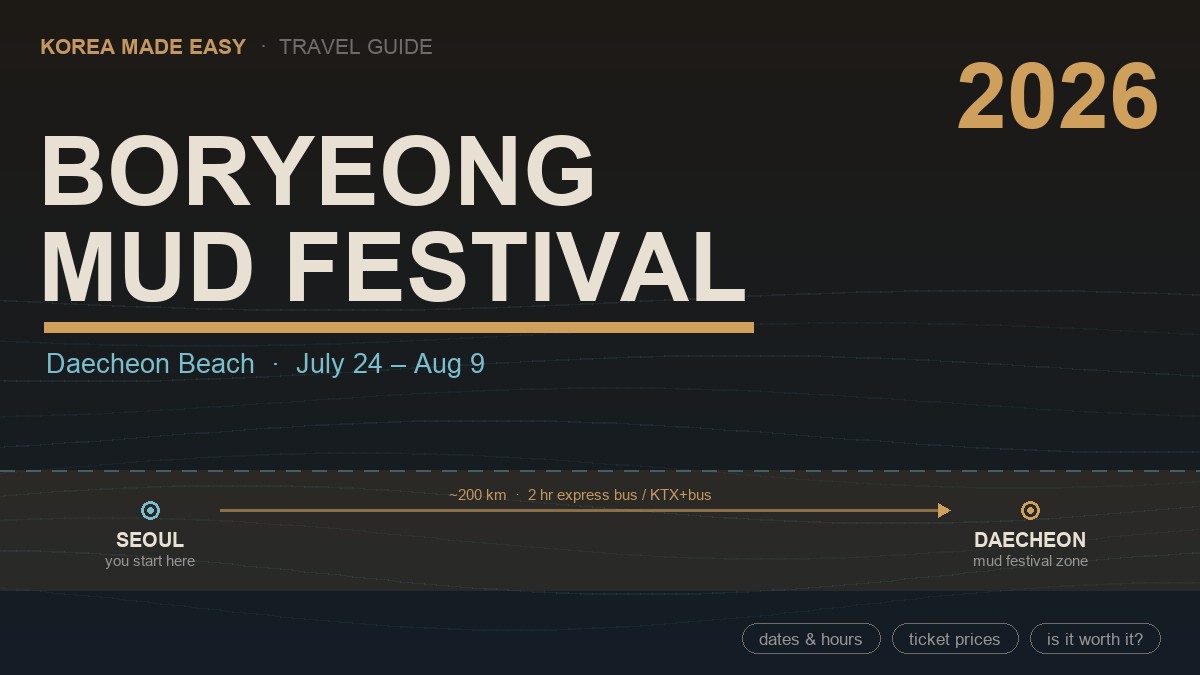
The payoff Unsure how the mud festival operates or how to manage a day trip from Seoul → understanding the full route, 2026 costs (under ₩60,000 on a weekday), and how to plan for future seasons.
📈 Trend signal: Boryeong Mud Festival 2026 / 보령머드축제 search demand (Naver DataLab)
ℹ️ Event Notice (Post-Festival Update):
The 29th Boryeong Mud Festival concluded on August 9, 2026.
Official dates and ticket prices for the 2027 festival have not yet been announced. This guide preserves the 2026 schedule, transport logistics, and on-site costs as an evergreen reference for future planning.
Every July, my group chat lights up with the same message from friends visiting Korea: “Wait, is the mud festival actually a thing? Should I go?” It is very much a thing — a two-and-a-half-week beach party where thousands of people, maybe a third of them foreigners, throw themselves into pits of grey coastal mud, ride inflatable slides, get pelted in a “mud prison,” and dance to EDM while a DJ hoses the crowd with a water cannon. But nobody actually searches “what is the mud festival” — they search how do I get there from Seoul, what do tickets cost, and is it worth the trip. So that’s what this guide answers, from someone who’s lived in Seoul for five years and watched friends do it both the smart way and the hard way.
This post contains affiliate links. If you book through one, I may earn a small commission at no extra cost to you.

Boryeong Mud Festival. Photo by Kai Hendry via Wikimedia Commons, CC BY 2.0.
The quick facts (2026 season record)
- 2026 Dates: The 29th Boryeong Mud Festival ran July 24 (Fri) to August 9 (Sun), 2026 (17 days). Dates for 2027 are unannounced.
- Where: Daecheon Beach (Mud Plaza / 머드광장), in Boryeong, Chungcheongnam-do, about 2.5 hours southwest of Seoul.
- 2026 Hours: Mon–Thu 13:00–18:00; Fri–Sun 10:00–18:00 (with a 13:30–14:30 break). Extended night hours ran until ~21:30 on opening day (Jul 24) and Thu Aug 6.
- 2026 Adult General Zone ticket: ₩12,000 weekday / ₩16,000 weekend (Fri–Sun).
- The 2026 bonus: Every 2026 ticket included a ₩5,000 Boryeong Love gift voucher redeemable at local participating shops.
Note on annual dates: Festival dates shift slightly each year. In 2026, the festival ran July 24–August 9. When planning for future years, always verify confirmed dates on the official festival site (mudfestival.or.kr) once they are announced.
A little background (it explains the whole vibe)
The festival didn’t start as a party. It began in 1998 as a marketing stunt: Boryeong’s mineral-rich coastal mud was being sold as skincare, and the city threw a beach event to promote it. Foreigners — especially Korea’s large English-teacher community in the 2000s — adopted it as the summer blowout, and it snowballed into the country’s most international festival, with bilingual signage and roughly 30% overseas attendance.
Knowing that origin story explains everything about how the day feels. It’s family-friendly and wholesome by afternoon, then flips into beach-party mode by night. And the “mud” is really the branding hook, not an endless ocean of it — which is the single most common source of disappointment, so keep expectations calibrated.
If you’ve never seen it, one minute of footage explains the appeal faster than any paragraph I could write — grey coastal mud, foam cannons, mud slides, and a beach full of strangers who stopped caring what they look like:
Video: “2025 Boryeong Mud Festival,” from 머드TV — the festival’s official YouTube channel (보령축제관광재단 / Boryeong Festival & Tourism Foundation). Embedded, not rehosted.
Why Seoul hotels and tours vanish in July — the data
Here’s the part locals understand and most visitors don’t: Korean demand for this festival doesn’t build slowly. It detonates. I pulled the Naver DataLab search-interest curve for “보령머드축제” (the Korean name), and it’s one of the sharpest seasonal spikes I’ve charted.
Naver DataLab — monthly search interest for “보령머드축제” (index, 100 = peak month):
| Month | Search index |
|---|---|
| January | 1.5 |
| February | 1.9 |
| March | 3.7 |
| April | 6.6 |
| May | 9.5 |
| June | 19.3 |
| July | 100 |
| August | 77.8 |
| September | 4.1 |
| December | 1.6 |
Index is relative (100 = the single highest month in the sample), not an absolute search count.
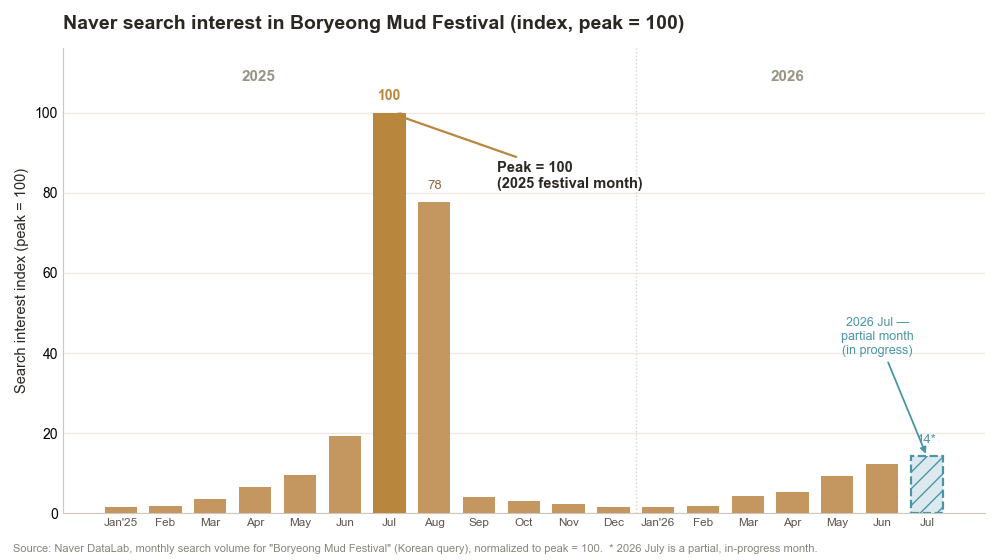
Read that curve and you understand the crunch. July search interest is roughly 65 times the winter floor. Millions of Koreans decide to go within the same few weeks — and they’re competing with you for the exact same beachfront hotels, the same buses, and the same tour seats. This is why “I’ll just book when I get there” fails in late July. The domestic surge you see in that spike is the reason a room that’s ₩70,000 in May becomes ₩200,000-and-sold-out during the festival.
Getting there from Seoul: 3 ways compared
Boryeong sits about 2.5 hours southwest of Seoul, and there’s no single “right” way — it depends on your budget, your Korean, and how much you value not planning. Here’s the honest comparison.
| Option | Time (Seoul → beach) | Approx. cost | Best for |
|---|---|---|---|
| Express bus (Central City Terminal → Boryeong) + local bus/taxi | ~2.5–3h door-to-beach | ~₩15,000 bus + ~₩1,500 city bus (or ~₩10k taxi) | Cheapest and most flexible; comfortable with luggage |
| Train (Yongsan → Daecheon) + local bus/taxi | ~3–3.5h door-to-beach | ~₩11,800 train + last mile | Scenic; dodges highway traffic on peak weekends |
| Day tour / shuttle from Seoul (+ admission) | Fixed door-to-door, ~13h round day | ~₩60,000–130,000 all-in | First-timers, non-Korean speakers, zero-planning |
A few things the table can’t show. The express bus leaves from Central City Terminal (Gangnam, subway lines 3/7/9) roughly hourly and is the workhorse choice. The train runs Yongsan to Daecheon on the Janghang Line. Both drop you in Boryeong city center, which is about 8 km from Daecheon Beach — from there you take a local city bus (every 10–20 minutes, more frequent after 7 p.m.) or a 10–15 minute taxi to Mud Plaza. There’s luggage storage at Daecheon Station and at Mud Square on the beach.
The packaged day tour is the “easy button” during festival season: round-trip shuttle plus admission, pickups around 6:55–7:35 a.m. near Hongik University, Myeongdong, or Dongdaemun, and back in Seoul by evening. It costs more, but it removes the two things that actually go wrong on a peak weekend — the last-mile bus scramble and the gamble on sold-out return trains. For future festivals, organized day-tour options are typically listed on platforms like GetYourGuide once festival operations begin.
Tickets, the voucher, and on-site costs
For the 2026 edition, ticket prices were refreshingly affordable. General Zone admission was ₩12,000 on weekdays and ₩16,000 Friday–Sunday for adults (teenagers and family tickets were a little less). During the season, an early-bird discount of around 10% was offered online before mid-June, and general tickets could be purchased at the gate.
Every 2026 ticket came bundled with a ₩5,000 Boryeong Love voucher. This was spendable at participating local shops and food stalls, which effectively lowered the net admission price. Typical on-site add-ons included the mud self-massage zone (₩3,000), showers (₩3,000), lockers (₩3,000–5,000), and towels (₩2,000–5,000).
Here was the all-in DIY tally for one adult doing it from Seoul during the 2026 festival:
| Line item | 2026 Weekday cost |
|---|---|
| Express bus, Seoul ↔ Boryeong (round trip) | ~₩30,000 |
| Local city bus to/from Mud Plaza (round trip) | ~₩3,000 |
| General Zone ticket | ₩12,000 |
| Shower + locker + towel | ~₩10,000 |
| Less the ₩5,000 Boryeong Love voucher | −₩5,000 |
| All-in (before food & drinks) | ≈ ₩50,000 |
That was roughly $36, landing under ₩60,000 even on a weekend (when the ticket was ₩16,000). Food, drinks, and any premium mud zones were on top — but the core travel and admission cost was genuinely modest. The expensive version of this festival was never the ticket; it was a festival-weekend hotel, which is exactly what day-tripping avoids.
Day trip or stay overnight? Let the locals answer
This is the number-one question, and the r/korea and r/koreatravel crowd have argued it out for years. The consensus leans toward day-tripping unless you’ve got a group.
On doing it in a day, one r/korea visitor is blunt and useful: “It is very possible to do a day trip and have done myself. Buses and trains will be busy — expect to stand. If you take a train back and they say they’re sold-out, ask for a standing ticket.” That standing-ticket hack is gold on a Saturday night.
The cost argument for day-tripping is real: “I recommend day trip. Hotels and motels would be way too expensive during the festival. It will cost at least 150,000 won per night for a cheap one… Hotels will start from 200k.”
The flip side comes from group travelers. One r/koreatravel commenter: “If you are going with a group that you intend to drink with and rent a pension with (not a day trip), yes, it’s worth it. If not, it probably isn’t.” And the tactical veteran: “Book a room BEFORE you go, try to get there Friday night (or the second weekend) when it’s less crazy, get in line EARLY Saturday before all the rides open, and then just chill on Sunday.”
If you land on the overnight side, reserving early is essential — that DataLab spike is your warning. Beachfront places like Mud Beach Hotel, Hound Hotel Daecheon Beach, and Hanwha Resort Daecheon Paros exist on Booking.com’s Daecheon Beach listings, and the good ones sell out first during peak festival weeks.
So is it actually worth it? An honest verdict
I’d rather you go in clear-eyed than annoyed, so here’s the mixed picture straight from people who’ve been. The disappointment is almost always about the mud itself. One long-time visitor: “I went 12 years ago and enjoyed it. I went again 2 yrs later… and didn’t really enjoy it. It was becoming a commercial thing and the practical mud was limited.” Another warns: “The mud area is pretty small… If you want to see tons of mud, don’t have too high expectations.”
The other honest warning is about time, not mud. On a peak weekend the lines are the real tax: one long-time expat blogger (Torn Tackies) clocked a 45-minute wait just to enter the mud zone, then found that “you can wait more than an hour for your chance to roll around in the mud for 2 minutes.” That single fact is the strongest argument in this whole guide for visiting on a weekday during future editions — same mud, a fraction of the queue, and cheaper admission.
But the people who go for the party and the company rarely regret it: “If you want to go, go and have fun… It can be a great way to meet new friends or just blow off steam.” As one visitor put it, the best part is the crowd — “everyone switches off and their friendly alter egos come out to play for the weekend.”
My read after five years here: this is a group-and-nighttime festival. Come with friends, treat the mud as the excuse rather than the main event, lean into the EDM/K-pop/fireworks side, and manage the “how much mud” expectation. Do that, and it’s one of the best summer days you’ll have in Korea. Come solo expecting a mud spa, and you might shrug.
What to bring and wear
- Old swimwear or clothes you don’t love — mud stains, and you’ll be soaked all day.
- A waterproof phone case or pouch. This is non-negotiable near the water-cannon zones.
- Cash for lockers, showers, and towels (₩10,000–20,000 covers it).
- Cheap flip-flops or water shoes, sunscreen, and a change of dry clothes for the ride home.
- Sort your mobile data before you go — you’ll want maps for the last-mile bus and to rebook trains. Our Korea eSIM guide covers which plan to buy.
One weather note, since this is peak storm season: a typhoon warning does not automatically mean a cancelled trip. We ran the actual landfall numbers — the odds are lower than the footage suggests.
Deciding between outdoor roller coasters and indoor attractions? See our comparison in the Lotte World vs Everland theme park guide.
FAQ
Can I visit the Boryeong Mud Festival as a day trip from Seoul? Yes. In 2026, many visitors completed the trip in a single day. It takes about 2.5–3 hours each way by express bus (from Central City Terminal) or train (Yongsan → Daecheon), avoiding scarce and expensive festival-weekend hotels.
How much were 2026 tickets, and could foreigners buy on-site? In 2026, General Zone admission was ₩12,000 on weekdays and ₩16,000 on weekends. Foreign visitors were able to buy tickets at the gate or online, and each ticket included a ₩5,000 Boryeong Love voucher. Dates and pricing for 2027 have not yet been announced.
Is the Boryeong Mud Festival really worth it? It depends on your group and expectations. It is most enjoyable with friends and during the evening events (EDM, concerts, fireworks); visitors expecting an endless natural mud reserve can be underwhelmed because the main mud zone is compact and lines were long on peak weekends.
Written by Yongwoo, a Seoul-based writer covering Korea travel for newcomers. Festival dates, prices, and transport schedules change year to year — always confirm current details with the official festival site and your operator before booking. First time flying in? Start with our guide to getting from Incheon Airport into Seoul, and if you’re building a longer loop, our 3-day Busan itinerary picks up where a mud-festival weekend leaves off.
Planning Your Korea Trip? Compare Your Options
Compare transport, mobile data, and attraction options. Prices and eligibility depend on your selected date and package.
AREX Incheon ↔ Seoul Express
Express train between Incheon Airport and Seoul Station. Follow the selected voucher’s seat reservation and redemption instructions.
Check AREX Express Tickets →Korea eSIM Options
Compare Korea eSIM search results. Check data allowance, supported network, device compatibility, activation, and speed limits.
Compare Korea eSIM Options →WOWPASS Card (Pay + T-Money)
Compare WOWPASS and T-money. Payment and transit balances are separate; check issuance, top-up, exchange, and withdrawal fees.
Read WOWPASS vs T-money →Top Seoul Passes & Day Tours
Browse general Seoul activity search results. This is not a guaranteed-entry pass or a fixed-discount offer; check each product’s inclusions.
Browse Seoul Activity Options →Sources
- https://mudfestival.or.kr/en/festival/main.html
- https://mudfestival.or.kr/en/festival/1_mud_festival/ticket_info.html
- https://www.korea.net/NewsFocus/Culture/view?articleId=274905
- https://www.touristkorea.com/boryeong-mud-festival-july-24th-august-9th-2026/
- https://english.visitkorea.or.kr/svc/contents/contentsView.do?vcontsId=96386
- https://en.wikipedia.org/wiki/Boryeong_Mud_Festival
- https://www.rome2rio.com/s/Daecheon-Beach/Daecheon-Station
- https://www.torntackies.com/boryeong-mud-festival-things-need-know/
Search-trend data from Google Trends (KR) and Naver DataLab. This article is independent commentary and is not affiliated with any broadcaster, agency, or the individuals mentioned.